An innovation lab can take many forms, from a small team with a digital home to a network of centres with their own prototyping spaces, and not every company needs one. Large organisations usually do: some form of innovation centre, run as part of an ongoing innovation programme, and often as the unit that orchestrates that programme.
The question that matters is not whether the lab is a place or a programme. It is what the lab is for, what it must deliver, who leads it, whether it stands alone or works across the business, how it is governed and how its success will be judged. Get those right and the lab becomes the engine of the company’s innovation; get them wrong and it becomes a showroom.
AI raises the stakes. Technology that once lived in expensive labs is now an API away, and product teams can build working prototypes in days, so the lab is no longer where leaders go for technology. Its value moves to orchestration and judgement: running the programme, increasingly with AI agents doing much of the routine work, and telling a real opportunity from a good demonstration. This guide covers when a company needs a lab, the forms it can take, why labs fail, the decisions that shape one, who should run it and what AI changes.
The boxed passages are quoted from Innovation Mode (Author’s Edition, 2026); the numbered notes list the outside sources.
What is an innovation lab? One job, many forms
Ask a leadership team what an innovation lab is and you will hear several answers: a prototyping space, an incubator, a team of technologists, a showroom for visitors, the people who run the hackathons. Companies use lab, centre, hub and studio for the same thing, and for different things. What they share is a job: helping the company discover, test and pursue opportunities beyond its day-to-day business.
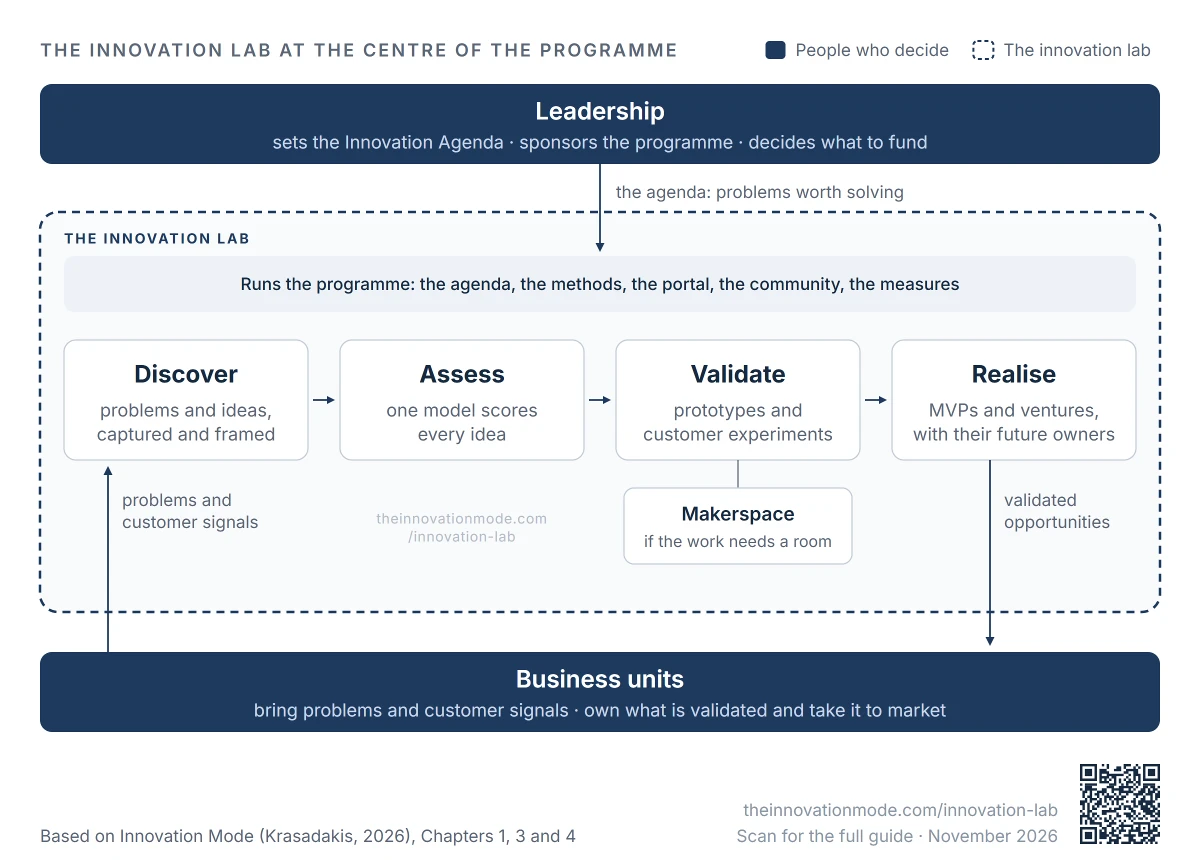
That job is part of something larger, the company’s innovation function: the processes, services, tools, knowledge and talent that let it discover and pursue opportunities continually rather than now and then. A lab gives that function a home and a team. In a large organisation it is often the unit that runs the whole innovation programme, as Figure 1 shows.
Within that job, the forms differ in scope, in how much they build themselves and in how close they sit to the business:
- Innovation team
- A small core that runs the programme and enables everyone else: methods, services, education and orchestration. Often the first form a lab takes; innovation team structure covers its roles.
- Innovation lab
- A team, often with a space of its own, that runs the programme’s services and builds prototypes and experiments with the business.
- Innovation centre
- A larger unit offering several services under one roof, for a region, a division or the whole company, sometimes open to clients and partners.
- Innovation hub
- Several labs and R&D groups that keep their own agendas but share one method, one portal and one overall innovation agenda.
- Makerspace
- A space equipped for physical prototyping, from 3D printers to electronics: a resource a lab provides when the work needs it. See the makerspace guide.
- R&D lab
- Develops technologies over long horizons and feeds the innovation programme with them; it does not replace the programme.
Venture studios, incubators and accelerators build or back new businesses, a related but different job. Universities and public bodies run innovation labs too, under different rules; this guide is about the corporate lab, a unit with a sponsor and a budget it has to justify.
Does your company need an innovation lab?
Not every company does. Two things decide it: the size and shape of the company, and how far its innovation has already come.
Small and mid-sized companies rarely need a dedicated lab. They need an innovation programme with a clear owner and a small team, an agenda of problems worth solving, and a simple way to capture, assess and test ideas. What matters most is the purpose, the culture, the talent and the leadership’s attitude to innovation, not the size of the budget or the sophistication of the tools.
Large organisations usually do need one, in some form. My view, after designing or optimising four innovation centres, is that beyond a certain size the innovation programme needs a permanent home: a team with the authority, the methods and the capacity to run it across divisions, and the means to test and build what the business units cannot test and build alone. The real questions are what that centre is for and how it connects to the business.
Groups with divisions, regions or acquired companies will grow several innovation groups whatever headquarters decides. The question is whether they work as one network, each with its own agenda and calendar but all on the same methods, assessment model and measures, sharing what they learn through one portal.
Science-led companies already have labs: R&D departments that pursue long-term breakthroughs. What they need is the connection, a programme that links research to the rest of the company, so that the other divisions are not left as consumers of what the labs produce.
Maturity matters too. A company where innovation is not yet on the leadership agenda will gain little from a lab; it needs a sponsor and a programme first. Where employees already join workshops and a community of innovators is forming, a lab gives that energy a home. The Innovation Maturity Index shows where a company stands on that path.
Do innovation labs work? What the evidence shows
Better than their critics say, and less well than their champions claim. Neither side usually shows its data, so here is what can be checked.
Most large companies built one. In 2015, Capgemini Consulting and Altimeter found 38% of 200 of the world’s largest organisations experimenting with innovation centres: 309 centres in all, 53 of them in Silicon Valley. Asked about the mission, 65% named access to the latest technology and 35% a better understanding of their customers’ needs.2 Technology first, customers second: that ratio explains much of what followed.
Few built a culture of innovation. Two years later, Capgemini’s Digital Transformation Institute surveyed 1,700 employees at 340 firms. 87% of those surveyed had an innovation centre; less than a fifth, 17%, thought they had a company-wide culture of innovation, and no firm had reached the top of the maturity scale.3 The centres were built, and the companies around them did not change.
The famous failure rate has no source. You will read that up to 90% of innovation labs fail. The figure travels from page to page without a study behind it. The oldest version I have found, a 2019 trade article, credits “the vast majority” to a 2015 Capgemini report and the 90% to an unnamed expert, with no link to either.4 The 2015 research, as it was reported at the time, counted how many companies were opening centres, not how many failed. Treat the number as folklore, and the gap as the fact.
Many labs closed, and not every closure was a failure. Nordstrom scaled back its Innovation Lab in 2015 and moved most of its people into other teams; as a spokesman put it, innovation was “now everyone’s job”.5 Walmart Canada closed its Blue Labs incubator about eight months after its official launch, saying it would integrate the unit’s innovative focus directly into the business.6 Walmart closed Store No. 8, the incubator it created in 2017, in January 2024, and around 300 people moved into other roles in its technology and innovation operations.7 Some of these endings were graduations: the methods and the people moved into the business, which is where the work belonged. A review of public-sector labs by the OECD’s Observatory of Public Sector Innovation counts “closing a lab means failure” among the twelve fallacies of the field, next to the hope that someone, anyone, will pick up whatever a lab produces.8
The pattern behind the failures is consistent, and it is not about labs as such. Many organisations have witnessed what I describe in the book as “the failure of stand-alone innovation labs that produced impressive prototypes but minimal business impact”. Stand-alone is the word that matters.
Why innovation labs fail: five design mistakes
When a lab fails, the people in it are rarely the cause. The design is. Each of the five common mistakes is a decision that was made badly, or not made at all, before the lab opened.
1. It is built as a showcase. Its real purpose is to show customers, investors and employees that the company innovates. A lab built to be seen will be judged on how it looks, and it will look good for a while. Steve Blank made the point about innovation outposts in 2015: setting one up does not mean the corporation is innovating. “At first it just means there’s a new building.”9
2. Its objectives are not linked to the strategy. A lab that chooses its own problems produces answers to questions the business never asked. Its work should start from the Innovation Agenda: the problems worth solving, named by the leadership and linked to the strategy.
3. It stands alone. A lab that works apart from the business competes with the units for ideas, people and credit, and looks like a privilege to everyone outside it.
4. Nobody owns what happens next. A validated opportunity needs a team to take it to market. Without agreed decision rights and an agreed handover, the lab ends at the demonstration, or hands over a prototype the receiving team cannot run. The stretch between development and commercialisation is where many good ideas die.
5. It is judged on the wrong things. Visitors, workshops, prototypes and press mentions are easy to count and say little. A lab measured on them optimises for them, and can look successful for years while little of its work reaches the market.
None of the five is about space or talent. All five are design decisions, which means all five can be fixed.
How to set up an innovation lab: the decisions that matter
Before the first hire or the first floor plan, settle these questions with the leadership team. They are the lab’s real design, and the space comes last.
1. Purpose: why the lab exists
Write down why the lab exists, in a sentence the whole company can repeat. The strongest purpose I know is to make the whole company better at innovation: to run the innovation programme, provide methods and services everyone can use, and build with the business rather than for it. A lab can build things itself (prototypes, experiments, the first version of a venture), and that is valuable when the work starts from the business’s problems and ends with a business owner. What fails is a lab whose purpose is to innovate instead of the company.
2. Objectives: what it must deliver, and by when
Turn the purpose into objectives the leadership will hold the lab to: which problems from the Innovation Agenda it takes on first, how many opportunities it should bring to validation, which methods and services the business should be using by the end of the year, and what should change in the culture. Objectives tie the lab to the strategy, and they protect it: a lab that can show what it was asked to do, and what it did, is hard to cut.
3. Leadership: who runs it, and where it reports
A lab needs one accountable leader, an innovation director in substance whatever the title, with a direct line to whoever owns the strategy: the CEO, through a Chief Innovation Officer, or another member of the C-suite. Placed inside one business unit, a lab inherits that unit’s horizon, budget cycle and rivalries, and the other units stop treating it as theirs. It also needs a sponsor at the top who takes part, not one who only signs off. Where the right leader is not yet in place, a fractional Chief Innovation Officer can lead the lab while the company hires; The Chief Innovation Officer covers the role.
4. Structure: isolated, central or distributed
This is the decision most labs get wrong by default. There are three basic shapes, shown in Figure 2.
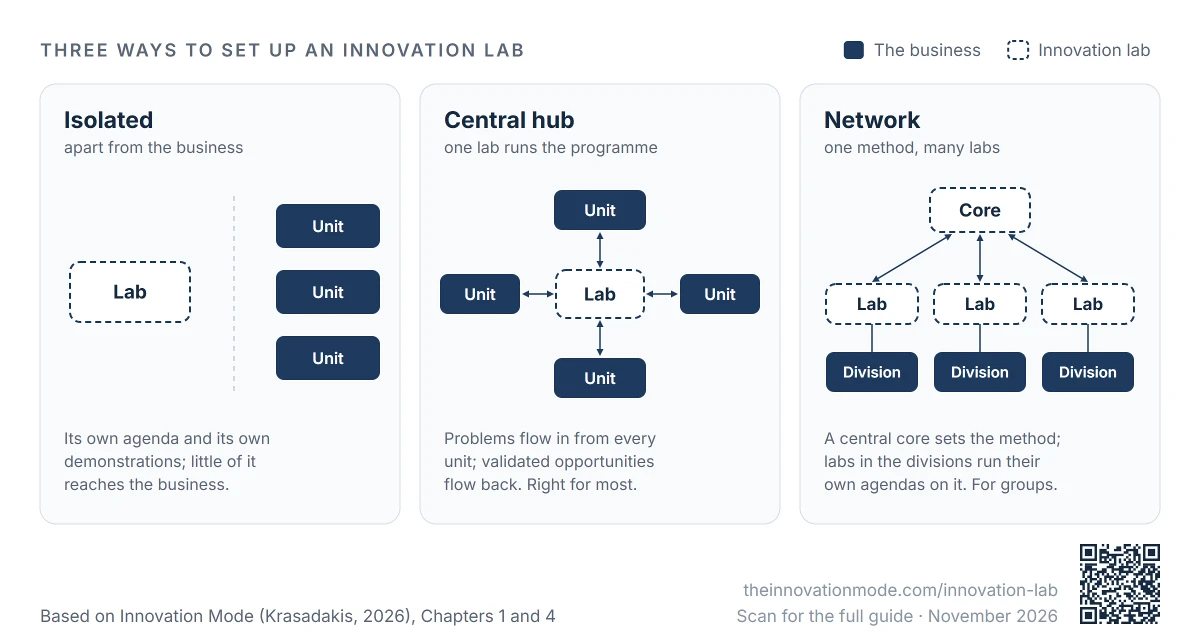
Isolated. The lab works on its own agenda, apart from the business. It moves fast and looks impressive, and it is the shape behind most of the failures above.
Central hub. One lab runs the programme for the whole company and works with every unit: problems and ideas flow in, validated opportunities flow back to the units that will own them. The right shape for most companies, and the natural home of the core innovation team.
Network. A central core sets the method, the overall agenda and the measures, and labs in the divisions run their own agendas on that shared system. The shape for large groups, and the reason the federated leadership model exists: who should lead innovation compares the models.
5. Governance: decision rights, funding and the handover
Decide who decides: who sets and updates the agenda, who chooses which opportunities are funded, paused or stopped, how often the lab brings its evidence to the leadership, and who owns an opportunity once it is validated. Fund the core team and the agenda centrally, so the lab serves every unit, and let units co-fund the validation work they ask for. Above all, agree the handover before the first project starts:
When core innovation teams develop innovative concepts without an agreed-upon handover protocol with the receiving product team, major disconnects can occur, for instance, misalignments and gaps regarding tech stack, product architecture, documentation, hosting environments, operational and support functions, and skills gaps. As a result, the receiving team may lack the capabilities, context, or bandwidth to carry the innovation forward.
The receiving team should be involved from the start, not presented with a prototype at the end.
6. Success criteria: how it will be judged
Agree before the lab opens how it will be judged, and in what order the evidence will arrive:
- Adoption. How many teams use the lab’s services without being asked: the leading indicator.
- Activity and engagement. Problems submitted, ideas assessed, experiments run; who takes part, from which units, and how often they return. Take a baseline in the first months, so that progress is measured against something.
- Output. The pipeline: ideas captured, assessed, flagged as opportunities, validated and launched, and the conversion from each stage to the next.
- Impact. Opportunities a unit took on, products launched, revenue earned or costs saved. Impact arrives quarters after the activity that produced it, so a lab judged on outcomes in its first year is judged on nothing, and one still judged on activity in its third year is theatre.
Report each layer separately and say which is which. Then write the exits into the plan. If no business unit has asked the lab for anything after a year, its purpose, its objectives or its reporting line is wrong, and it should shrink back into a small team running the services the units do want. If its methods and people have moved into the business, as Nordstrom said of its lab when innovation became “everyone’s job”, the lab has done its job: in the most innovative companies, innovation stops being a separate programme.
7. People: a small core first
Start smaller than you think: a director, an innovation architect and a programme manager can start a lab that lasts. The core grows with the programme, adding orchestrators, advocates and workshop facilitators, then the specialists who validate and build, such as validation leads, MVP leads and venture leads, many of them just in time. A rotation that brings employees from across the company into the lab for a project or a period adds capacity and does more against isolation than any communication plan. Innovation team structure covers every role.
8. Space: a choice, not the definition
Only now the space. A lab needs a digital home first: one place where everyone can see the agenda, submit an idea, follow the projects and find the people, which in a company of remote and hybrid teams is the only place everyone shares. A physical space is worth having when the work needs it: physical prototyping, workshops, demonstrations, and a reason for distributed teams to meet in person. It can be a light build space, a tech space, a demo space or a full manufacturing lab, and it belongs where the business can walk in. The makerspace guide covers the options.
What AI changes for the innovation lab
For two decades, a lab’s advantage was access: to technology the rest of the company could not reach, and to people who could build with it. AI has removed much of that advantage. Advanced technology is an API away, and AI coding assistants let a product team build a working prototype in days. A lab whose value was the prototype has lost its monopoly.
That makes a well-designed lab more necessary in a large organisation, not less. When anyone can generate ideas and prototypes, the scarce capability is deciding which of them matter, and taking the right few to market:
When AI enables anyone to generate brilliant ideas, shape strategies, and soon build digital products, the ability to conceive and implement becomes less important. At the same time, new competencies emerge as critical success factors for innovation: separating signal from noise, recognizing genuine opportunities, racing to market, establishing partnerships, and architecting smart in-market experimentation frameworks that maintain products differentiated.
The services become agents. Much of what a lab’s staff did ten years ago can now run as AI agents: scanning the market, finding related work across the company, routing ideas to the people who can judge them, drafting workshop material, scoring ideas against the company’s model. I have built systems in which AI acts as both innovator and evaluator, and seen them perform well in demanding innovation work. Ainna Enterprise, our agentic innovation platform, runs that work in production: its agents discover, frame and grade opportunities, and people decide.
People become judges. What stays human is the agenda, the decision about what the company will bet on, the relationships with the units and the accountability for the risk. The lab gets smaller in coordination roles and stronger in judgement roles. Add agents as the business starts to use the lab, not before: a sophisticated system adds little in the first iterations.
An innovation lab is not an AI lab. Many companies are now opening AI labs: pilots, use cases, a centre of excellence for the technology. That is a technology programme. It is useful, and it is not the innovation function. An innovation lab starts from the company’s problems; AI is one of the tools it uses and one of the answers it may find. A lab named after the technology of the year inherits that technology’s hype cycle and is judged in its terms; a lab named after the company’s problems is judged by outcomes. Chief AI Officer vs Chief Innovation Officer covers who should own which, and agentic innovation describes the whole process run by agents.
Where to start
- Name the problem the lab should solve. If the answer is “we are not innovative enough”, diagnose first. The six innovation deficits show whether the cause is leadership, organisational design, capabilities, the connection to the market, talent and culture, or the ability to build. A lab can address several of them; it cannot make up for a leadership team that does not want it.
- Find your level. The free Innovation Maturity Self-Check gives early signals in five minutes.
- Settle the purpose, the objectives and the leader. In writing, with the leadership team, with the sponsor and the accountable leader named.
- Choose the structure. A central hub for most companies, a network for groups; never isolated.
- Agree the governance and the success criteria. Decision rights, funding, the handover, what will be measured at twelve months, and the exits.
- Start small. A core team, the agenda, a way to capture and assess ideas, and a first validation, by hand where possible. Add the platform, the agents and the space as the business starts to use the lab.
The document that holds these decisions is the lab’s charter; in my method it is the Innovation Masterplan, and the leadership signs it.
Further reading
- Innovation team structure: the six core roles, the extended team and how the team grows.
- The Chief Innovation Officer: the executive who leads the innovation function, and the lab within it.
- Who should lead innovation?: six leadership models, and the federated model a network of labs needs.
- How to set up a corporate makerspace: the four space types, the equipment and the safety rules.
- Why corporate innovation fails: the six deficits a lab is meant to address.
- The Innovation Maturity Index: the seven levels, and what each one needs.
- What is an innovation culture?: the conditions no lab can create on its own.
- Innovation Mode, the book: the innovation function, the team and the programme in full.
Notes
- Krasadakis, G. (2026). Innovation Mode: Designing Innovative Companies in the Era of Artificial Intelligence, Author’s Edition. Innovation Mode Publishing. The boxed passages are quoted from this edition. ↑
- Consultancy.uk (2015, September 17). Businesses increasingly invest in innovation centres. Consultancy.uk. Reporting Capgemini Consulting and Altimeter, The innovation game: Why and how businesses are investing in innovation centres (2015). consultancy.uk ↑
- CDOTrends editors (2017, December 18). Capgemini: Innovation centers are not delivering. CDOTrends. Reporting the Capgemini Digital Transformation Institute’s survey The discipline of innovation (2017), of 1,700 employees at 340 firms. cdotrends.com ↑
- Contant, J. (2019, July 22). Three reasons innovation labs almost always fail. Canadian Underwriter. canadianunderwriter.ca ↑
- Howland, D. (2015, February 5). Nordstrom scaling back Innovation Lab. Retail Dive. retaildive.com ↑
- Sagan, A. (2023, February 15). Walmart Canada shutters Blue Labs innovation hub. The Logic. thelogic.co ↑
- Talk Business & Politics staff (2024, January 22). Walmart to shutter its tech incubator Store No. 8. Talk Business & Politics. talkbusiness.net ↑
- Kumpf, B., and Monteiro, B. (2024, May 13). The devious dozen: 12 fallacies behind innovation lab “failures”. OECD Observatory of Public Sector Innovation. Drawing on a directory of 137 public innovation labs from 37 countries and four international organisations. oecd-opsi.org ↑
- Blank, S., and Simoudis, E. (2015, December 8). How to avoid innovation theater: The six decisions to make before establishing an innovation outpost. Steve Blank. steveblank.com ↑
Cite this guide
Krasadakis, G. (2026, November 24). Do you still need an innovation lab in the era of AI? Innovation Mode. https://theinnovationmode.com/innovation-lab
@online{krasadakis2026lab,
  author = {George Krasadakis},
  title = {Do you still need an innovation lab in the era of AI?},
  year = {2026},
  date = {2026-11-24},
  organization = {Innovation Mode},
  url = {https://theinnovationmode.com/innovation-lab}
}