Enable, don’t produce
The commonest mistake in setting up an innovation team is to make it the place where innovation happens: a lab of bright people building the company’s future in isolation. Innovation Mode sets it up the other way round. The team is a task force of senior people with a passion for innovation and a bias for action, and the Dream Team “is not supposed to produce innovation” (p. 55). Its job is to make the rest of the company better at it.
That purpose shapes both its make-up and its place in the organisation. It has no pure implementation roles, such as software development, and it works across the organisation as an autonomous team that enables and empowers innovation, rather than as a department that owns it.
What an innovation team is responsible for
- 1. Leading the innovation transformation programme
- It architects the programme that lifts the company up the Innovation Maturity Index, keeps it connected to the C-suite’s strategy, and owns its delivery: the initiatives, projects, events, workshops and education, steered by data on progress, engagement and culture.
- 2. Provisioning innovation capabilities
- It selects and provisions the systems and processes the company needs to innovate at pace and scale, such as AI-powered ideation and market intelligence tools, working with internal teams, vendors and consultants, and drives their adoption through communication, training and support.
- 3. Operating the innovation function
- It maintains the innovation agenda and a company-wide innovation calendar, monitors the feedback loops, manages the portfolio of innovation projects, sets the cadence of innovation events, and runs the communication engine without generating noise.
- 4. Driving the innovation culture
- It grows an active community of innovators: giving feedback on ideas, mentoring teams, listening to people across levels and departments, and inspiring engagement with the whole effort.
“The wide adoption of the innovation capabilities is a critical element of the definition of done for the innovation team and a leading indicator of success.”Innovation Mode, Author’s Edition (2026), pp. 56–57
The structure: a flat core and an extended team
“The team’s structure is flat: all members report directly to the innovation executive” (p. 58). The innovation executive reports in turn to the company’s leadership: to the CEO as Chief Innovation Officer, or to another member of the C-suite as head or VP of innovation. Innovation Mode calls this leader the innovation director, whatever the actual title.
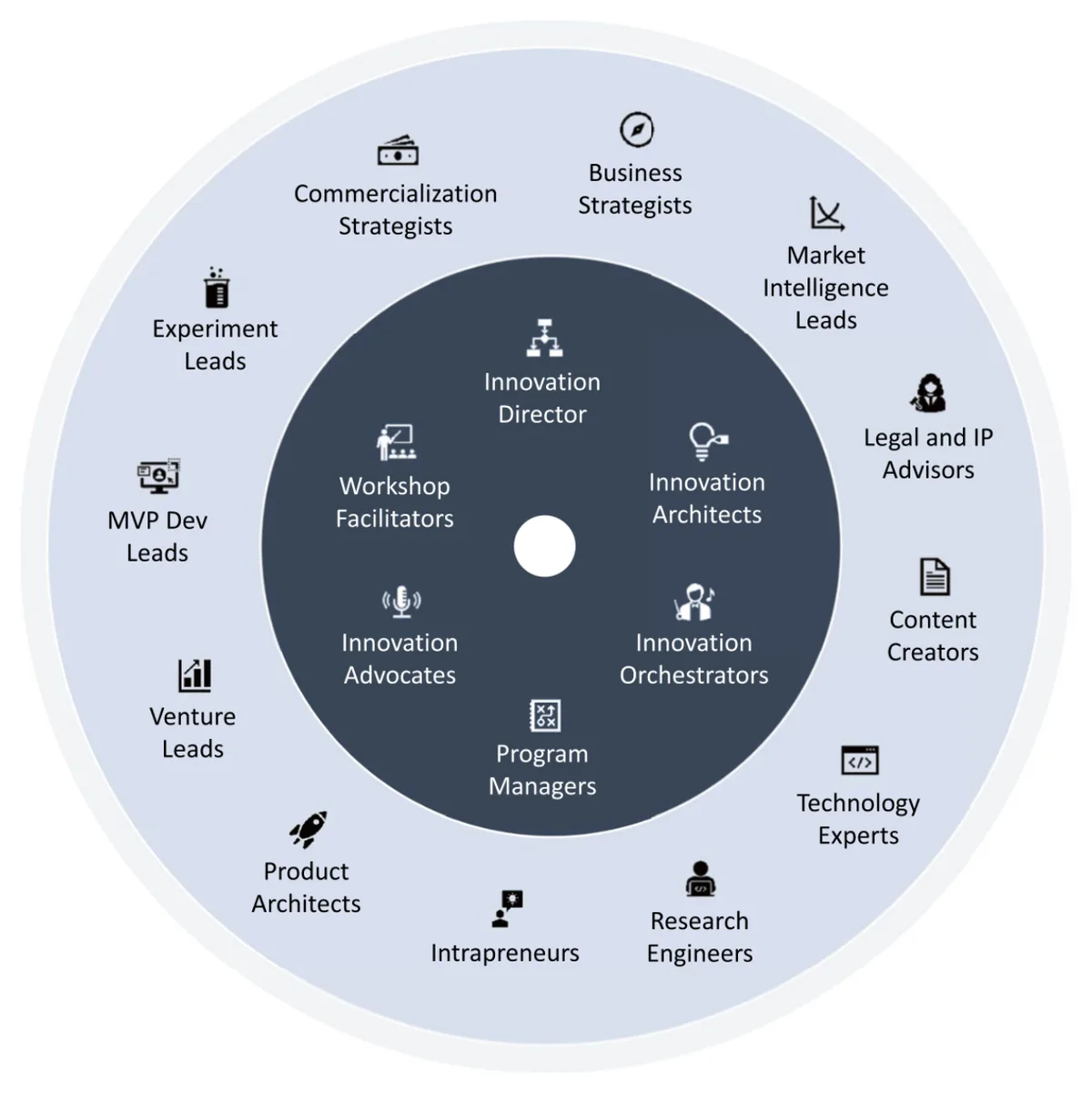
Around the core of senior leaders, fully committed to the programme, sits an extended team. Its members contribute just in time, as experts and advisors, or full time as the programme grows. Beyond both is the community of innovators who volunteer for innovation activities. Figure 1, at the top of this page, shows the core and the extended team together.
The six core roles
Along with the innovation director, five roles form a core “powerful enough to kick off the innovation transformation program” (p. 60).
- Innovation director
- Sets the vision for the innovative version of the company and the roadmap to get there, leads the team and the programme, builds a network across the organisation, partners with business leaders, and educates the C-suite on innovation methods, trends and emerging technologies.
- Innovation architects
- Experts in innovation frameworks, methods and organisational design who architect the whole innovation function: the blueprint of capabilities, the roadmaps and priorities, and the gaps in technological readiness.
- Innovation orchestrators
- Operate and improve the innovation process: they monitor innovation health metrics, review the opportunity portfolio, drive steering discussions with stakeholders, and organise innovation education such as an innovation academy.
- Innovation advocates and connectors
- Passionate communicators who explain the programme, share the stories that inspire people to take part, and connect talented innovators, teams and stakeholders around specific opportunities.
- Programme managers
- Make things happen: they run many parallel workstreams to deliver innovation capabilities quickly, without bureaucracy, and drive their adoption by showing the value of every deliverable.
- Workshop facilitators
- Skilled innovators who lead cross-functional teams through brainstorming sessions, design sprints and other ideation events, and help participants find real user needs and shape solutions to them.
The extended team
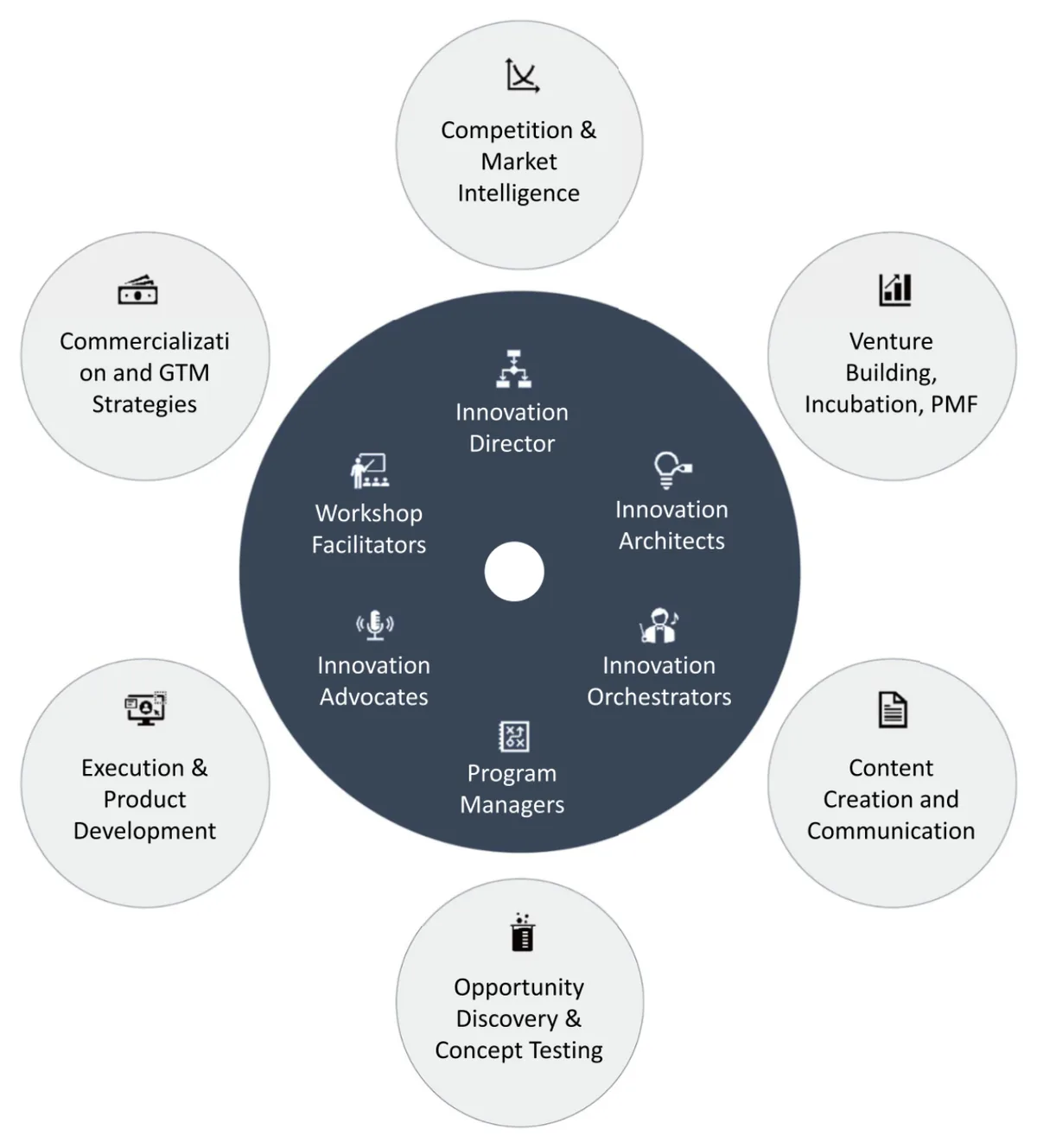
As the programme progresses, the workload grows and new roles become essential. They do not have to be hired at once, and some can be provided “just-in-time,” as a service (p. 63), which makes the team more elastic.
- Technology advisors
- Technologists who explain what cutting-edge technologies can and cannot do, and what is relevant to the business.
- Product architects
- Turn early ideas into product concepts and technical architectures, and assess feasibility.
- Product managers
- Decide what to build first, what a minimum viable product looks like and how to define its success, and aim for product-market fit.
- Opportunity validation leads
- Decide whether and how a concept should be validated, and design and run the experiments that produce the evidence.
- MVP leads
- Turn validated concepts into product requirements and minimum viable products, quickly, with the right development teams.
- Venture leads
- Grow a launched MVP towards product-market fit, and inform decisions to pivot, park or sunset it.
- Legal advisors
- Help manage risk without slowing innovation down, and speed up the identification and protection of intellectual property.
- Intrapreneurs
- Driven, self-motivated individuals with a start-up mentality, who spot opportunities, shape proposals and pitch them, and inspire others by example.
- Business strategists
- Find strategic opportunities in the wider ecosystem, and validate business models and monetisation for new products and services.
- Commercialisation advisors
- Help teams turn concepts into commercial offerings: pricing and monetisation, go-to-market plans, partnerships and launch.
- Content creation lead
- Runs the communication strategy, the innovation portal and the newsletter, and shows success stories and lessons learned.
- Market intelligence lead
- Scans markets, competitors and the wider ecosystem to detect opportunities and threats early.
All members are expected to go beyond their job descriptions: to advise, ideate, evaluate ideas, educate and inspire. A guest innovator programme lets employees from across the company join the team for a project or a period, which adds capacity and keeps the team open to the rest of the organisation.
How big should an innovation team be?
There is no fixed headcount. The right size depends on the company’s size, industry and innovation maturity, and on the scale of the programme. Start with the core, enough to launch the programme and bring the first waves of change, and add extended roles as the work demands, many of them just in time or as a service.
As the company moves up the maturity levels, the team grows into satellite teams that report to the innovation director, each offering one well-defined service.
Permanent staff or consultants?
Who joins the team decides its speed, its credibility and its influence on the culture.
Beyond character, two choices shape the team.
- Internal or external
- Internal candidates bring knowledge of the organisation and established relationships. External talent brings fresh perspectives from other industries and geographies that challenge conventional thinking. A good team balances both.
- Permanent or consultants
- Carefully chosen consultants can support some roles, especially early in the programme. But the core innovation team “benefits significantly from permanent professionals who are deeply integrated within the organization” (p. 71): it builds continuity, knowledge and commitment, and makes innovation a core capability rather than a temporary initiative. Specialist advisors remain valuable for expertise gaps and intensive phases.
How to avoid the innovation bubble
The risk every innovation team faces is being seen as a separate unit: a privileged few exploring ideas with the latest technology, free of the pressures of operations. Innovation labs set up as public symbols have done lasting damage to that reputation.
“Too many innovation labs are sponsored by senior executives as public symbols of their commitment to fostering innovation when in reality such labs are viewed as useless ivory towers by most company employees.”Mark Settle, 7X CIO and Author, in 60 Leaders on Innovation (2021), p. 62
Innovation Mode answers it by positioning the team differently from the start (p. 72):
- It is not set up to produce innovation, but to inspire, enable and orchestrate it, and to make innovation inclusive.
- It works as a hub connected to every part of the organisation, bridging gaps and removing silos.
- It educates everyone in innovation techniques and invites everyone into the process.
In practice that means a visible launch by senior executives, ideally at an all-hands, real examples of the team enabling others, systematic sharing of information, and rotation of talent between the business and the team. The other danger runs the opposite way: a dedicated team can make everyone else feel innovation is no longer their job.
“And I think that the big danger is that having an Innovation Officer or a dedicated innovation team, makes people feel that innovation is beyond their role and responsibility.”Tom Goodwin, Co-Founder, All We Have Is Now, in 60 Leaders on Innovation (2021), p. 25
The innovation team in the AI era
AI changes what the team does more than who is on it. Innovation Mode already sees generative AI taking over the repetitive parts of the content role, from routine communications to newsletter drafts, so the team can focus on storytelling (p. 68). Further along, AI agents scan markets, generate and assess ideas, and test concepts, as described in agentic innovation.
Our view: as agents take on more of the market intelligence, discovery and first assessment, the team’s weight shifts towards orchestrating people and agents together, and towards the intrapreneur, the role that increasingly absorbs work once spread across the innovation team, as argued in The Innovator’s Identity Crisis in the Age of AI.
Questions about innovation teams
What is an innovation team?
What roles does an innovation team need?
How big should an innovation team be?
Should an innovation team use permanent staff or consultants?
How do you stop an innovation team becoming an innovation bubble?
Who should the innovation team report to?
Further reading
- The Chief Innovation Officer: the leader of the team, the mission and the ten responsibilities.
- Who Should Lead Innovation?: the six leadership models, and the Federated model the team makes work.
- The Innovation Maturity Index: the levels the team takes the company through.
- Innovation Workshop Templates: the tools a workshop facilitator runs sessions with.
- Innovation Mode, Author’s Edition (2026): Chapter 3 sets out the Dream Team, its roles and its positioning.
Cite this guide
Krasadakis, G. (2026, October 22). Innovation team structure: roles and the Dream Team. Innovation Mode. https://theinnovationmode.com/innovation-team-structure
@online{krasadakis2026team,
  author = {George Krasadakis},
  title = {Innovation team structure: roles and the Dream Team},
  year = {2026},
  date = {2026-10-22},
  organization = {Innovation Mode},
  url = {https://theinnovationmode.com/innovation-team-structure}
}