
Turn AI ambition into a strategic portfolio and roadmap, in 8 weeks.
For executives who own the AI mandate. A prioritised portfolio of high-value AI opportunities aimed at real problems, with the 12–24 month roadmap to realise them.
AI Spend Is Accelerating. Often on the Wrong Initiatives.
AI budgets are growing faster than AI clarity. Pilots stall before production. Vendors get selected before use cases are validated. Talent gets hired without a clear roadmap. Most AI initiatives fail not because the models don’t work, but because organisations invest before they decide where AI actually creates competitive advantage. That’s a strategy problem, not a technology one.
What Most Companies Do
- Chase vendor demos that promise transformation overnight
- Run AI pilots that never scale beyond the demo environment
- Hire data scientists without a clear strategy for what to build
- Confuse AI automation with AI-powered competitive advantage
- Present "we’re exploring AI" as a strategy to the board
What This Programme Delivers
- An objective assessment of your AI readiness across five dimensions
- A scored portfolio of use cases prioritised by impact and feasibility
- Detailed product concepts for your top 3–5 AI opportunities
- A phased implementation roadmap covering 12–24 months
- A board-ready executive AI briefing you can present next quarter
The hardest part of adopting AI isn’t the technology itself.
It’s knowing where to apply it, in what sequence, and how to measure it.
George Krasadakis
Five Deliverables. Designed for Action.
Every deliverable is shaped by Innovation Mode (Author’s Edition, 2026), the first published architecture for agentic innovation in a corporate context, covering AI-powered opportunity discovery, AI-assisted validation, and agent-driven realisation. The architecture is built on 25 years of shipping intelligent systems, from data mining platforms in the late 1990s to autonomous AI agents today, including Ainna.ai in production. Together these frameworks form an AI transformation roadmap your team can act on, not theoretical.
AI Readiness Assessment
A comprehensive diagnostic across five capability dimensions: data infrastructure, technical talent, process maturity, leadership alignment, and cultural readiness. No generic benchmarks: a diagnosis specific to your operating reality, identifying exactly where the gaps will slow you down.
AI Use Case Portfolio
A prioritised portfolio of AI opportunities mapped across your business, from quick wins that build momentum to strategic bets that create competitive moats. Each use case scored on business impact, technical feasibility, data readiness, and implementation complexity. Not a wishlist: a decision-ready framework.
AI Product Concepts
For your top 3–5 priority use cases: detailed product concepts including user journeys, technical architecture, build-vs-buy recommendations, integration points, and success metrics. These are the specifications your product and engineering teams need to move from "interesting idea" to "let’s build this."
AI Innovation Masterplan
A phased AI transformation plan covering 12–24 months: what to pilot first, what to scale, what to defer. Includes technology stack recommendations, vendor evaluation criteria, talent requirements, AI governance framework, and risk mitigation. Each phase has clear milestones and decision gates, sequenced as an AI innovation roadmap your board can authorise and your teams can execute.
Executive AI Briefing
A board-ready presentation synthesising findings, recommendations, and roadmap, designed for communicating AI strategy to leadership, investors, and stakeholders. Includes talking points for the questions your board will ask: ROI timelines, competitive positioning, risk exposure, and talent strategy. Present it next quarter.
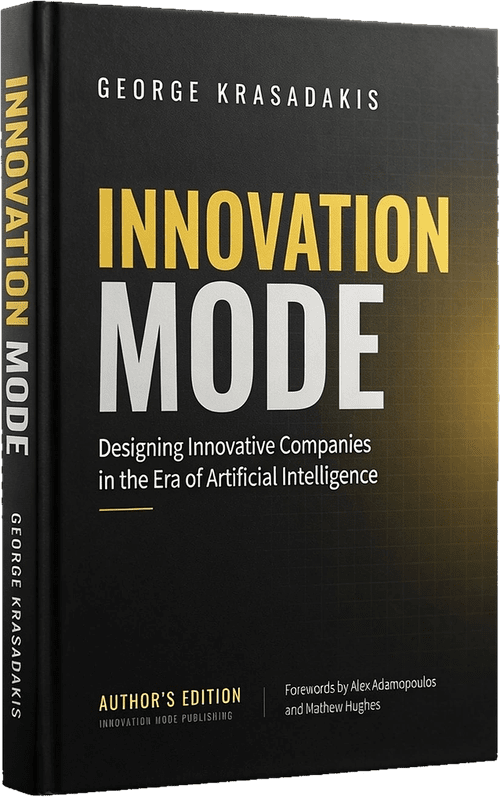
Every programme includes 10 copies of Innovation Mode: the complete framework for building AI-powered innovation capabilities. Your leadership team receives the definitive guide to sustaining the AI transformation long after the programme concludes.
From AI Ambiguity to AI Clarity. In 8 Weeks.
50 hours of AI strategy advisory delivered across 32 sessions. Every week targets a specific dimension, building toward a complete, actionable AI strategy your team can execute. Remote or hybrid.
AI Readiness
We assess your AI capabilities: data infrastructure and quality, technical talent and skills gaps, existing AI/ML initiatives, vendor relationships, and organisational readiness for AI-driven change, using the same diagnostic discipline as our Innovation Maturity Index. We benchmark against what’s achievable and identify the specific constraints that will shape your strategy.
Opportunity Mapping
We map AI opportunities across your entire value chain: customer experience, operations, product development, decision-making, and back-office functions. We interview stakeholders across business units to surface pain points. The goal: identify where AI creates competitive advantage, not just automation.
Strategic Prioritisation
We score and prioritise identified opportunities: business impact, technical feasibility, data readiness, time to value, and strategic alignment. We separate quick wins from long-term bets and identify the sequencing that builds capability while delivering results. You’ll know exactly which use cases to pursue, and which to defer.
AI Product Concepts
For your top 3–5 priority use cases, we develop detailed product concepts: user journeys, technical architecture sketches, data requirements, integration points, build-vs-buy analysis, and success metrics. These aren’t vague ideas. They’re specifications your teams can act on.
Technology & Vendor Strategy
Technology stack, vendor selection, and build-vs-buy decisions. Evaluation criteria for AI platforms, guidance on foundation models vs. custom training, cloud strategy, compute requirements, and data architecture. We help you make the infrastructure decisions that determine whether your AI initiatives scale or stall.
AI Governance & Risk
An AI governance framework appropriate to your organisation: policies for data usage, model validation, bias monitoring, and human oversight. Regulatory considerations, IP protection, and risk management. This isn’t about slowing you down. It’s about building AI capabilities that scale without creating liabilities.
Implementation Roadmap & Executive Briefing
We synthesise all findings into a comprehensive AI Implementation Roadmap and a board-ready Executive AI Briefing. Your roadmap covers 12–24 months (what to pilot first, what to scale, what to defer) with clear milestones, resource requirements, and decision gates at every phase.
Final deliverables presented to leadership: AI Readiness Assessment, Prioritised Use Case Portfolio, AI Product Concepts, Implementation Roadmap, Executive AI Briefing, and 10 copies of Innovation Mode.
Your Roadmap: From Foundation to AI-Powered in Four Phases
The AI Implementation Roadmap sequences your AI maturity transformation across 12–24 months. Each phase builds on the previous: quick wins first, strategic bets second, autonomous capabilities last.
The Advisory Installs the Operating Model. Ainna Runs It.
Three of the six Innovation Deficits are organisational: the advisory treats them. The other three (capabilities, real-world market connection, venture building) are infrastructure, and infrastructure isn’t advised into existence. It has to be built. That infrastructure is Ainna, the agentic system specified in Innovation Mode, running in production.
For organisations, Ainna Enterprise deploys as internal innovation infrastructure: white-labelled, in your own cloud, carrying your innovation agenda.
See it on your problem, not a generic demo. Submit one real challenge from your organisation or industry and watch Ainna frame it into a scored, board-ready opportunity, live. Each session is prepared individually around your submission, so demo slots are limited. Book early.
AI Strategy from an AI Inventor, Not a Consultant
This programme is led by an AI inventor who has been building intelligent systems for 25 years, from data mining platforms in the late 1990s to autonomous AI agents today. Not a team of junior analysts learning on your dime. The person who wrote the book, built the tools, and is the named inventor on the patents.

For Executives Who Own the AI Mandate
This programme is commissioned by the executive who owns the AI agenda, typically the CEO, CAIO, CTO, CDO, or VP-level sponsor with budget authority. They convene a core team of 4–6 stakeholders for the engagement: heads of product or technology, business unit leaders, and someone from data/analytics. What matters is leadership commitment to act on the findings.
CEOs, COOs & Board-Level Leaders
You need to present an AI strategy next quarter. This programme gives you the assessment, the portfolio, and the board-ready briefing to do it with confidence.
CTOs, CDOs & Heads of Technology
You own the technical roadmap. This programme provides the architecture decisions, vendor framework, and build-vs-buy analysis your team needs to execute.
Heads of Product, R&D & Innovation
You decide what gets built. This programme delivers detailed AI product concepts (user journeys, technical architecture, integration points) for your highest-impact opportunities.
Chief AI Officers & VP AI/Data
You own the AI mandate. This programme gives you an objective external readiness assessment, a scored use case portfolio, and a published methodology to reference: a Chief AI Officer as a Service framework that compresses your Year 1 framework-building into 8 weeks, freeing you to focus on execution.
On Innovation Mode: The Book Behind the Methodology
The frameworks deployed in this programme are drawn from Innovation Mode (Author’s Edition, 2026). Here’s what innovation leaders have said about the book and its first edition.
"Not just a book but a blueprint for what it really takes to build innovative companies in today’s world: companies that don’t just talk about innovation but live it in their culture, in their systems, and in their everyday decisions."Alex Adamopoulos | CEO, Emergn
"An excellent overview and reference point about people, culture, and capabilities as the key pillars of innovation and practical ways to discover, validate, and realize opportunities on the road to innovation."Dr. Mathew Hughes | Professor of Innovation and Entrepreneurship, University of Leicester
"Very practical and inspirational for executives, leaders, middle-level managers, and teams willing to transform their vision to actual execution. Must-read and must-use."Achilleas Stergioulis | Director, INTRASOFT International
"A must-read for innovation managers, top-level corporate executives, and entrepreneurs!"A. Tzoumas | CTO, SciFY.org
Questions from Prospective Clients
What are the signs my organisation needs an AI strategy advisory engagement?
How much does an AI strategy advisory engagement cost?
What ROI should we expect from an AI strategy advisory engagement?
What’s the time commitment for our team?
How is this different from AI consulting from the big firms?
How does this relate to the Corporate Innovation Advisory?
Do I need the advisory programmes or the Ainna platform?
Who implements the strategy after the engagement ends?
Should we run this programme if we already have a Chief AI Officer?
Does this work for non-tech companies or organisations already running AI initiatives?
Is this specifically about generative AI, or AI more broadly?
Does this cover AI governance and regulatory considerations?
How do you prioritise AI use cases for enterprise investment?
Why do most enterprise AI pilots fail to scale to production?
What does effective AI governance look like in a corporate environment?
What does a Chief AI Officer (CAIO) actually do?
How do you measure ROI on enterprise AI investments?
What is agentic AI and how is it changing corporate innovation?
Ready to Move from AI Conversations to AI Decisions?
Apply with a brief form and receive a tailored proposal within 48 hours, matched to your organisation’s size, industry, and AI maturity.
50 hours · 32 sessions · 8 weeks · Remote or hybrid · Led by the inventor of 18 patent families
Also available: Corporate Innovation Advisory, an 8-week programme for building your organisation’s innovation architecture and capability.
Not ready for advisory? Start with the free membership: the monthly Innovation Mode Briefing, early access to new releases, and member-only discounts.
Go deeper: Transforming a Company Into an AI-Powered Organisation → · Rethinking Product Requirements for the AI Era →