
Most hackathons are theatre. Ours perform.
Theatre hackathons run on applause — they peak on Friday, fade by Monday, and leave a stack of pitch decks no one picks up.
Our hackathons are the start of the process, not the end — designed to feed the innovation pipeline: a brief that names the bet, a rubric that survives the boardroom, a communications timeline that doesn't drift, and a funding pathway that turns the winner into a roadmap item.
Six deliverables, two complete worked examples, a step-by-step playbook — built for innovation leaders who refuse to wing it.
One-time payment · Lifetime access · Instant download — templates, worked examples, and playbook, yours forever.
Six deliverables. Every phase covered.
From the first sponsor conversation to the post-event report — every document is fully editable, with embedded guidance on every slide and section. Download once, reuse across every hackathon you ever run.
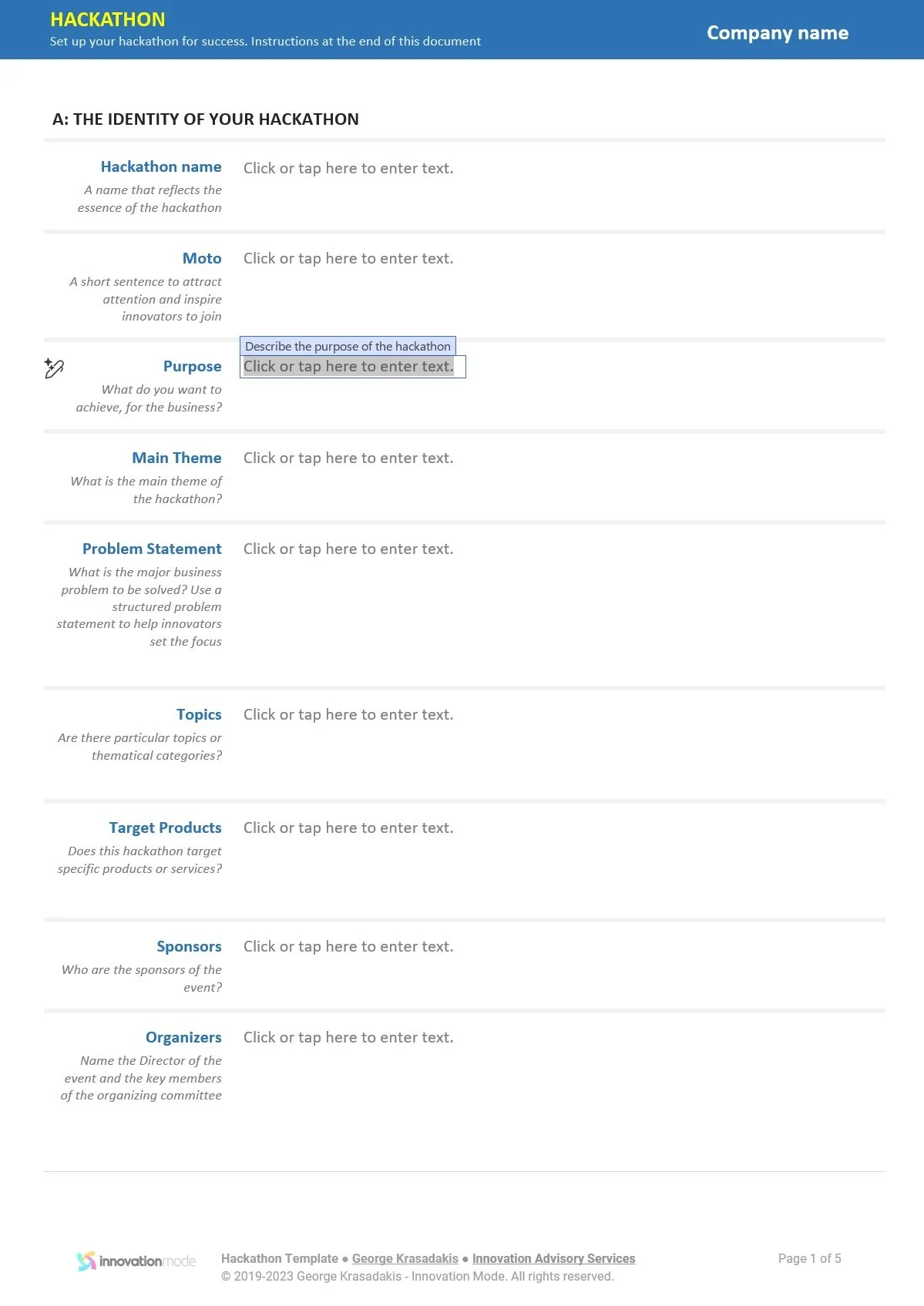 .docx · editable
The hackathon brief
A Word template that defines the entire event — theme, sponsor alignment, KPIs, format, eligibility, prizes, and the judging rubric. Embedded guidance on every section so you never wonder what goes where.
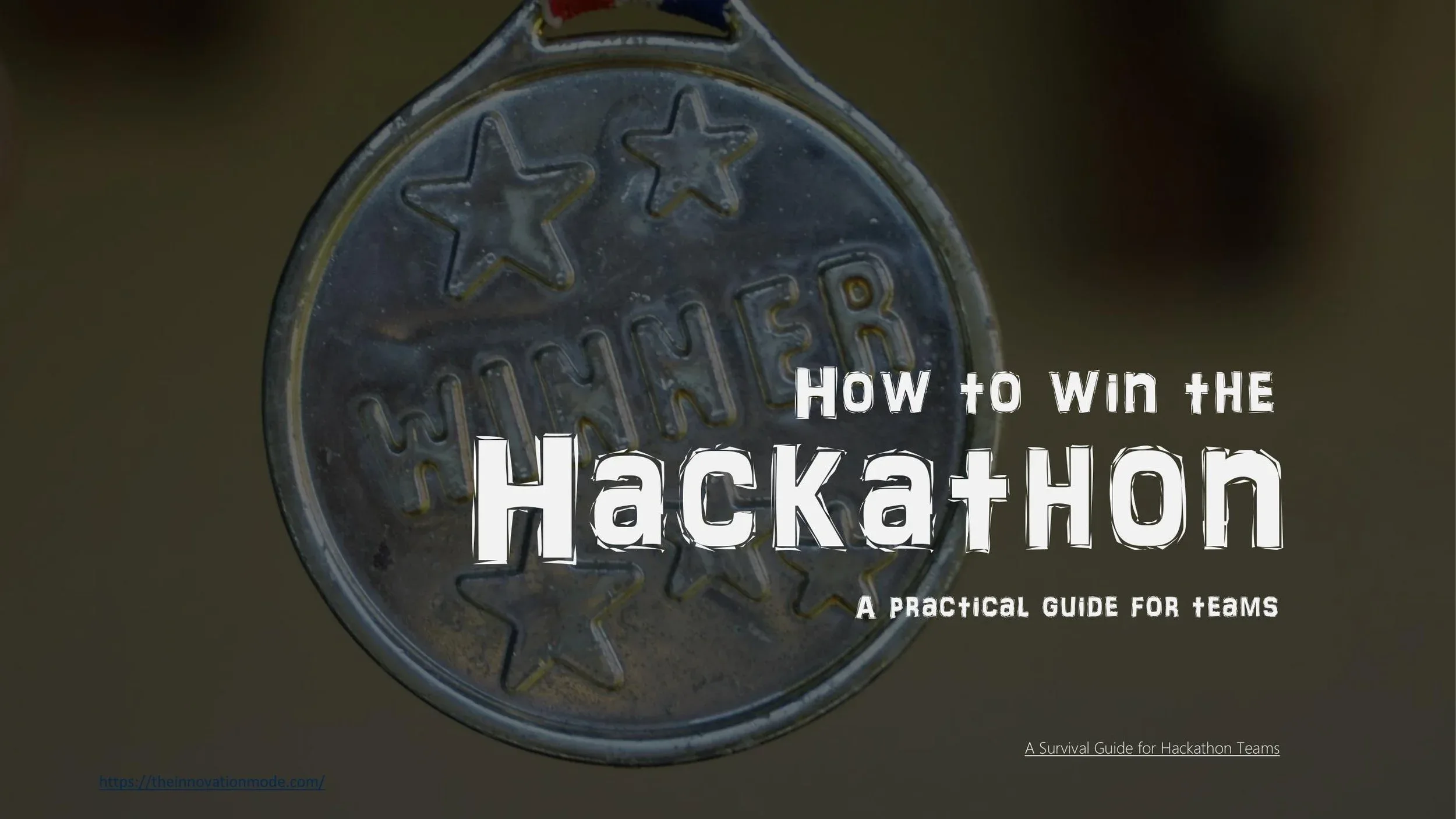 .pptx · editable
The pre-read deck
A PowerPoint deck sent to participants ahead of the event — covering theme, problem statements, judging criteria, agenda, and expected outcomes. Sets expectations before participants start work.
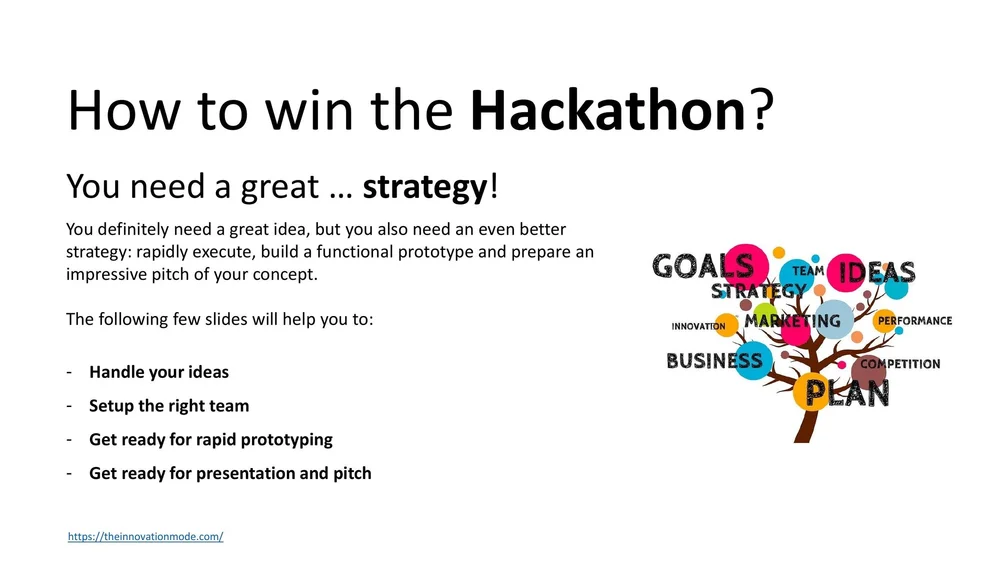 .pptx · for teams
The participant pitch deck
A 12-slide template that participating teams use to present their projects — problem, solution, demo, business case, roadmap. Standardises pitches so judges score the work, not the polish.
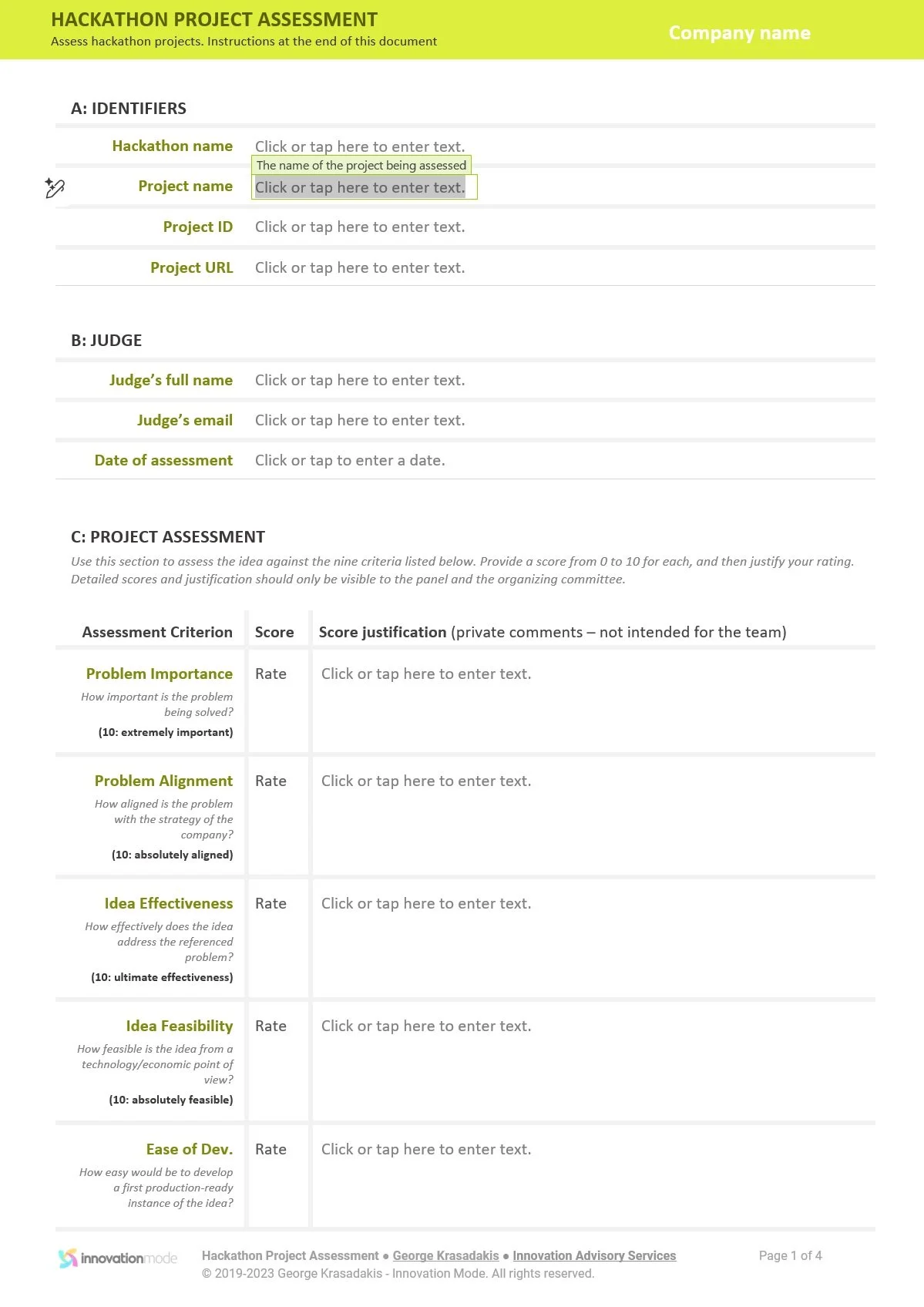 .xlsx + .docx
The scoring & assessment model
A complete judging system — weighted rubric, scorecard spreadsheet, conflict-of-interest protocol, tie-break logic, and judge briefing notes. Defensible to leadership, fair to teams, fast at the table.
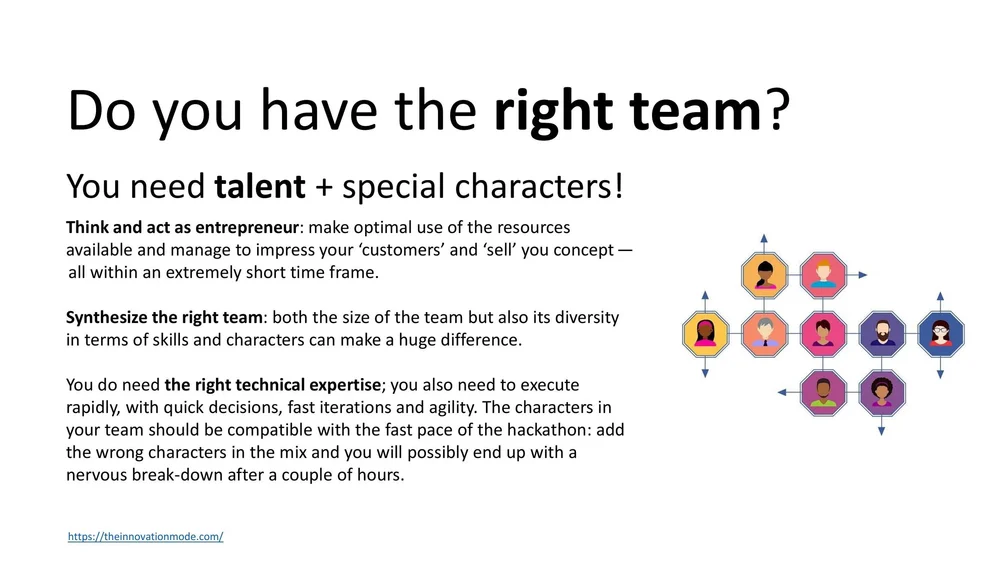 timeline + 25 messages
The communications timeline & message library
A countdown timeline with every milestone mapped — from event announcement through post-event recap — plus 25+ pre-written messages: announcement emails, registration nudges, kick-off scripts, mentor invites, participant reminders, judge briefings, results, and post-event recaps. Nothing drifts. No one drops off the calendar.
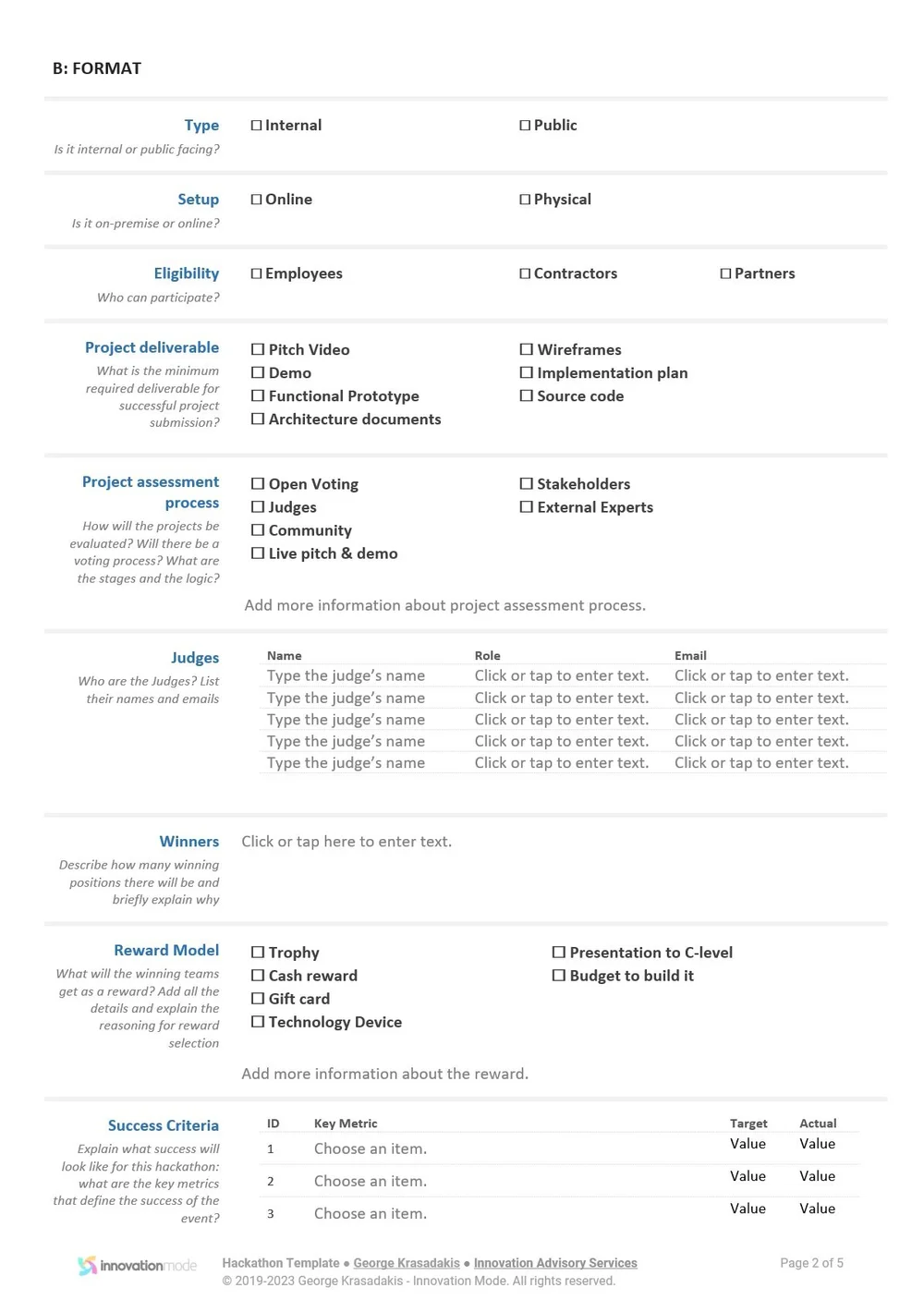 E-book · PDF
The hackathon playbook
A companion e-book that explains the methodology behind every template — how to choose a theme that aligns with strategy, design a rubric that survives scrutiny, structure prizes that motivate without distorting, and convert post-event ideas into funded projects.
Read over the author's shoulder.
Every example hackathon comes with inline commentary from George Krasadakis — not just explaining each design decision, but showing you the choices to avoid, and why. You're not studying a finished hackathon. You're watching the author think through the trade-offs.
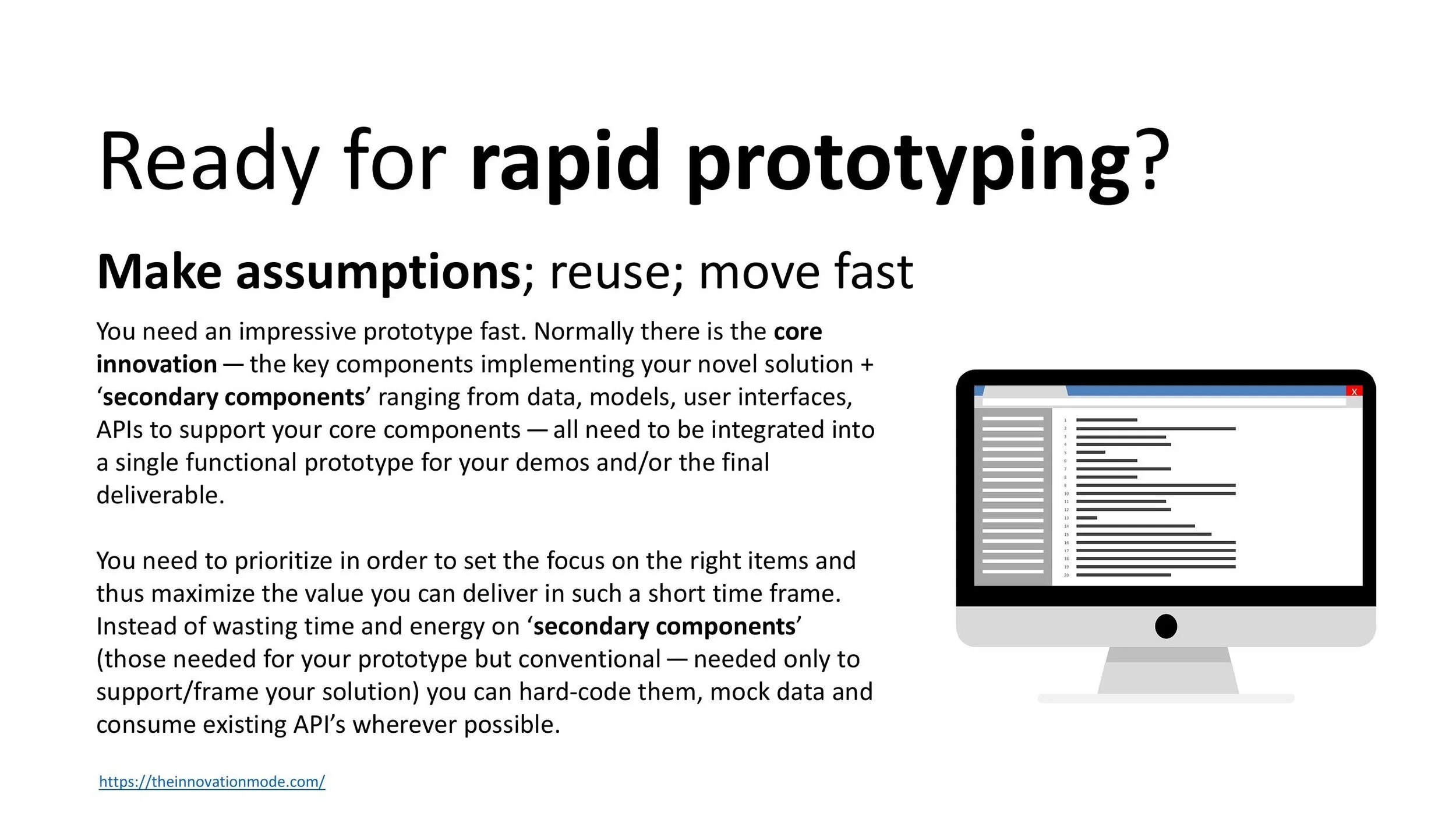
"Weight insight over polish. Demos are surface. They're not the point — a beautiful demo of the wrong problem is the worst possible outcome."
"Don't pick judges purely by seniority. A senior leader who hasn't built anything in a decade will reward stories. Mix in builders — they reward proof."
Sample commentary from the worked hackathon examples. Both example briefs and decks are fully annotated — every section, every slide.
This kind of reasoning doesn't come from generic AI — it comes from 25 years running corporate innovation programs. The one exception: Ainna.ai, built on the same methodology.
Your hackathon, phase by phase.
The toolkit covers four phases of the hackathon lifecycle — Design, Promote, Run, and Reflect / Measure / Act. The full web framework is in the Corporate Hackathon Guide; post-event measurement is covered in Innovation Mode 2.0.
Frame the event itself — strategic theme, sponsor alignment, goals, format, eligibility, prizes, and the judging rubric.
6 sectionsFill the room. Communication plan, pre-read briefing, registration, team formation, and mentor and judge recruitment.
4 sectionsRun a real event. The run-of-show — your minute-by-minute event schedule — kick-off rituals, mentor checkpoints, pitch coaching, final demos, and live judging.
5 sectionsMake Monday matter. Scoring decisions, winner announcement, funding pathway, outcome measurement, and the next iteration.
5 sectionsThe 20 sections
Hover a chapter above to see its sections — or hover any section to find its chapter.Two complete hackathons — not a hollow template.
You don't get one example. You get two — deliberately different. Same framework. Two markedly different formats and themes. The test every toolkit should pass.
Numbers per example. Both examples cover every one of the 20 sections end-to-end — and every brief and slide is annotated inline by the author.
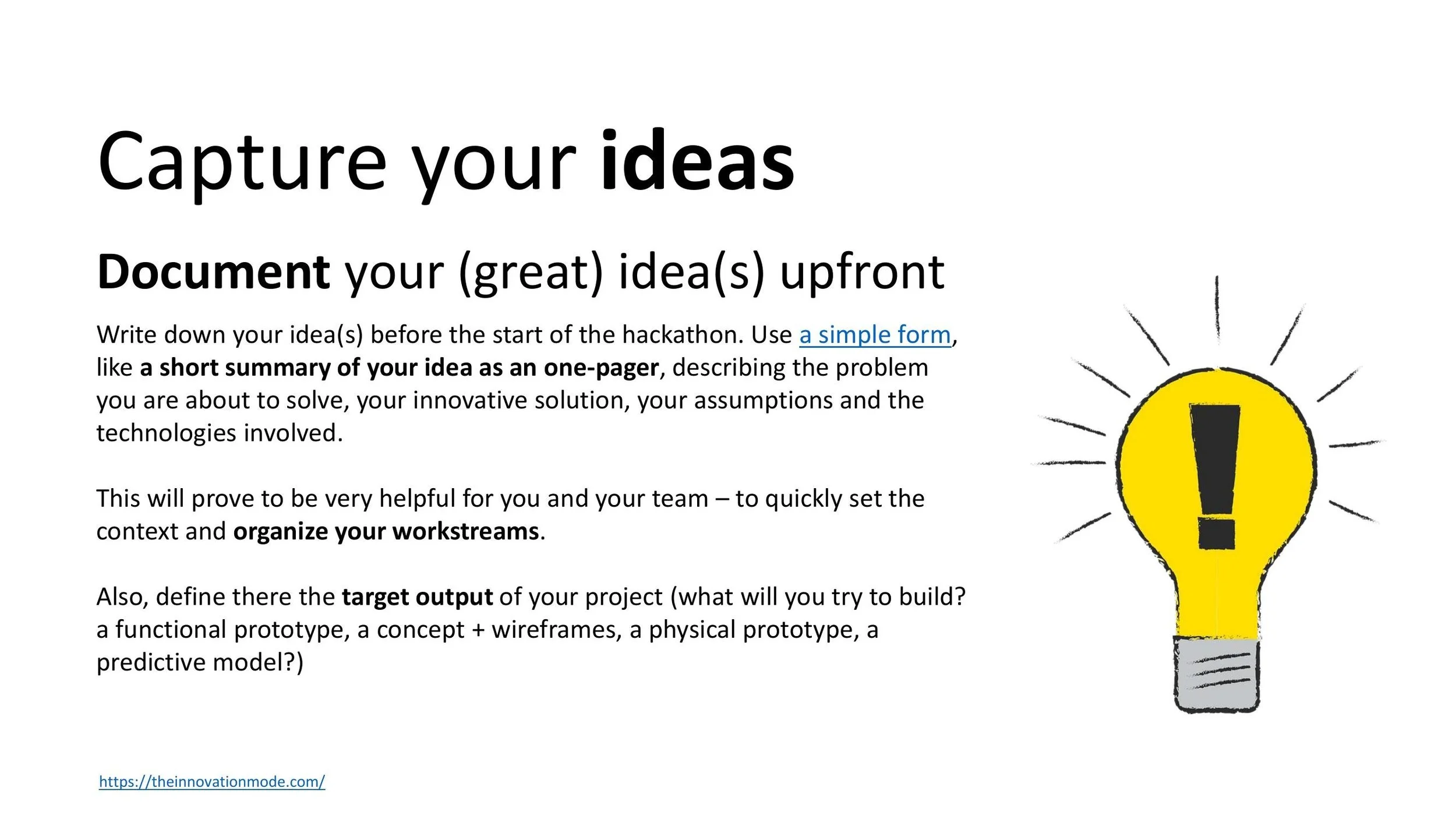
For innovation leaders who run programs, not events.
Put winners on the roadmap
Walk into the next steering committee with a defensible scoring model, an audit trail behind every judging decision, and a funding pathway already drawn for the winner. The artefacts make the case for you.
- Tie every theme to a portfolio bet
- Defend scoring decisions to procurement and HR
- Hand the winner a budget, an owner, and a deadline
Cut planning time in half
Skip the blank page. Plug your event details into the templates and deliver the brief, pre-read, and communications timeline in days — not weeks.
- Pre-built run-of-show with hour-by-hour milestones
- 25+ pre-written messages from announcement to recap
- Standardise formats across every event you run
Surface real ideas, not just energy
Use a hackathon to find what's worth building. The rubric and funding pathway turn weekend ideas into roadmap items — and the mentor checkpoints kill the ones that aren't.
- Theme design tied to your roadmap
- Mentor checkpoints that kill weak ideas early
- A funding pathway from winner to MVP
Win on the problem, not the prototype
Your hackathon doesn't have to be an engineering contest. The rubric weights problem clarity, customer evidence, and business case above demo polish — so the winning team isn't always the one that brought a developer.
- Submission rules accept business cases, not just demos
- Eligibility copy that invites domain experts, marketing, and customer ops
- Both worked examples assume cross-functional teams
Three ways to use the system.
System — the toolkit, for you to run the event yourself. System, Live — we design and run the event with you, end to end. Custom — multi-event programs, multi-region rollouts, organisation-wide hackathon operating models.
- The hackathon brief — 20 sections, with guidance .docx
- The pre-read deck — 25 slides .pptx
- The participant pitch deck template — 12 slides .pptx
- The scoring & assessment model .xlsx + .docx
- The communications timeline & 25+ message library .docx
- Two annotated worked example hackathons PDF
- The hackathon playbook (e-book) PDF
- Lifetime updates as the toolkit evolves
- Discovery A 30-minute intake call to set context, followed by a structured questionnaire covering strategy, audience, format, judging, prizes, IP, and post-event activation
- Design A bespoke hackathon plan delivered as a working document — theme design, timeline, audience strategy, judge composition, scoring rubric, prizes, communications timeline, run-of-show, implementation plan. Async review cycle with your advisor.
- Calibration A 60–90 minute judge calibration session with your full panel before event day. Walk the rubric, run sample submissions, align scoring across the panel.
- Debrief A 60-minute post-event call covering outcomes, ROI tracking, the funding pathway for winners, and next-iteration design.
- The full System — yours to reuse on every future hackathon you run
- 3 months of Ainna.ai Pro for theme generation, idea screening, and submission scoring (retail: $297)
Multi-event programs and organisation-wide rollouts.
For groups running hackathons at scale — recurring innovation challenges, multi-region rollouts, train-the-trainer for internal program managers, or a permanent hackathon operating model embedded into your innovation function. Scoped per engagement.
- Multi-event programs
- Multi-region rollouts
- Internal program manager training
- Custom rubric & theme design
- Permanent operating model design
Typically engagements from $25K
Use it forever.
Both tiers come with full commercial reuse rights for hackathons you run inside your own company, your team's events, your startup's challenges, or your division's quarterly innovation days. No per-seat fees. No expiration. The System is yours to use across every hackathon you ever run.
Consultancy or agency use?
If you plan to use the toolkit to deliver hackathons or innovation events as paid services to external clients, get in touch — we offer a separate agreement for firms running events for clients.
Everything you might be wondering.
What exactly do I receive after purchase?
The Hackathon Architect's System (€499) includes six deliverables: (1) the hackathon brief template covering 20 sections with embedded guidance, (2) a 25-slide pre-read deck, (3) a 12-slide participant pitch deck template, (4) the scoring and assessment model with weighted rubric and judge briefing, (5) a communications timeline plus 25+ pre-written messages from announcement to recap, and (6) the hackathon playbook e-book. You also get two complete annotated example hackathons. All files download instantly in native editable formats — no subscription, no DRM, reusable across every hackathon you ever run.
The Hackathon Architect's System, Live (on request) is a four-phase advisor engagement around one event: Discovery (30-min intake call and structured questionnaire), Design (a bespoke hackathon plan delivered as a working document — theme, timeline, audience, judges, rubric, prizes, communications, run-of-show, implementation plan), Calibration (60–90 min judge calibration session before event day), and Debrief (60-min post-event call covering outcomes, ROI, and next iteration). You also keep the full System and 3 months of Ainna.ai Pro (retail $297).
Custom covers multi-event programs, multi-region rollouts, organisation-wide hackathon operating models, and live judge participation at your event. Scoped per engagement — typically from $25K. Request a proposal with the scope.
Is the example a real, finished hackathon — or placeholder text?
Fully finished — and annotated. You get two complete worked examples: Apex, an internal AI hackathon for a global enterprise, and Outlook, a 5-week open innovation challenge with external partners. Each covers all 20 sections end-to-end — theme, KPIs, format, eligibility, prizes, judging rubric, communications timeline, mentor checkpoints, run-of-show, scoring, funding pathway, and post-event tracking. And every section carries inline commentary from George Krasadakis explaining design decisions, structural choices, and the trade-offs to avoid.
Does this work for virtual, hybrid, and in-person hackathons?
Yes. The brief and rubric are format-agnostic. The run-of-show and communications timeline include parallel guidance for in-person, hybrid, and fully virtual events — and the two worked examples deliberately cover different formats so you see how the same structure adapts. The toolkit covers events from a 24-hour internal sprint to a multi-week open innovation challenge.
Does it cover internal hackathons and external open innovation challenges?
Both, deliberately. Apex is an internal employee-only AI hackathon — the format most corporate innovation leads run first. Outlook is an open innovation challenge involving external startups, customers, and university teams — with the IP, eligibility, and judging adjustments that opening up requires. The two examples were chosen to span the full range of corporate hackathon formats.
What methodology is the toolkit based on?
The 4-phase structure — Design, Promote, Run, and Reflect / Measure / Act — and the 20 sections are drawn from the Innovation Mode 2.0 methodology (Springer, 2026), developed over 25 years of corporate innovation work and reflected in the corporate hackathon planning template already published on this site. The toolkit packages that methodology into deliverables you can run with on Monday morning.
Does the scoring model hold up to procurement, HR, and legal scrutiny?
Yes — that's a deliberate design goal. The scoring model includes weighted criteria with explicit definitions, a conflict-of-interest protocol for judges, transparent tie-break logic, a written judge briefing, and an audit trail for every score. The rubric is structured to defend any winner decision against challenges from non-winning teams — a question every internal hackathon eventually has to answer.
Can I use the templates for client work or paid hackathon services?
For hackathons you run inside your own company, team, or startup — yes, without restrictions. Both tiers include full commercial reuse rights. Reuse the templates for every hackathon you run internally — no per-seat fees, no renewal, no expiration.
Consultancy or agency use is a separate arrangement. If you plan to deliver hackathons or innovation events as paid services to external clients, get in touch — we offer a separate agreement structured fairly for firms running events for clients.
How long does it take to set up a hackathon using this?
Most innovation leads using the toolkit deliver the brief, pre-read, and communications plan in 3–5 working days — what typically takes 3–4 weeks from a blank page. The longer event — a 5-week open innovation challenge — requires more total calendar time, but the planning and document-prep phase compresses the same way: from weeks of drafting to days of customising.
Do I need specific software to use the templates?
Microsoft Word or Google Docs for the brief and message library. Microsoft PowerPoint or Keynote for the decks. Microsoft Excel or Google Sheets for the scoring model. The PDF versions of the e-book and worked examples open anywhere.
How is this different from a free hackathon template online?
Free templates give you headings — usually a half-finished agenda and a checklist. This is a coherent system: editable templates with embedded guidance, two complete worked hackathons annotated by the author, a defensible scoring model, a 25+ message communications library, and a methodology e-book that explains why each design decision matters. It's the difference between a blank page and a complete working example.
Want to read the framework first? See the Corporate Hackathon Guide for the strategic framework, and Measuring Hackathon Success for the 9-criteria measurement framework.
Can I just generate this with ChatGPT or Claude?
You can generate surface-level hackathon plans quickly — agendas filled with generic copy. What generic LLMs can't produce is the framing: the specific calls that say "weight insight over polish," "structure prizes around career visibility, not cash," or "kill weak ideas at the first mentor checkpoint, not the final pitch." That's 25 years of corporate innovation work made portable. The one AI that does generate this quality of reasoning is Ainna.ai — because it's trained on exactly this methodology.
Will I get updates when the toolkit evolves?
Yes — lifetime updates. When templates are refreshed with new sections, formats, or examples, you get the new versions at no extra cost.
How does the System, Live engagement actually work?
Four phases, async-first.
Discovery (week 1). A 30-minute intake call to set context — your strategic objective, audience, constraints, and event date. You then complete a structured questionnaire covering format, judging, prizes, IP, and post-event implementation. The questionnaire is async, so you can complete it at the right moment with the right stakeholders pulled in.
Design (weeks 2–3). Within 7 working days of receiving the completed questionnaire, your advisor delivers a full custom hackathon plan as a working document — theme design, timeline, audience strategy, judge composition, scoring rubric, prize structure, communications timeline, run-of-show, and implementation plan. You return comments async, your advisor revises, you confirm.
Calibration (week before event). A 60–90 minute judge calibration session with your full panel on the call. Walk the rubric. Run 2–3 sample submissions. Align scoring across the panel before they ever see a real submission.
Debrief (within 2 weeks of demo day). A 60-minute post-event call covering outcomes, ROI tracking methodology, the funding pathway for winners, and what to change for the next iteration.
Total elapsed time: roughly 6 to 10 weeks around your event.
Do you offer advisory or hands-on support beyond the System, Live tier?
Yes — three pathways. System, Live covers a single hackathon end-to-end with the four-phase advisor engagement. Custom engagements cover multi-event programs, multi-region rollouts, train-the-trainer for internal program managers, organisation-wide hackathon operating models, and live judge participation at your event — scoped per engagement, typically from $25K. For broader transformation work, the Innovation Advisory program covers the full corporate innovation function, and the AI Strategy Advisory program covers AI strategy at the organisation level.
Are there educational or academic licenses?
Yes — universities, business schools, innovation centres, and accelerator programs can license the toolkit for course use, faculty research, and student-run hackathons. Academic licensing is structured as an annual site license covering faculty use, student distribution for enrolled cohorts, and integration into course materials. Individual faculty and researchers can also inquire about academic-individual pricing. Get in touch with details about your institution and intended use.
Explore the full hackathon framework.
Corporate Hackathon Guide
The strategic framework behind every template in this toolkit — lifecycle, design parameters, evaluation models, and reward structures.
Read the guide → Measure what mattersMeasuring Hackathon Success
The 9-criteria measurement framework for tracking hackathon outcomes — from participation quality to post-event pipeline conversion.
Read the framework → Plan your hackathonHackathon Planning Template
The free operational planning template — 4 phases, 6 design decisions, and 4 worked examples to get started before buying the toolkit.
Get the template → Choose your themeCorporate Hackathon Ideas
Theme ideas tied to portfolio strategy — AI, sustainability, customer experience, operational efficiency, and more.
Browse themes →For broader transformation work beyond hackathons — innovation strategy, operating model design, and AI strategy at the organisation level.
Stop reinventing every hackathon from scratch.
Start your next corporate hackathon with templates, two complete worked examples, a defensible scoring model, and a communications library — grounded in 25 years of corporate innovation work.
Part of the Innovation Mode toolkit series, grounded in Innovation Mode 2.0. See also: the Corporate Hackathon Guide, Measuring Hackathon Success, and the Hackathon Planning Template.
Built and designed by George Krasadakis — AI inventor, 20+ patents, and author of Innovation Mode 2.0 (Springer, 2026).
Educators, universities, and innovation programs — contact us for academic licensing options.
Field notes on this subject
Planning a Corporate Hackathon? 50+ Ideas That Actually Work
Most hackathon idea lists are useless - "build a chatbot" helps no one. These 50+ themes are framed around real business problems, organized by innovation type, and designed to attract diverse teams - not just developers. Plus: how AI has made hackathons more inclusive than ever.
Should We Still Organize Corporate Hackathons in the AI Era?
AI can generate ideas in seconds - so are corporate hackathons still relevant? More than ever. But the old annual model is broken. Here's why innovation leaders should run hackathons more frequently, how AI tools make them radically more inclusive, and what it takes to turn hackathon concepts into real products.
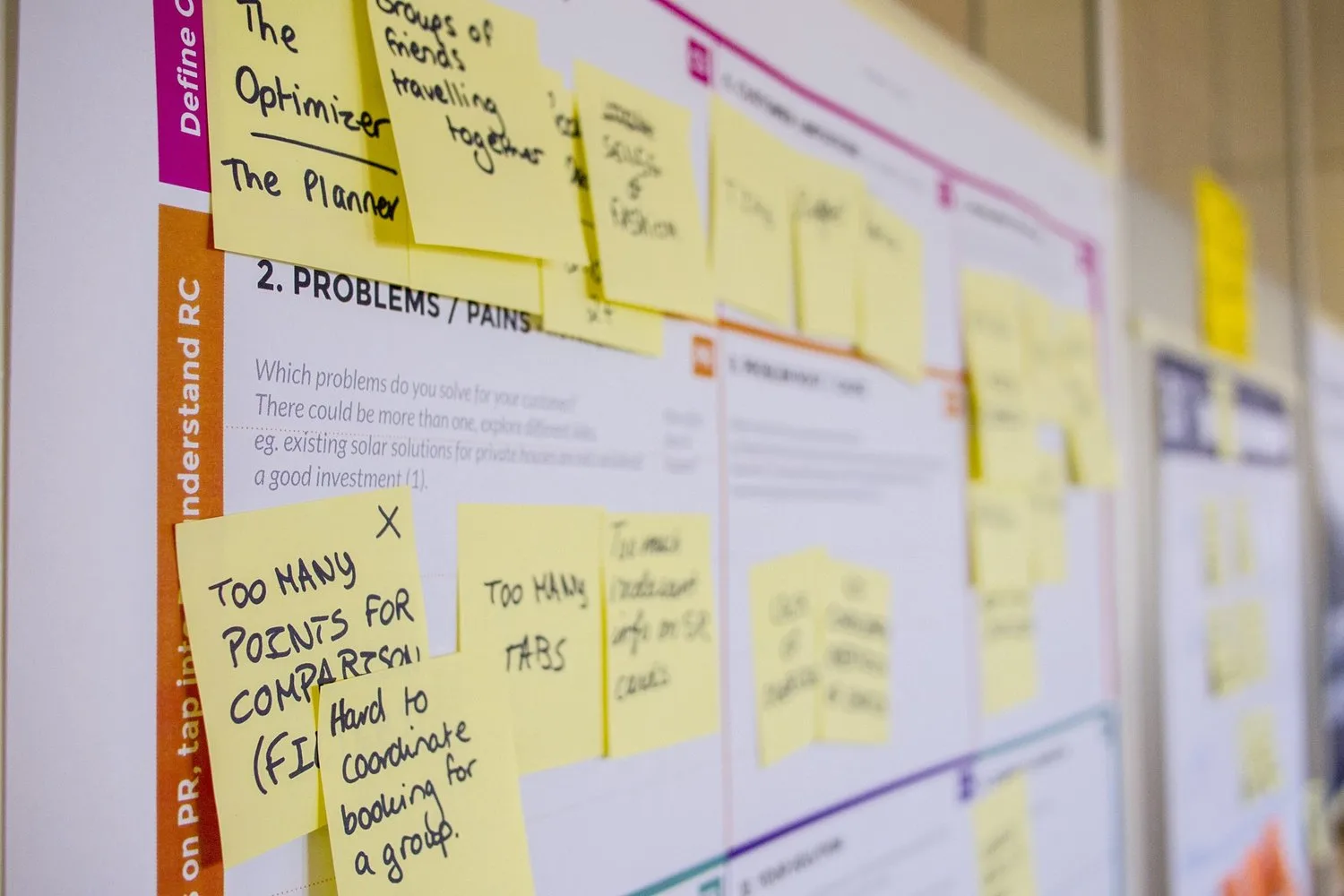
Running a Design Sprint: How To Ensure Success
Design Sprints can generate remarkable output for your company, such as a backlog of impactful ideas (also with IP opportunities), functional prototypes, learnings, and key insights from customers along with real business opportunities. At the same time, they can lead to significant cultural improvements towards the ‘innovation mode’. But …