Corporate hackathons are evolving from engineering contests into in-market concept validation contests — where teams compete to produce high-potential opportunities backed by smart market-testing strategies and real-world evidence of business potential, not just polished prototypes.
The hackathon is no longer about how fast teams can prototype their great idea. It is about how well they can validate it — with market insights, commercial reasoning, and a defendable proposal. Prototyping is still part of the submission; but no longer its centrepiece.
From the hackathon method in Innovation Mode, Chapter 5. Part of the hackathon hub.
From prototyping fast to validating smart
For decades, the corporate hackathon was an engineering ritual — a contest of ideation and rapid prototyping under deadline pressure, judged primarily on what got built. That form is obsolete: AI tools frame sophisticated product concepts and generate working prototypes in minutes — in response to natural-language, non-technical descriptions. The challenge is shifting — from conceiving and building to justifying what should be built.
In the AI-powered hackathon, the strongest teams spend almost no time writing code. They use AI to produce functional prototypes in hours, then devote the runtime to the questions that decide whether an opportunity exists: who is the customer, what evidence supports demand, what is the go-to-market path, what is the pricing, what partnerships matter, what legal and IP considerations apply.
“The emphasis will shift toward bringing great concepts closer to marketable positions quickly—conceiving, framing, and prototyping the concept but also, most importantly, figuring out market entry strategies, hypothesis validation ‘hacks,’ and gathering real-world evidence to justify further investments.”Innovation Mode, Author’s Edition (2026), p. 189
This is the single most important shift any hackathon organiser can absorb. The events that win in this era are not engineering contests. They are in-market concept validation contests — awarding high-potential concepts backed by smart market-testing strategies and real-world evidence of business potential. Teams that pick the right problem, prove there is real demand, and shape a credible commercialisation path beat teams with the most polished code — every time.
The implications cascade through every layer of hackathon design — who gets invited, what teams are asked to produce, how submissions are judged, what gets rewarded, how success is measured, and how outputs connect to the rest of the innovation function. A hackathon designed for the engineering-led model, applied today, actively works against the outcomes the organisation is trying to achieve.
The framework that follows assumes the new reality. It works for traditional hackathons, but it is calibrated for what hackathons are becoming.
| Activity | Pre-AI hackathon | AI-era hackathon |
|---|---|---|
| Ideation, conceiving & framing | Pre-AI: 15% | AI era: 15% |
| Design, prototyping, data preparation, demo set up | Pre-AI: 75% | AI era: 10%, AI prototyping |
| Market entry & go-to-market | Pre-AI: None | AI era: 22% |
| Business models & pricing | Pre-AI: None | AI era: 22% |
| Validation & evidence | Pre-AI: None | AI era: 21% |
| Pitch | Pre-AI: 10% | AI era: 10% |
From functional prototypes to high-potential opportunities
When prototyping takes hours instead of days, the nature of the hackathon deliverable changes. What matters is no longer the demo itself — it is how well the team has justified the opportunity around it.
“The primary purpose of a genuine hackathon is to produce high-potential, actionable opportunities.”Innovation Mode, Author’s Edition (2026), p. 165
That means developing a credible business model with smart pricing, defining the partnerships that would make the concept viable, building an intelligent go-to-market strategy, and — most importantly — gathering real-world evidence that validates the hypothesis. Teams that arrive with a polished demo but no evidence of demand have produced something impressive and unconvincing.
“Hackathon teams will have to focus their energy and creativity primarily on justifying the opportunity around their concept by developing business models, smart pricing, defining partnerships, and intelligent go-to-market strategies.”Innovation Mode, Author’s Edition (2026), p. 189
This shift has practical consequences for how hackathons are designed. If the deliverable specification still asks for "a working prototype and a three-minute pitch," the strongest commercial thinkers may feel less motivated to join — and the company will receive what AI can produce on its own: impressive, well-prototyped ideas with no commercial depth behind them. The deliverable specification, the judging rubric, the mentor model, and the pre-event education all need to reflect what the organisation actually wants to receive.
The hackathon of the future has to shift toward outputting real opportunities — backed by enough real-world evidence and market signals to justify further investment. Organisations that recalibrate around this will surface stronger opportunities from every event. Those that don't will continue to produce impressive prototypes that go nowhere after the winner announcement — because nobody built the case for taking them forward.
For the operational sequence, step by step, see How to Plan and Run a Corporate Hackathon.
The anatomy of a hackathon and the impact of AI
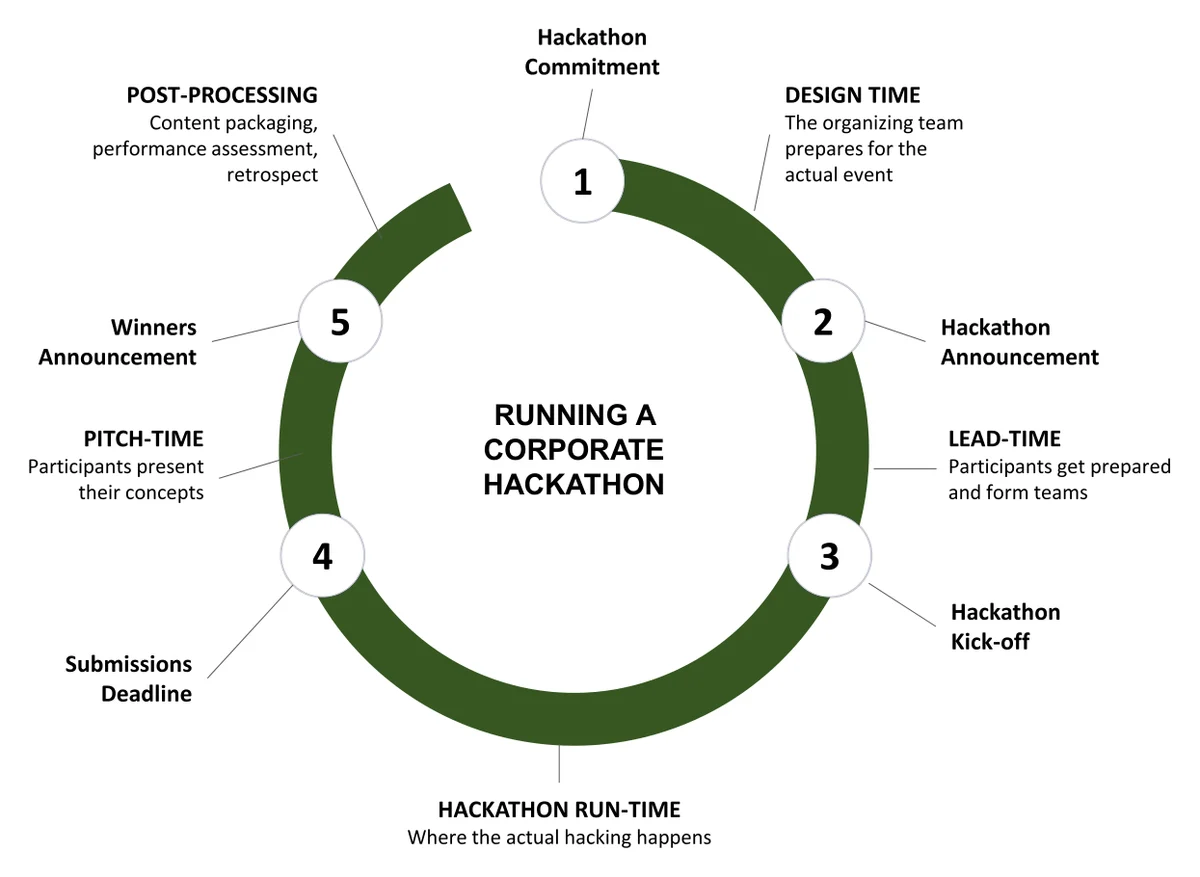
Every successful corporate hackathon moves through the same five phases, in order. Skipping or compressing any one of them is the most common cause of disappointing outcomes. What changes with AI is what happens inside each phase — captured in the notes alongside each section.
1. Design Time
From the decision to host to the announcement. Most events fail here — not at runtime. This is where the key decisions get made: theme, format, eligibility, deliverables, evaluation method, reward model, success criteria, and more. These must be carefully considered and set to define the right hackathon to serve the company's needs. The organising committee works with sponsors and corporate leaders to align them all before a single email goes out.
2. Lead Time
The period toward the hackathon kick-off is essential for all involved parties. Innovators get familiar with the hackathon's context and engage with high-level research, ideation, networking, and team formation. The organising committee ensures that all systems, content, space, and equipment are arranged as planned. A formal announcement — ideally from senior leadership at an all-hands or similarly visible event — frames the hackathon as a call to innovate, backed by a strong narrative linking it to the broader innovation efforts and the organisation's purpose. In parallel, the team runs educational activities to clarify the format, emphasise the multidisciplinary nature of teams, and ensure participants can join prepared.
“The announcement should come through as a ‘call to innovate,’ inviting people to switch contexts from daily activities to a mode of exploring novel solutions addressing a well-presented problem.”Innovation Mode, Author’s Edition (2026), p. 179
| Action | Objectives | Frequency and audience |
|---|---|---|
| Hackathon announcement | Objective: Raise awareness about the forthcoming hackathon. Share the theme, timelines, and basic rules | When and who: Once; company-wide |
| Join a team | Objective: Remind registered users who haven’t joined a team to explore the teams looking for talent | When and who: 3–5 times toward the kick-off date. Targeting registered members without a team |
| Find talent | Objective: Remind users with registered projects who haven’t formed a complete team to explore talent looking for projects | When and who: 3–5 times toward the kick-off date. Targeting registered projects with talent gaps |
| Hackathon countdown | Objective: Update participants with practical information and reminders for signing up | When and who: Daily, the last week before the event, company-wide |
| Raise awareness | Objective: Emphasize reasons to join and how the hackathon is inclusive | When and who: 3–5 times toward the kick-off date; non-registered, eligible |
| Hints and guidance | Objective: Provide practical advice, hints, and content that help participants perform better during the event | When and who: Daily, starting x days before the event; registered users |
| Kick-off announcement | Objective: Share highlights from the opening speech | When and who: Once; company-wide |
| Runtime updates | Objective: Share highlights from the venues and projects | When and who: Once or twice per day during the event; company-wide |
| Completion | Objective: Share highlights from the closing speech, including statistics on participation and project completion | When and who: Once; company-wide |
| Pitch plan announcement | Objective: Communicate the plan for assessing the shortlisted projects | When and who: Once. Targeting shortlisted teams, judges, and leadership |
| Winner announced | Objective: Celebrate the winning projects and teams | When and who: Once. Company-wide |
| Feedback invite | Objective: Capture feedback from participants and stakeholders as signals regarding the success and impact of the hackathon | When and who: Once. Company-wide |
| Retrospective | Objective: To reflect on the event, analyze feedback, and identify opportunities for improvement | When and who: Once. Targeting hackathon participants and stakeholders |
3. Runtime
The runtime is where the real work happens. Following the kick-off, teams start working on their ideas — framing, visualising, and implementing their concepts. The organising team remains available to handle requests and help teams achieve their goals. Advisors and mentors help innovators focus and accelerate. Leaders are present — demonstrating support by sharing their thoughts and providing direction. As the event progresses, efforts shift from development to presentation: teams compile their pitches, demos, and deliverables for formal submission.
4. Pitch Time
As soon as the runtime is over, another intense phase begins: the project evaluation toward the final rankings and selection of the winners. This process is orchestrated by the organising committee, and depending on the evaluation method selected, it may last from a couple of days to several weeks. At the end of the process, every idea is enriched with scores and feedback. The committee cross-validates the results, produces the final ranking, applies the reward scheme, and prepares the formal announcement — ideally delivered through an all-hands where winning teams present their ideas and their plans to take them forward.
5. Post-Hackathon
Hackathons produce rich content — ideas, prototypes, video presentations, and demos — that is valuable beyond the specific event. The organising team packages this content and makes it available through the proper channels: ideas and project summaries are hosted in the Innovation Portal, demos and prototypes are linked to their repositories, and videos are shared across the organisation. In parallel, the team runs a survey to capture perceived success, hosts a retrospective, and uses predefined success criteria and actual metrics to compile a narrative of the event's performance. Some of these metrics — particularly validated and commercialised opportunities — can only be obtained months after the event. See the full measurement framework.
“I see hackathons gradually evolving into in-market concept validation contests, with companies awarding high-potential concepts backed by smart market-testing strategies and real-world evidence of business potential.”Innovation Mode, Author’s Edition (2026), p. 189
The key decisions that define your hackathon's purpose and character
From a leadership standpoint, hackathons are expensive, serious business events that must be planned accordingly. Defining the hackathon with clarity is essential for setting the right expectations. During Design Time, the organising committee works with corporate leaders and sponsors to define the hackathon's purpose and character — making decisions on theme, format, eligibility, deliverables, evaluation method, and reward model that must be carefully considered before anything is announced.
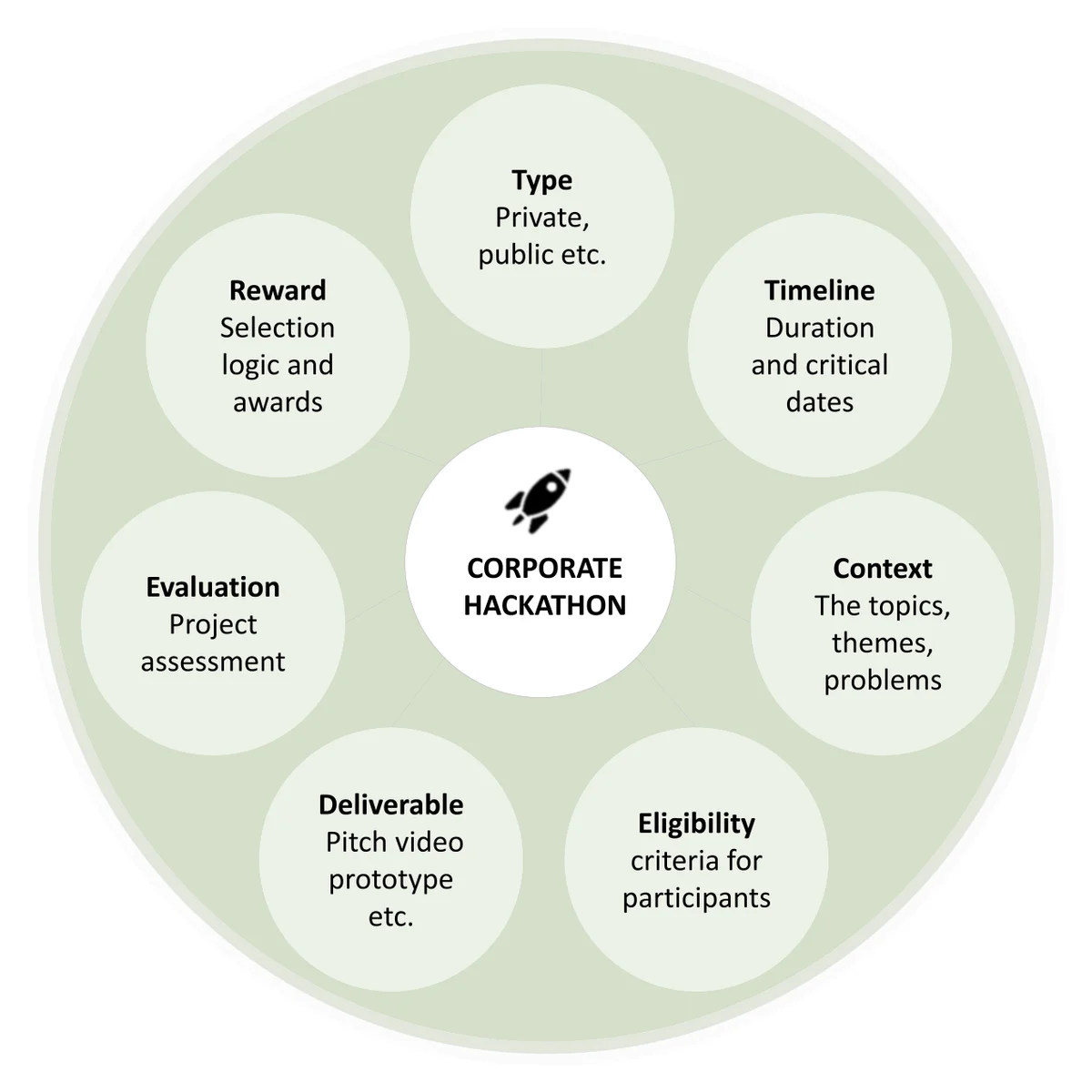
- Set the context. The hackathon theme is a critical element that requires careful definition and clear communication: it establishes the problem space where participants will innovate. The theme should be shaped in collaboration with the leadership and the event's sponsors. The clarity and specificity of the theme directly impact the quality and relevance of participant solutions. A common mistake is framing hackathons around a technology rather than a business problem — "Generative AI" is not a theme; "reducing customer onboarding time by 60%" is.→ AI helps here: it can generate high-quality context material, briefing documents, and research packs that help participants understand the problem space before the event begins.
- Name and brand the hackathon. Effective branding is a key success factor. A smart, memorable name that reflects the event's essence and ambition attracts attention and inspires participation. A non-technical executive summary of the objectives — clearly stating the central theme and focus areas — raises interest across the organisation. Consistent branding reinforces the company's innovation culture and boosts the event's identity.
- Decide if public or private. A fundamental decision that leads to very different types of hackathons. Private hackathons happen within the company and are far simpler to organise — the typical objective is to generate solutions to defined problems while strengthening innovation culture. Public hackathons welcome external participants, help boost the organisation's innovation profile, and attract talent — but come with increased complexity around platforms, communication, IP, and confidentiality. A hybrid approach invites members from the ecosystem — partners, academia, or companies within the same group.
- Set the timeline. Carefully setting the duration and key dates is critical for success — these factors directly impact participation rates and overall costs. Hackathons typically last at least one day but sometimes extend to a week. Organisers must select dates that avoid conflicts with major product releases or large-scale corporate events, and allow sufficient lead time (at least two weeks, four to six for a company-wide event) for preparation, communication, and team formation.→ In the AI era, shorter runtimes produce stronger submissions because prototyping is no longer the bottleneck.
- Set the eligibility. Establishing clear eligibility rules — defining who can participate and how — is essential. A private hackathon might target a specific team, group, or division, or welcome participation across the organisation including contractors and partners. Non-full-time employees typically require a different registration process or additional agreements addressing intellectual property concerns upfront. These requirements must be explicitly stated and effectively communicated.→ In the AI era, non-technical participants are not a concession to inclusivity — they bring commercial thinking, product sense, and leadership skills that increasingly determine the quality of hackathon outcomes.
- Set the place. The hackathon's physical and virtual environment influences the participant experience and collaboration. For in-person events, open layouts encourage interaction while separate meeting rooms allow teams to focus. The physical space must be equipped with essential tools — whiteboards, digital screens, projectors, and free-form collaboration areas. For virtual events, real-time collaboration tools are essential.
- Set the minimum required deliverable. The minimum required deliverable defines what a team must submit for a valid entry — from a concept pitch video to a functional demo or working software. This decision is critical because it determines how inclusive the hackathon will be across organisational disciplines. A requirement for functional code naturally orients the event toward engineering teams, potentially discouraging non-technical innovators and leading to missed opportunities.→ In the AI era, functional prototyping stands more as a way to communicate complex projects and less as a demonstration of execution ability. The deliverable is shifting toward a justified opportunity backed by a working demo — not the inverse.
- Define success. To avoid subjective takes, success must be described upfront, in accordance with the business objective of the hackathon, following a data-driven approach: the desired outcome must be defined as numeric targets attached to specific metrics — participation rates, project quality scores, percentage of opportunities identified, team diversity metrics. Such a measurement framework creates accountability and enables meaningful comparison across events, transforming subjective impressions into actionable insights.→ In the AI era, measurement frameworks designed for code-heavy outputs need recalibration — the metrics that matter now track opportunity quality, not technical complexity.
- Define the reward package. In a truly innovative organisation, people do not need special incentives to join innovation activities. However, a properly designed reward scheme drives significant impact: it offers a token of appreciation while sending a strong message about the importance of innovation. The recommendation is to emphasise nonmonetary rewards — linking hackathon achievements with career ambitions and innovation outcomes — through recognition, development resources, stage time, special titles, and organisation-wide acknowledgement. Cash awards can drive participation in public hackathons but should be carefully framed in internal events to avoid appearing transactional.
- Define the project evaluation process. The evaluation method must be objective, consistent, and transparent. Objectivity requires ideas to be assessed against predefined criteria by experts who are not influenced by "political" dimensions of the submission. Consistency means the assessment protocol is used across hackathons without exceptions, allowing comparison of ideas across events. Transparency means participants understand the criteria, the weight factors, and the business reasoning for selecting winners. Four models exist — open voting, closed voting, live demos and pitching, and a hybrid two-stage approach — each with different tradeoffs around scale, objectivity, and bias.→ In the AI era, hybrid and closed models now scale to events with thousands of submissions, making them the default for serious programmes.
“The core rules of the hackathon, along with its branding and communication package, must emphasize the openness of the event and dismiss any preconceptions about technical prerequisites.”Innovation Mode, Author’s Edition (2026), p. 177
The operational detail for each decision is in How to Plan and Run a Corporate Hackathon.
Selecting the hackathon project evaluation method
The evaluation method must be objective, consistent, and transparent. Objectivity requires ideas to be assessed against predefined criteria by experts who are not influenced by the team or other dimensions of the submission. Consistency means the assessment protocol is used across hackathons with no exceptions, allowing comparison of ideas across events. Transparency means participants understand the criteria, the weight factors, and the business reasoning for selecting winners. Below are four models — starting from the simplest and moving to more sophisticated approaches — along with how each is affected by AI.
- 1. Open voting
- All employees browse hackathon projects, vote, and comment. The organising committee aggregates the results to identify the winners. Although frequently used, it is rarely a good option: it usually reflects the team's social influence instead of their project's potential.
- 2. Closed voting
- A robust evaluation process where a predefined group of experts reviews submissions independently using the standard idea-assessment model. Each expert scores every project; scores are averaged to produce the final ranking. Ideally done through the Innovation Portal, ensuring outputs are stored and discoverable.
- 3. Live demos & pitching
- Teams present to a panel of judges who have studied the shortlisted projects. Each team pitches, demonstrates, and answers questions. Judges use the idea-assessment model to score each project. The main advantage is live interaction — teams can explain their proposals and receive quality feedback.
- 4. Hybrid two-stage · recommended
- Combines the best of closed voting and live demos. Stage one: a large group of experts assesses every project independently through closed voting, producing a shortlist. Stage two: finalists pitch to a panel of judges who have already studied all entries. Judges have the big picture and are prepared to ask the right questions.
Rewarding top innovators
The reward scheme defines how many winners will be announced and what they will get in return. A properly designed reward scheme offers a token of appreciation to the winners while sending a strong message about the importance of innovation for the company. The recommendation is to emphasise nonmonetary rewards and focus on linking hackathon achievements with career ambitions, innovation outcomes, and the company's success. The following seven classes of rewards can be combined into a scheme that fits the organisation's culture.
- 1. Badges and trophies
- Winners receive prizes and special objects — such as cubes with the winner's name and the occasion — as symbols of recognition and acknowledgement of exceptional performance. Simple to produce, lasting in effect.
- 2. Development resources
- A package of resources supporting further exploration or early implementation of the idea — time, talent, equipment, funding, and tools. For a genuine hackathon team, securing the resources to build their project is the most meaningful and inspiring reward of all: the winning team gets what it needs to compile a business proposition and present it to senior stakeholders for further consideration.
- 3. The stage
- Hackathon winners get a presentation slot to pitch their project in a highly visible corporate event or to present a functional version of their idea directly to senior corporate leaders. Visibility that no other internal mechanism provides.
- 4. Organisation-wide acknowledgement
- Winning a hackathon should be seen as a remarkable achievement worth communicating across the organisation. Winners are featured in the Innovation Portal and the newsletter, referenced in daily interactions, and credited through formal attribution when hackathon work moves into subsequent phases — for instance, a product success story communicated as "originated from hackathon project X."
- 5. Special corporate titles
- Specific innovation titles — such as "Distinguished Innovator" or "Inventor of the Year" — help innovators build a reputation and celebrate their hackathon achievements while inspiring others to join the innovation efforts.
- 6. Technology
- Winners receive a technology package as a reward — devices or related products relevant to the hackathon's theme. A tangible, immediate prize that complements the longer-term recognition elements.
- 7. Cash awards
- Cash rewards can drive higher participation rates, especially in public hackathons where volume is a key success factor. However, if used in an internal hackathon, monetary rewards should be appropriately framed and communicated to motivate innovators without appearing transactional. Cash should be combined with other rewards that have a long-lasting cultural effect.
“A well-designed reward scheme provides an excellent opportunity to celebrate top-performing innovators and reinforce key innovation messages. It impacts not only the particular event but also future participation rates, the culture of innovation, and the performance of the broader innovation program.”Innovation Mode, Author’s Edition (2026), p. 177
Quantifying hackathon performance
The metrics below can be used to define specific KPIs and conversion rates, leading to a standardised measurement framework for hackathon events. When this is in place, the team can build baselines, monitor the evolution of these KPIs, and understand how they correlate with the overall innovation culture. Some of these metrics — particularly validated and commercialised opportunities — can only be obtained months after the hackathon's completion. Nevertheless, whenever this happens, it is essential to link back to the source hackathon and reflect it in the performance record. This measurement framework is a special case of the broader opportunity creation funnel described in Innovation Mode.
- 1EngagementLive
- 2Valid submissions+1 day
- 3Opportunities flagged+1 week
- 4Actionable+1–2 months
- 5Validated+3–6 months
- 6Commercialised+6–18 months
The full measurement framework sets out target benchmarks, conversion ranges, warning signs, and a worked example.
What goes wrong — and why it matters more now
The classic hackathon failure modes — weak post-processing, subjective evaluation, poor follow-through — still happen. But the AI era introduces new risks that are subtler and harder to detect. None of them are about execution on the day. All of them are about decisions made during Design Time that quietly shape the outcome before the event begins.
1. Framing AI as the theme rather than the medium
AI is now the substrate for every hackathon — it is how teams conceive, prototype, and validate. Treating it as the theme confuses the medium with the subject. The theme should name a real business problem; AI is how participants attack it. Events framed around AI for its own sake produce technology-led submissions with weak commercial reasoning and limited downstream value.
2. Letting prototype polish dominate the evaluation
When AI compresses prototyping to hours, visual polish is no longer evidence of effort or capability — it is the default output. Judges who still over-weight the quality of the demo are scoring against criteria from the engineering era. The risk is that teams who did rigorous validation and built a strong commercial proposition lose to teams that produced a more impressive demo with thinner thinking behind it.
3. The engineering-only perception
Traditionally, it is software engineering teams who organise hackathons. As a result, it is common for people to perceive hackathons as engineering contests — a perception that acts as a barrier to entry for non-coding employees. Non-technical innovators may feel discouraged from joining or appear less confident that they can bring value. This misconception makes the event less inclusive — and in the AI era, where commercial thinking and domain expertise increasingly determine outcome quality, it is also a performance problem.
4. Measurement frameworks designed for code-heavy outputs
When the hackathon was an engineering contest, measuring technical complexity and prototype quality made sense. In the AI era, the outputs that carry value are different — validated opportunities, business case strength, evidence of market demand, downstream pipeline integration. Organisations still measuring with engineering-era metrics see numbers that have no relationship to the outcomes they actually want from the event.
5. AI-generated artefacts masking shallow thinking
A team can now produce a professional presentation, a working prototype, and a polished pitch video without doing the hard work of problem framing, customer validation, or business modelling. Without an evaluation rubric that probes for evidence and originality of thought — and judges prepared to ask tough questions — AI-generated polish becomes a hiding place. The evaluation process must be designed to distinguish between impressive presentation and genuine commercial insight.
6. The performance trap: "we hosted a hackathon"
The event becomes a leadership communication exercise — proof that the company is investing in innovation. The framing is internal-facing; the outputs are shaped for announcements rather than follow-through; the post-event work never happens. When the hackathon's primary purpose is signalling rather than producing opportunities, the organisation's strongest innovators recognise it — and subsequent events see lower participation and weaker submissions.
From standalone hackathons to connected innovation experiences
The direction of travel is visible, and the implications are significant.
Prototyping will continue to compress. The distance between describing an idea and seeing it running will shrink to minutes. The technical bar for participation will keep falling; the bar for commercial thinking will keep rising. Cross-functional teams led by domain experts will outperform engineering-led teams by wider margins. The hackathon's most critical skillset is shifting toward obtaining the bigger picture, sensing products, understanding macro trends, and shaping innovative business models and go-to-market strategies. Functional prototyping will stand more as a way to communicate complex projects and less as a demonstration of execution ability.
Evaluation will increasingly involve AI-assisted scoring at scale, freeing human judges for the work they are best at — probing business cases, examining evidence, and assessing whether teams genuinely understand their problem. Closed and hybrid evaluation models, once limited by judge bandwidth, will become tractable for events with thousands of submissions.
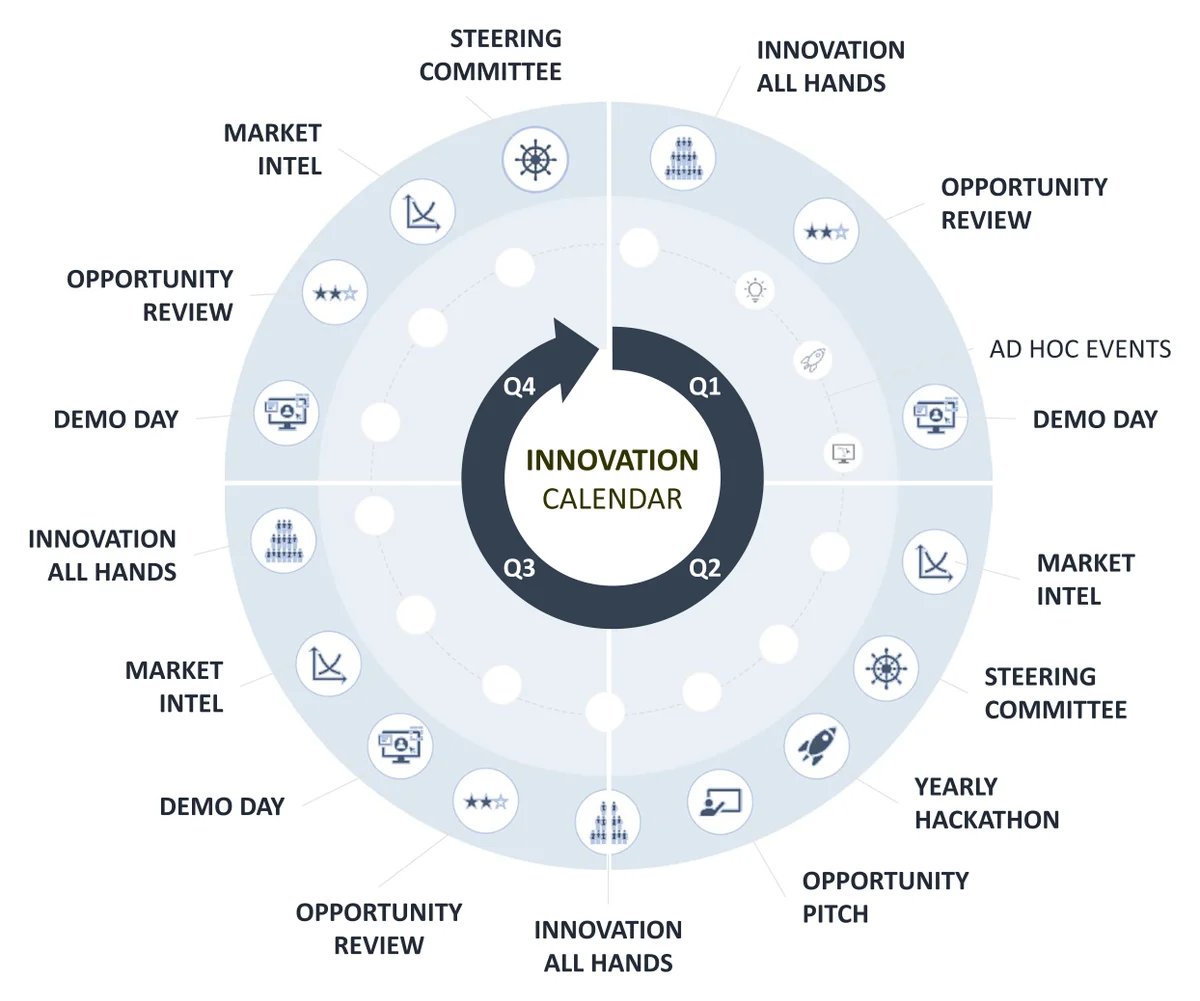
Most importantly, hackathons will become integrated into the broader innovation programme. In a connected model, hackathons output their content directly to the Innovation Graph, contributing to the organisation's supply of ideas and opportunities. Ideas, projects, and artefacts remain discoverable and usable beyond the hackathon, regardless of their ranking. Hackathons evolve as connected innovation experiences that feed opportunities to the corporate innovation knowledge base. Quarterly or monthly micro-hackathons become operational, not exceptional. The annual flagship hackathon remains — but as a cultural anchor, not as the only mechanism for surfacing opportunities.
“AI is opening up development to all while compressing development cycles dramatically.”Innovation Mode, Author’s Edition (2026), p. 188
Organisations that adapt their hackathon design to this trajectory will compound advantage. Those that continue to run engineering-era contests will produce energetic events with disappointing outcomes — until eventually the events stop being scheduled, because no one defends the budget for them.
Adopt the new hackathon format
Every organisation's innovation context is different — the strategy, the talent pool, the maturity of the innovation function, the appetite for change. If you are planning a hackathon or building hackathons into a broader innovation programme, our advisory services can help you adapt these frameworks to your specific situation, avoid the common failure modes, and make the most of every event as a source of validated, high-potential opportunities.
Corporate Hackathon Programmes design one event with you or build a programme across many, and Corporate Innovation Advisory builds the innovation function around them; request a proposal.
Running a hackathon that produces real opportunities requires more than methodology. The Hackathon Masterclass, coming soon, turns the frameworks on this page into practice: a 90-minute video on designing, running and following through on a corporate hackathon, with the templates to run your own: the brief, the decks, the judging system and the full set of messages. It covers the full lifecycle, from Design Time to post-event measurement, so your team spends its time on the decisions that matter rather than building infrastructure from templates and spreadsheets. Subscribers get first access and a launch discount.
Key questions about corporate hackathons
How are hackathons changing in the AI era?
Can AI replace corporate hackathons?
Do I need to know how to code to participate in a hackathon?
When should my company NOT run a hackathon?
How should I judge hackathon projects?
How can I measure hackathon success?
What makes a corporate hackathon fail?
Do corporate hackathons actually produce real innovation outcomes?
What is a corporate hackathon?
When and why should a company host a corporate hackathon?
Should my hackathon be private or public?
How do I organise a successful corporate hackathon?
How long should my hackathon last?
How often should my company run hackathons?
What are the best hackathon themes for companies?
How much does it cost to run a hackathon?
What does a hackathon judge look for?
What should I reward hackathon winners with?
Should my hackathon teams be cross-functional?
What tools do I need to run a hackathon?
What is the difference between a hackathon and a design sprint?
What is the difference between a hackathon and an innovation challenge?
Further reading
Designing and running a hackathon that produces real opportunities requires operational depth beyond what a strategic reference can cover. The following resources address specific aspects of hackathon implementation — from the detailed planning template to the measurement framework, theme selection, and the Hackathon Masterclass.
- How to Plan and Run a Corporate Hackathon: the five phases in operation: seven steps, six design decisions, eight weighted judging criteria, the common mistakes and four worked examples.
- Measuring Hackathon Success: the full conversion funnel, target benchmarks, the 4-moment cadence, and a hypothetical six-month worked example.
- 50+ Hackathon Ideas: a theme inventory organised by innovation type (process, product, and business model) with AI-era framings.
- The Hackathon Masterclass: a 90-minute video masterclass with every template to run your own: brief, decks, scoring workbook, judge pack and communications library. Coming soon.
- Corporate Hackathon Programmes: one event designed with an advisor, or a programme across many.
- The hackathon hub: everything on corporate hackathons, for organisers, participants and the executives who fund them.
Cite this guide
Krasadakis, G. (2026, October 21). Organising winning corporate hackathons in the AI era. Innovation Mode. https://theinnovationmode.com/corporate-hackathon-guide
@online{krasadakis2026hackathons,
  author = {George Krasadakis},
  title = {Organising winning corporate hackathons in the AI era},
  year = {2026},
  date = {2026-10-21},
  organization = {Innovation Mode},
  url = {https://theinnovationmode.com/corporate-hackathon-guide}
}