Innovation Toolkit 4.0 · Now with a worked case

Innovation,
by the book.

Eight editable templates that take a problem worth solving to a product worth testing. And one worked case carried through every one of them, from the sponsor’s brief to the go/no-go decision, so your team learns from filled-in documents, not blank ones. Built on the frameworks of Innovation Mode (Innovation Mode Publishing, 2026).

8Innovation templates
1Problem statement
6Idea examples
3Experiment examples

One-time payment · Instant download · Perpetual licence for your organisation. Free for students and educators, agency licence available.
Sample Product Framing, first page
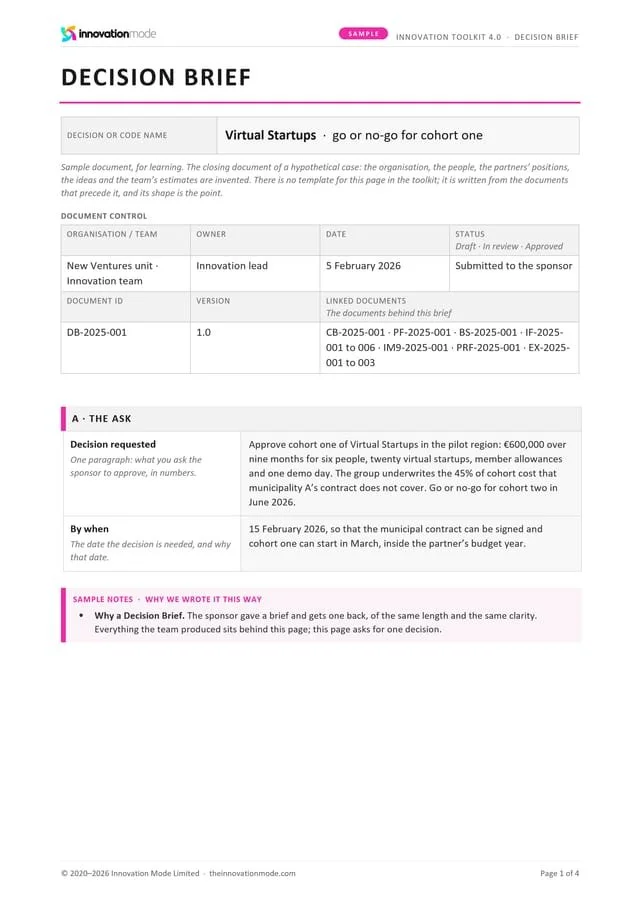
Sample Decision Brief, first page
Sample Idea Framing, first page
Sample Experiment Design, first page
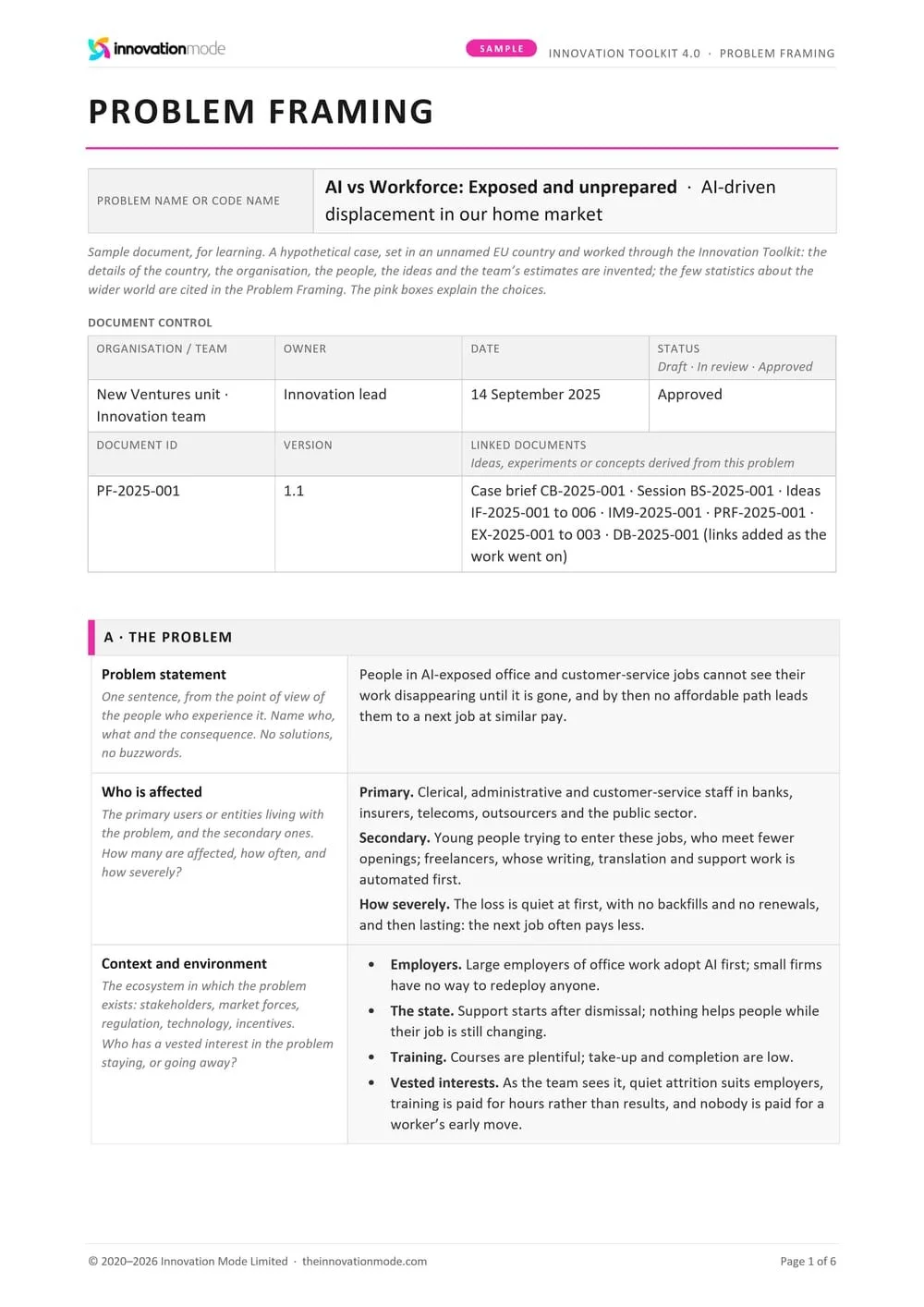
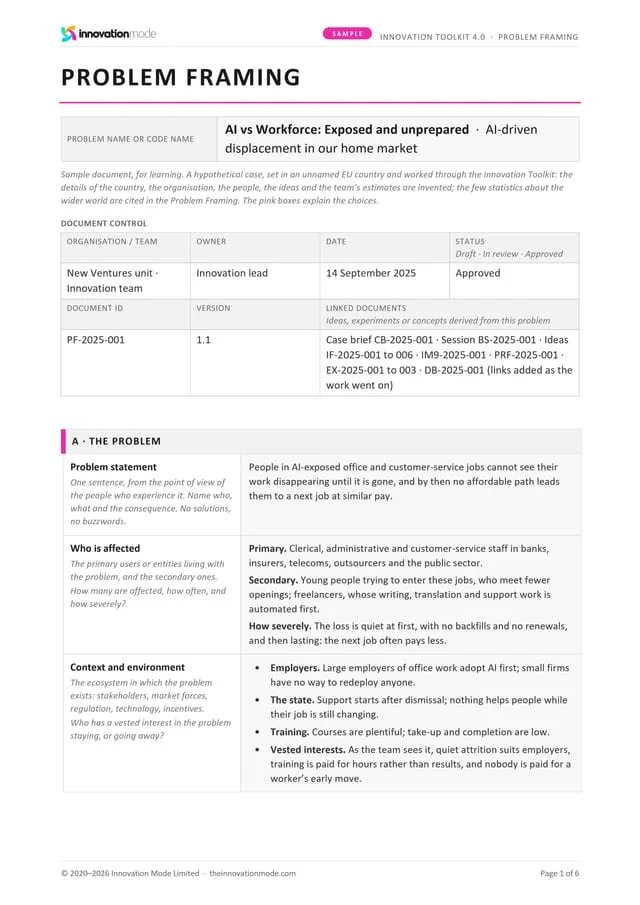
Sample Problem Framing, first page, with the SAMPLE badge: AI vs Workforce, Exposed and unprepared
4.0 New edition
  • 8 in-depth templates
  • 20 AI prompts
  • AI-ready Markdown files
  • End-to-end realistic example
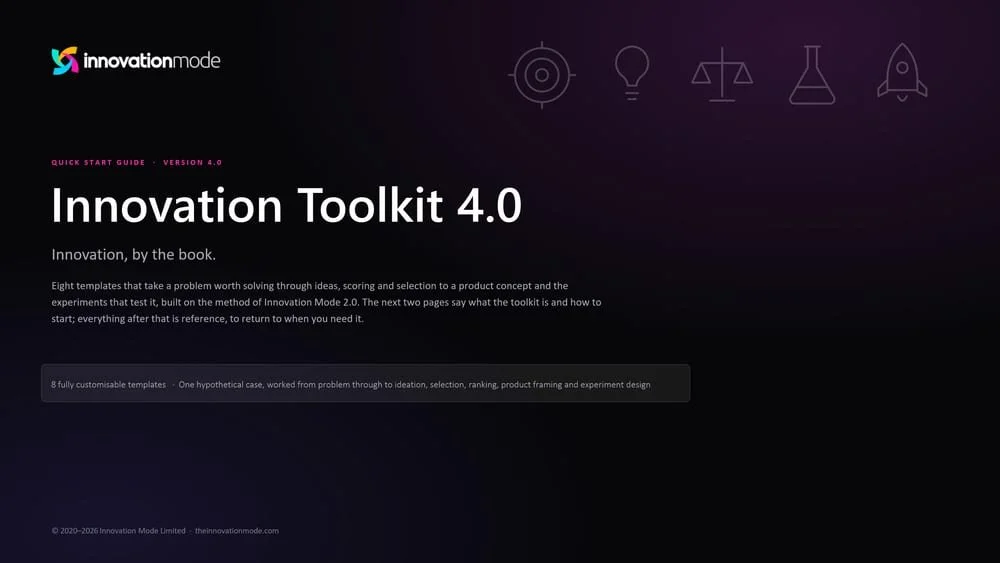
  • Quick Start Guide
The system at work

One system of templates, proven on a real-world problem.

The eight templates work as one system. Each is designed to provoke deep thinking at its stage, and together they give innovators a 360-degree view of their idea: the problem behind it, the people it serves, the value it creates, the risks it carries and the evidence it still needs. The toolkit demonstrates the system end to end on a real-world problem, the displacement of office and customer-service work by AI, from the sponsor’s brief to a go/no-go decision, with every template filled in and the reasoning explained.
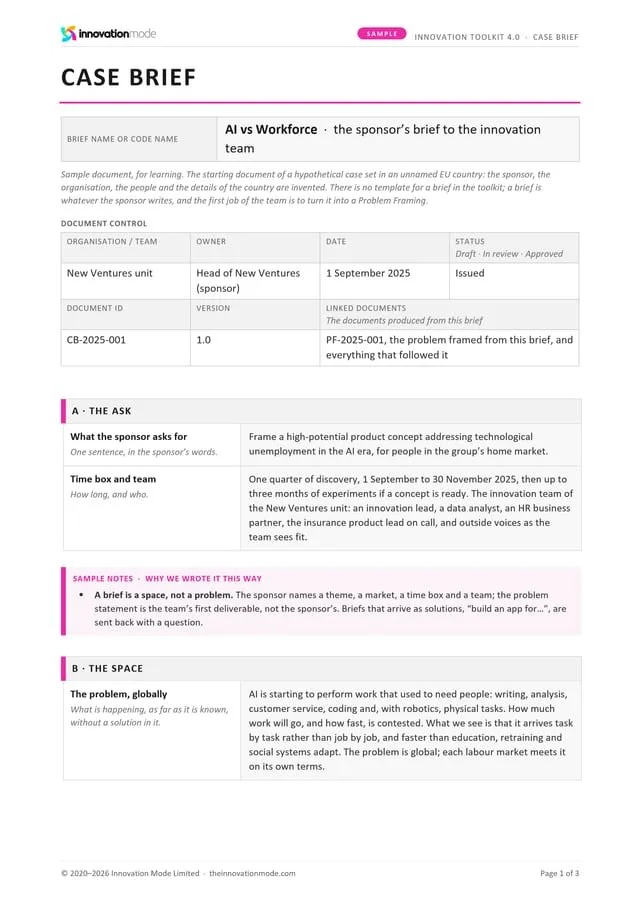
Sample Case Brief, first page
Sample Problem Framing, first page
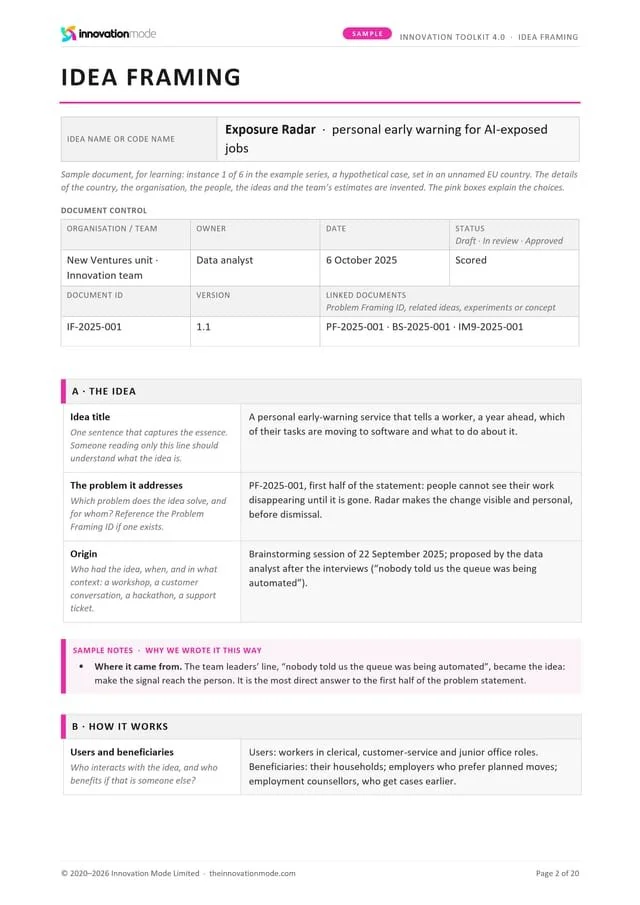
Sample Idea Framing, the first of six: Exposure Radar
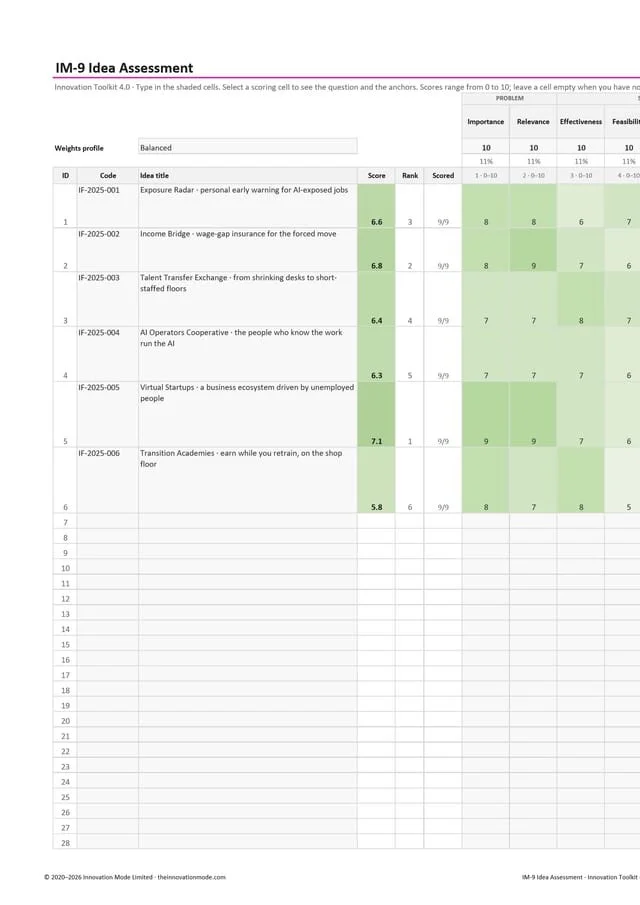
Sample IM-9 workbook, the Ideas sheet with six scored ideas
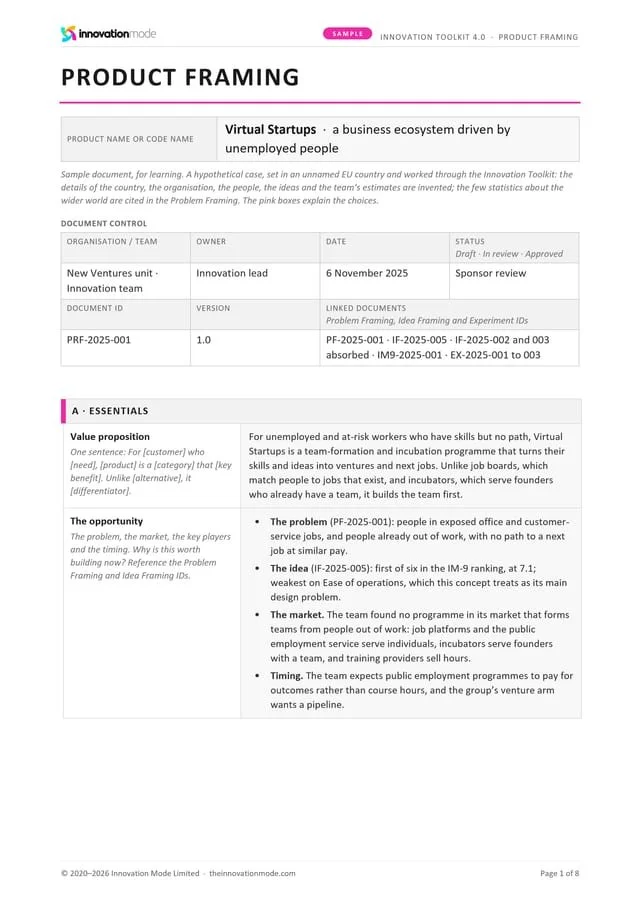
Sample Product Framing, first page
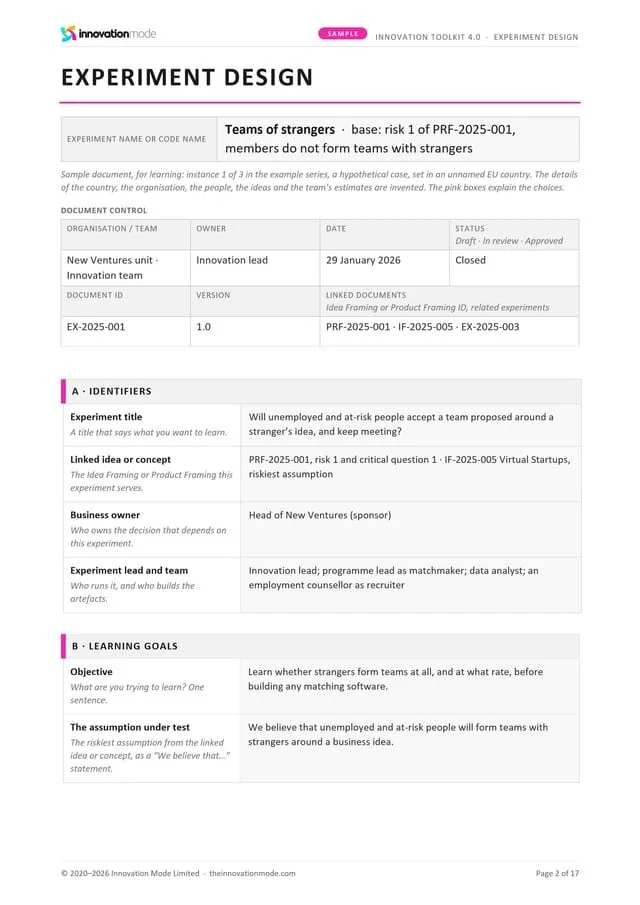
Sample Experiment Design, the first of three: Teams of strangers
Sample Decision Brief, first page
Cover of the Quick Start Guide
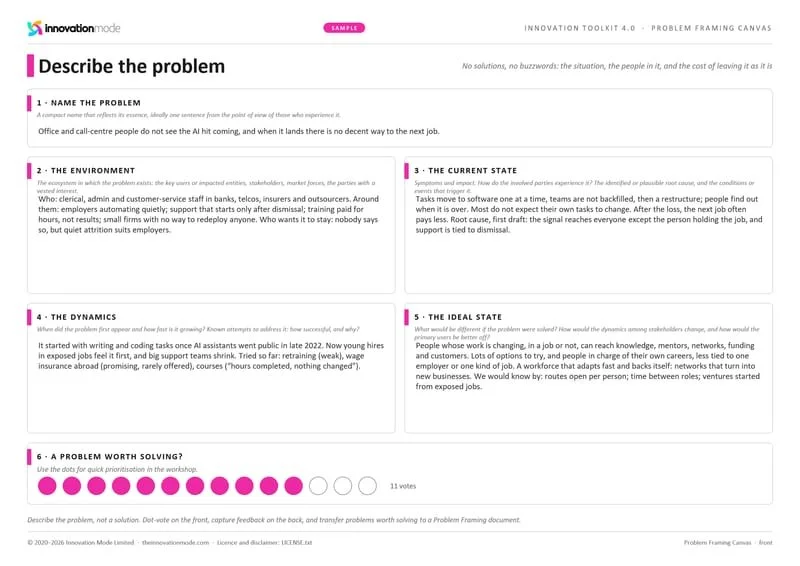
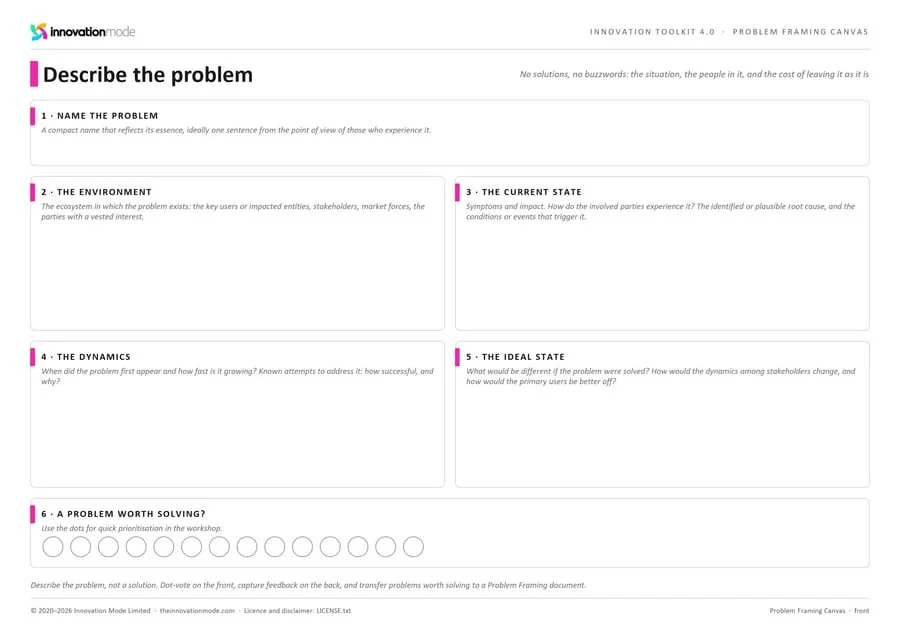
Sample Problem Framing Canvas, filled in
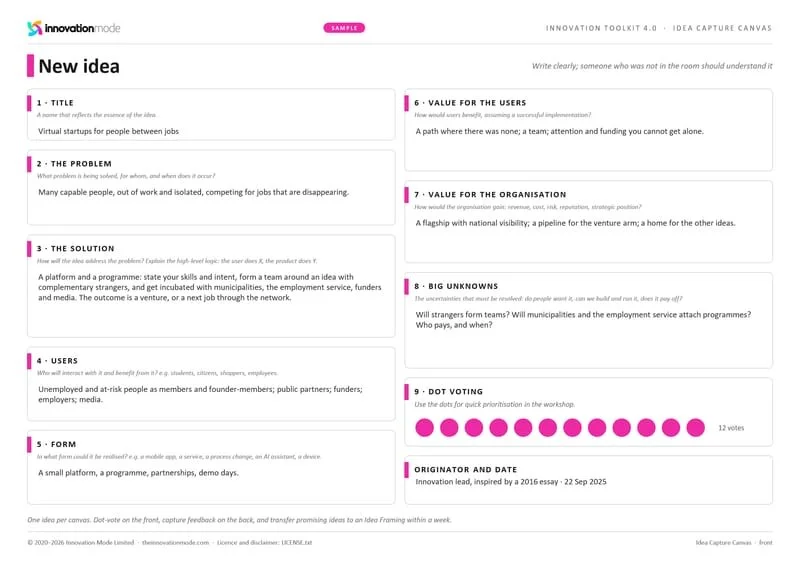
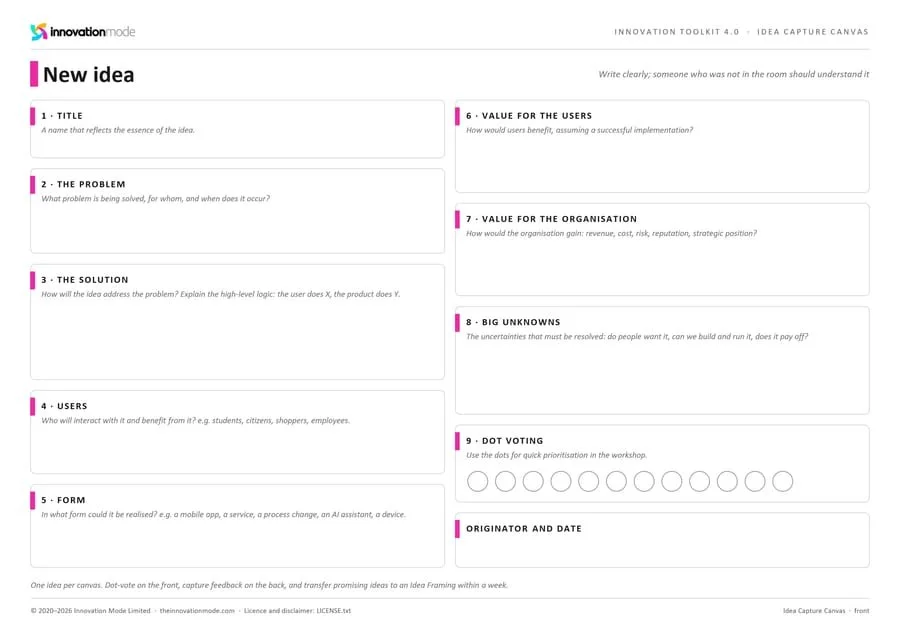
Sample Idea Capture Canvas, filled in, with dot votes
The worked case, step by step

How an open-ended brief becomes an evidence-backed decision.

  1. 00 · BriefThe sponsor asksA global problem, a concern for one market, one quarter, a small team.
  2. 01 · ProblemThe team frames itWho is affected, how severely, what doing nothing costs, with the sources.
  3. 02 · IdeasSix ideas take shapeFrom an insurance product to a workplace academy, each framed in full.
  4. 03 · ScoreIM-9 picks a winnerSix ideas on nine criteria. Virtual Startups comes first at 7.1.
  5. 04 · ProductThe winner becomes a productCustomers, value, business model, and the risks, named and numbered.
  6. 05 · ExperimentsThree tests of the riskiest risksEach with a metric, a target and a decision rule agreed before the data arrives.
  7. 09 · DecisionOne page back to the sponsorWhat we did, what we found, what we ask for: go or no-go.

Hypothetical, set in an unnamed EU country. The problem is real and the few statistics about the wider world come from cited public sources; the country’s details, the sponsor, the organisation, the people, the ideas and the scores are invented for learning, and the documents say so. Nothing in the series is a recommendation, a forecast or business advice.

The eight templates

From a problem worth solving to a product worth testing.

Eight templates cover the journey from problem to tested product, and each one also works on its own. Five Word documents structure the thinking at every stage. The IM-9 workbook in Excel, with its guide, turns a long list of ideas into a ranked shortlist you can defend. Two printable canvases are made for deep-focus, in-person brainstorming: paper on the table, no screens, and ideas that leave the room ready to score.
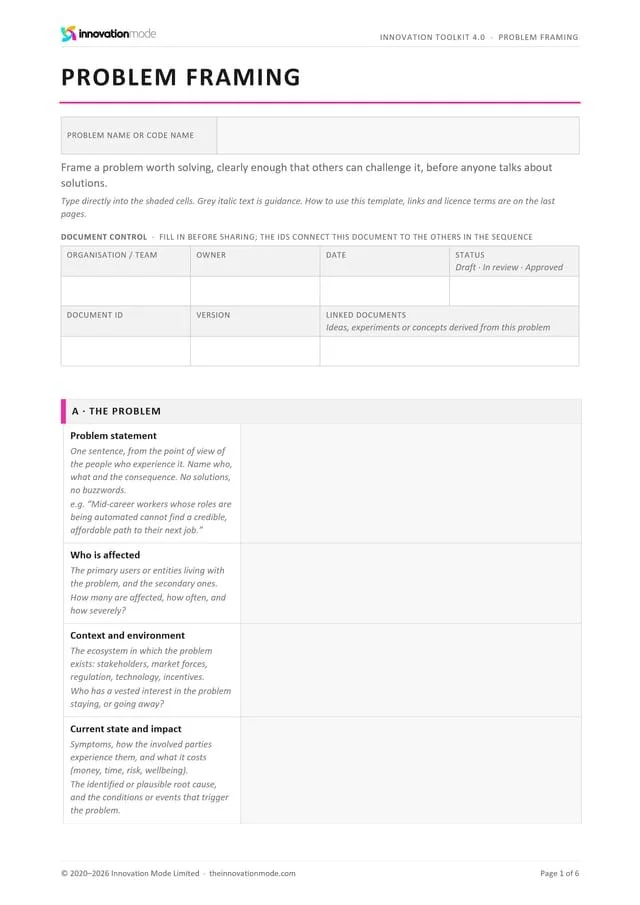
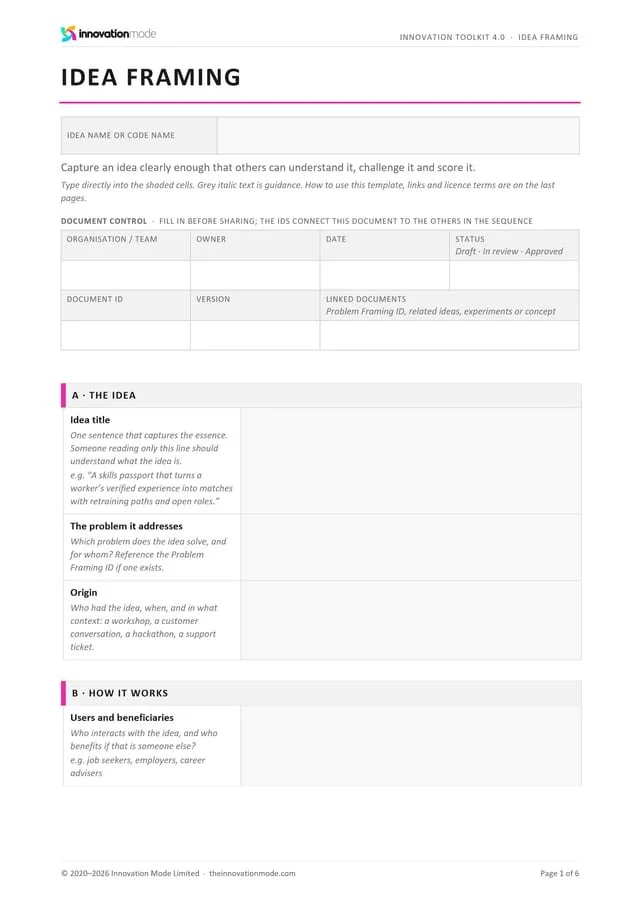
Problem Framing template, first page
Idea Framing template, first page
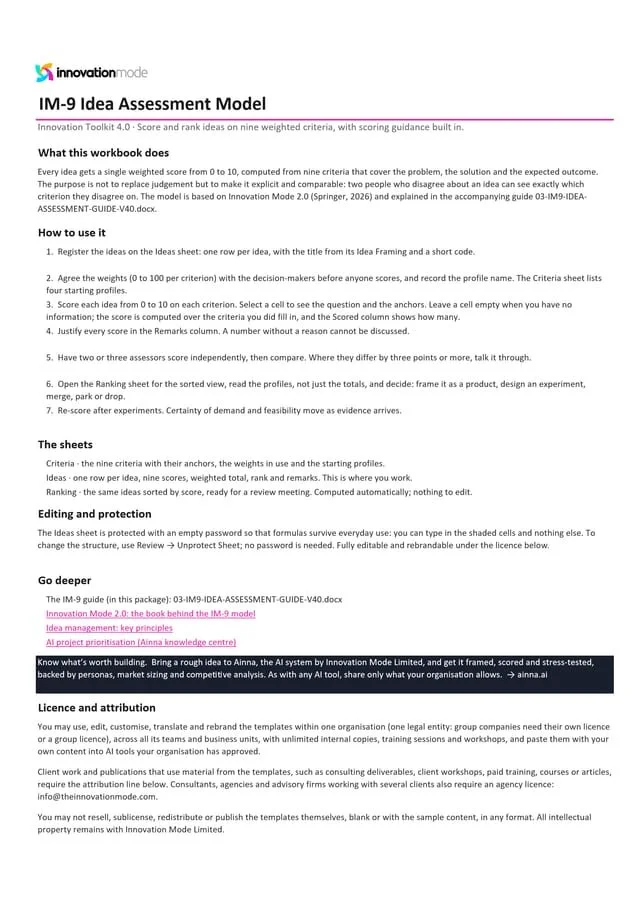
IM-9 Idea Assessment workbook, the Read me sheet
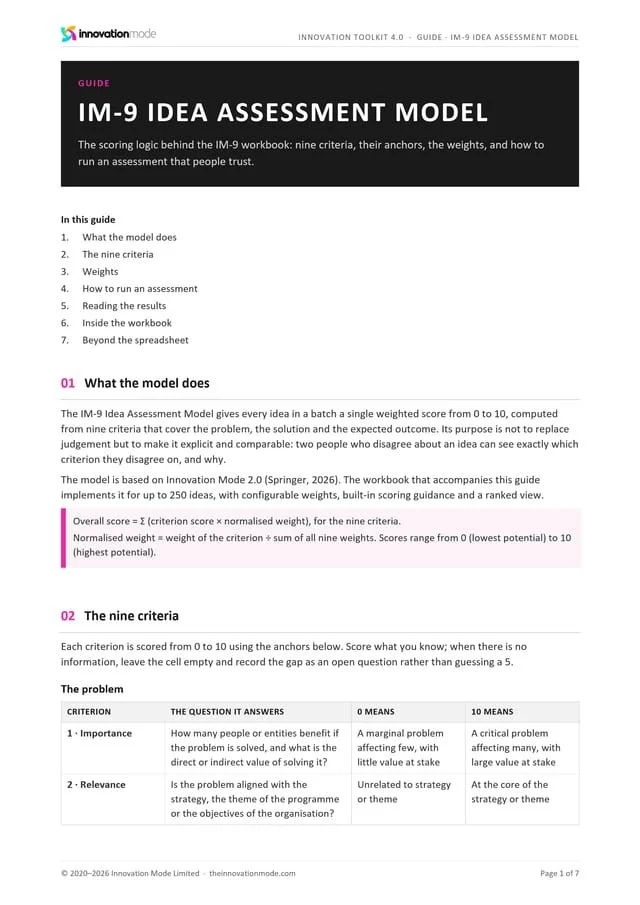
IM-9 Idea Assessment Model guide, first page
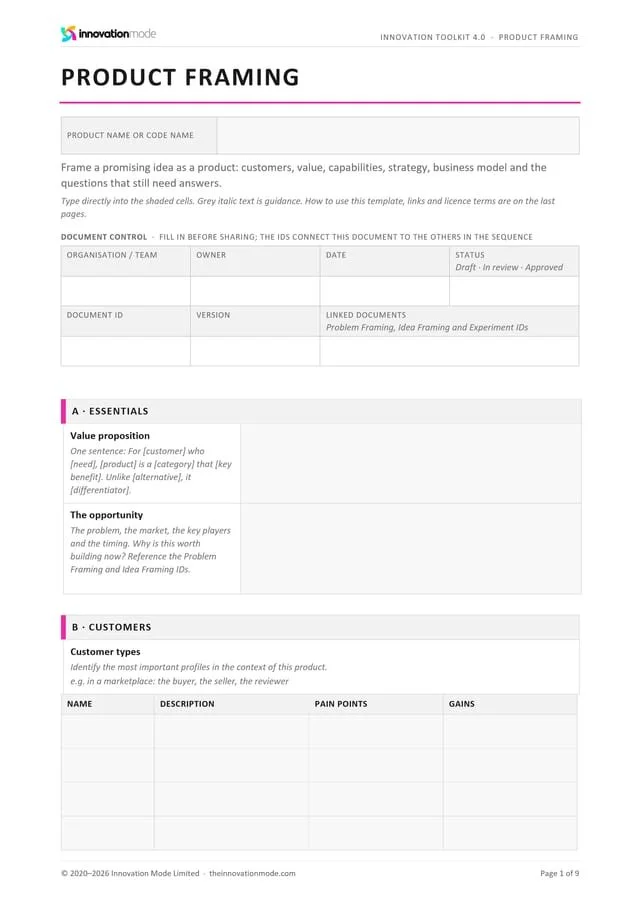
Product Framing template, first page
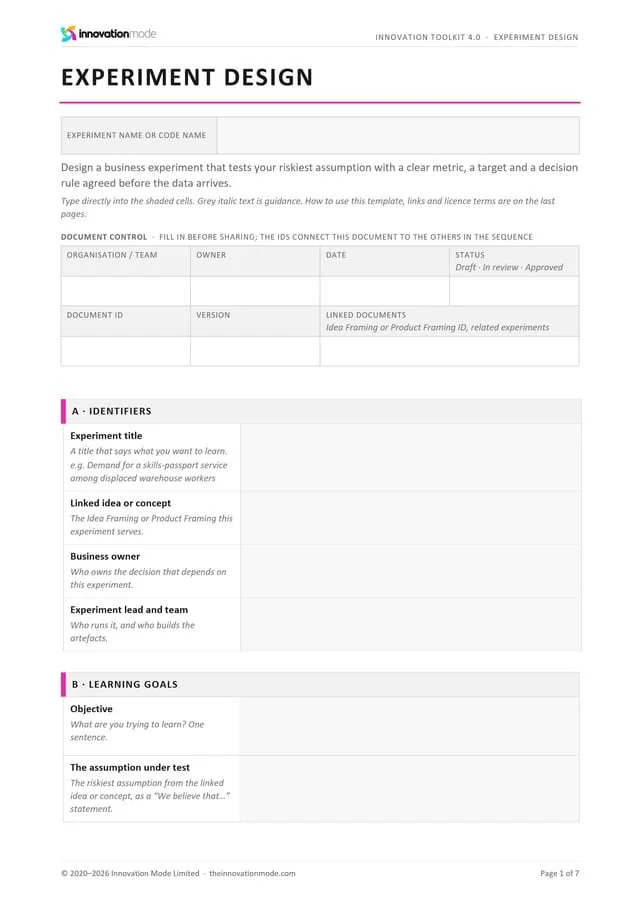
Experiment Design template, first page
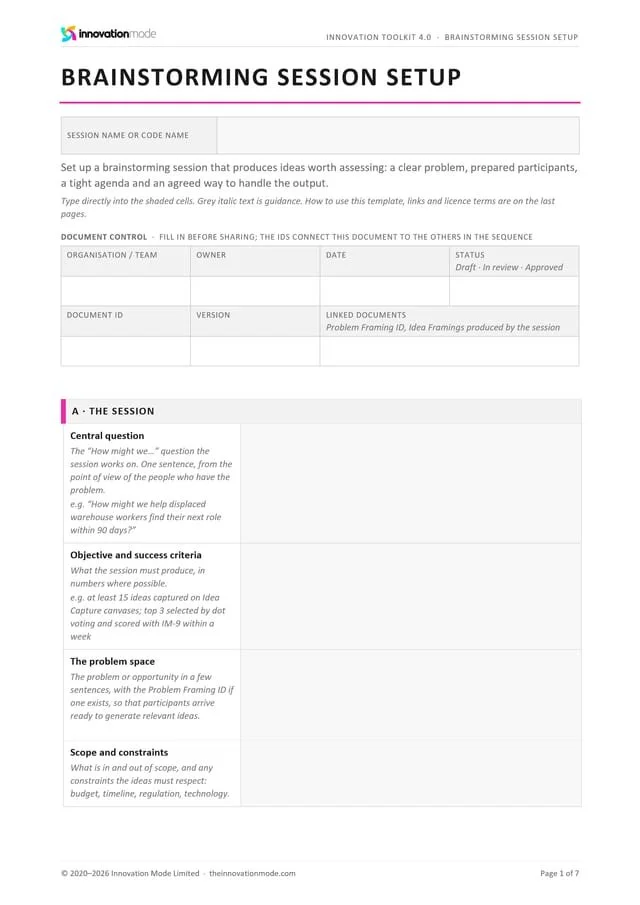
Brainstorming Session Setup template, first page
Problem Framing Canvas, printable A4
Idea Capture Canvas, printable A4
01Frame the problemProblem FramingFrame a problem worth solving, clearly enough that others can challenge it: who is affected, the context, the cost of doing nothing, the constraints.MS WordGuide & examples
02Capture ideasIdea FramingCapture an idea clearly enough that others can understand it, challenge it and score it: the problem it addresses, how it works, who benefits, what is unknown.MS WordGuide & examples
03Score and prioritiseIM-9 Idea AssessmentOne weighted score per idea: built-in scoring guidance, four starting weight profiles and a ranked view, with a guide on the anchors and how to run an assessment people trust.MS Excel + MS Word guideThe methodology
04Define the productProduct FramingFrame a promising idea as a product: customers, value, capabilities, strategy, business model, and the named risks and open questions that still need answers.MS WordGuide & examples
05Validate assumptionsExperiment DesignDesign a business experiment that tests your riskiest assumption with a clear metric, a target and a decision rule agreed before the data arrives.MS WordGuide & examples
06Run the sessionBrainstorming Session SetupA central "How might we" question, prepared participants, a tight agenda and an agreed way to handle the output.MS WordWorkshop guide
07Run the sessionProblem Framing CanvasA printable A4 canvas: the problem, the environment, the current state, the dynamics, the ideal state, and the closing question: is this a problem worth solving?MS PowerPoint · A4Workshop guide
08Run the sessionIdea Capture CanvasOne canvas per idea: problem, solution, users, form, value, big unknowns, dot voting, and a back page for the feedback captured on the spot.MS PowerPoint · A4Workshop guide

Fully editable Word, Excel and PowerPoint files, with nothing locked behind a password, made for Microsoft 365 and Office 2016 or later; they also open in Google Workspace, with some limits. Rebrand, restyle, restructure or translate them as you need; every style is named, and the README shows how to protect the structure for colleagues.

Quick Start Guide · AI companion

Up to speed fast, in control of the whole process.

The Quick Start Guide gets your team up to speed and helps you orchestrate the process: which template to use when, how the pieces fit together, and how to take a first problem through the full sequence. The AI companion works alongside you, with prompts that make an assistant interview you, challenge your thinking and suggest alternatives, never inventing your answers.
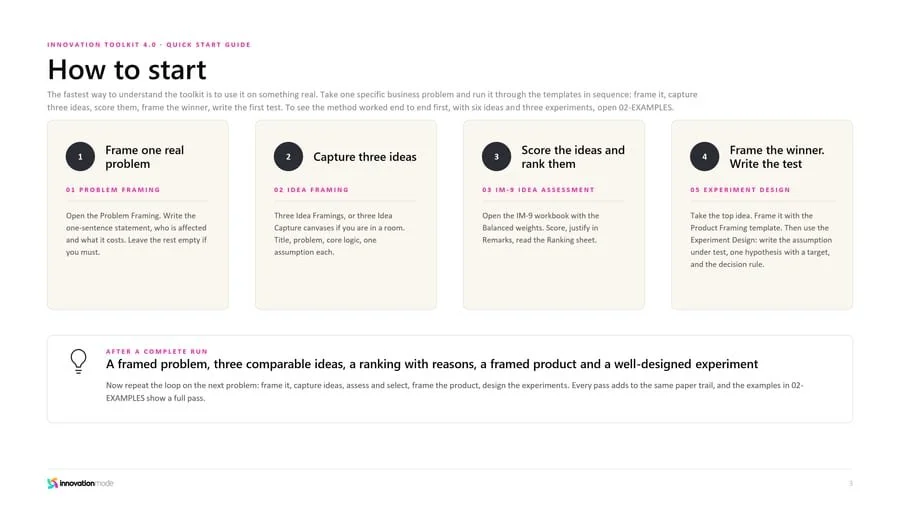
Guide slide: How to start, with three steps
How to start. Take one real problem and run it through the sequence.
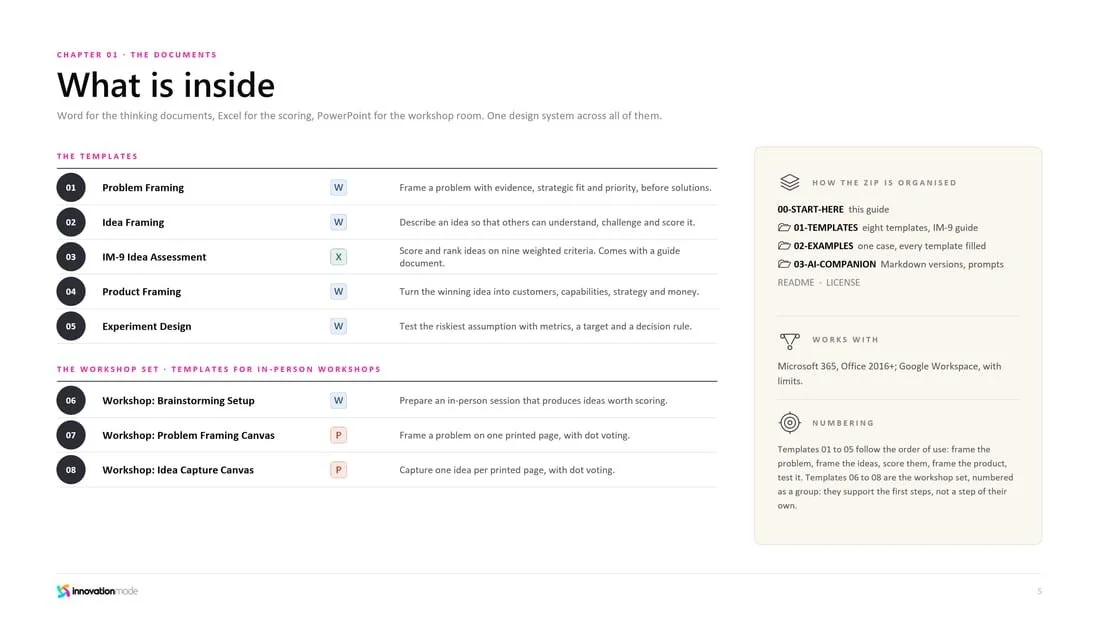
Guide slide: What is inside, every template with its format and purpose
What is inside. Every document with its format and its job, in one list.
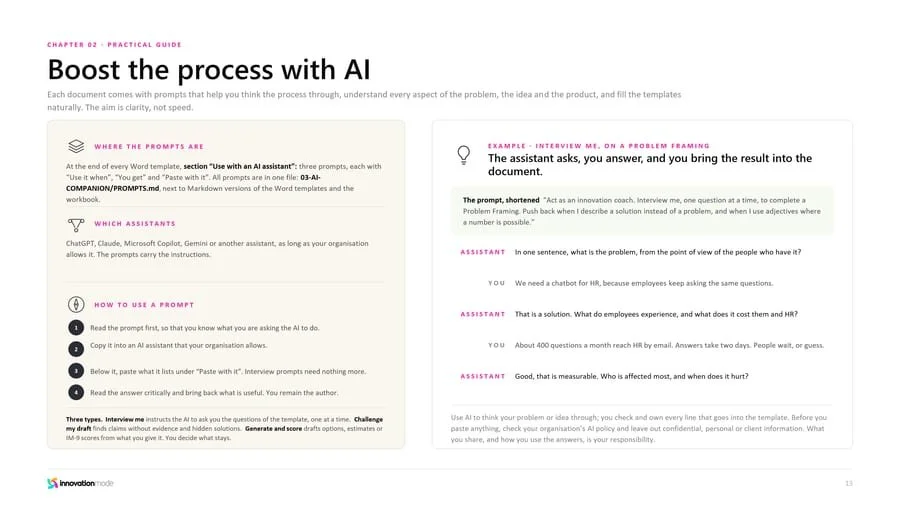
Guide slide: Boost the process with AI, prompts for each document
Boost the process with AI. Twenty prompts that make the assistant interview you and challenge your draft, each saying what to paste. You decide what stays.
In the boxWhat it isFormat
Quick Start Guide open first17 slides to get up to speed: the documents, the flow, how to run the process, the worked case and the terms of use.PDF
01 · TemplatesThe eight templates and the IM-9 guide, in one consistent design, ready to copy, customise and share.Word · Excel · PowerPoint
02 · ExamplesThe worked case: nine sample documents from the sponsor’s brief to the Decision Brief, plus the live scored workbook.PDF · Excel
03 · AI companionMarkdown versions of the Word templates and the workbook, a library of 20 prompts and a README, for any AI assistant or for Ainna.Markdown
README · LicenceThe workflow, how to use and customise the templates, and the licence in full.Text
IM-9 Idea Assessment Model

One score per idea, nine criteria, weights you set.

IM-9 brings method to idea assessment. Every idea is scored against the same nine criteria and the same written anchors, with weights agreed before anyone scores, so assessments stay objective, consistent across teams and rounds, and robust enough to defend in front of a sponsor. Documented in Innovation Mode, delivered as an Excel workbook with a guide.

The problemIs it worth solving?
1
ImportanceHow many benefit if the problem is solved, and what is the value at stake?
2
RelevanceIs the problem aligned with the strategy, the programme theme or the objectives?
The solutionCan it be built and run?
3
EffectivenessDoes the solution address the underlying problem, fully and directly?
4
FeasibilityIs it feasible with current technology and economics?
5
Ease of developmentHow easy is a first production-ready version, with available resources?
6
Ease of operationsHow easy would it be to run after it is built?
The outcomeWhat would it change?
7
Business impactWhat would a good implementation and a proper launch change?
8
NoveltyIs the idea new, or already known? Check experts, the public domain, patents.
9
Certainty of demandHow certain is the demand, on the evidence available?
Four starting weight profilesAll editable. Agree them before anyone scores.
ProfileImpRelEffFeasDevOpsImpactNovDemand
Balanced101010101010101010
Quick wins551015202010510
Strategic bets20201055520155
Validated demand101015105515525
The worked case, scoredSix ideas, Balanced profile, October 2025.
Virtual Startups7.1
Income Bridge6.8
Exposure Radar6.6
Talent Transfer Exchange6.4
AI Operators Cooperative6.3
Transition Academies5.8

Switch to Quick wins and the Talent Transfer Exchange comes first; Strategic bets widens the winner’s lead. Read the profiles, not just the totals.

Who it is for

Built for innovation teams.
Free for students and educators.

A shared language and a structured way of working for everyone who turns problems into products: innovation leaders and product teams inside organisations, and the students and educators who learn the craft.

For practitioners

Innovation managers & CINOs

Standard documents for problem framing, ideation, scoring and validation across business units, a worked case to train teams on, and a scoring model you can defend in front of a board.

For practitioners

Product managers & R&D leaders

Frame products with named risks, design experiments with decision rules, and prioritise with a weighted model instead of a debate.

Free academic access

University professors & lecturers

Use the toolkit in innovation, product management and entrepreneurship courses. The worked case is a ready-made case study, with the reasoning shown. No budget approval needed.

Free academic access

Students & researchers

Practise on the same documents corporate innovation teams use, and build portfolio-ready deliverables: a problem framing, a scored idea set, a product framing, an experiment design.

Why this toolkit

Simple on the surface. Deep where it counts.

The templates are simple enough to use on day one and deep enough to change how a team thinks. Their questions push innovators to look at an idea from every angle and to challenge the assumptions they would otherwise take for granted.

Codified, not generic

Built on a published method

Every template maps to a stage of Innovation Mode (Innovation Mode Publishing, 2026): its 70+ interventions, the Innovation Deficits diagnostic, the Maturity Index and the Six Phases of transformation.

Practitioner-built

By the author of the book

Created by an innovation leader with 25 years of hands-on experience: inventor of 18 patent families, more than 80 projects shipped, five ventures founded, and advisory engagements with global companies.

For organisations

Tailored to your industry and your process

Combine the toolkit with our Innovation Advisory programme, and we adapt it to the way your organisation works.

Your industryTemplates, examples and IM-9 criteria adapted to your sector and its vocabulary.
Your processMapped to your stage gates, governance and decision forums.
Your teamsHands-on sessions on a problem of your own, from brief to experiment.
With AinnaThe same method on Ainna, the agentic innovation platform, at scale.
Get the toolkit

Ready to use today. Yours to adapt.

The complete system in one download: eight templates, the Quick Start Guide, the worked case and the AI companion. Rebrand it, translate it and roll it out across your organisation, with no subscription and no per-seat fees.

€249

One-time purchase · Instant download · Perpetual licence · No subscription

The complete corporate innovation toolkit: problem framing, ideation, idea assessment, product framing, experiment design and workshop canvases, with a worked case that shows every template filled in. Customise with your branding and distribute across your entire organisation.

Buy the Innovation Toolkit · €249 →
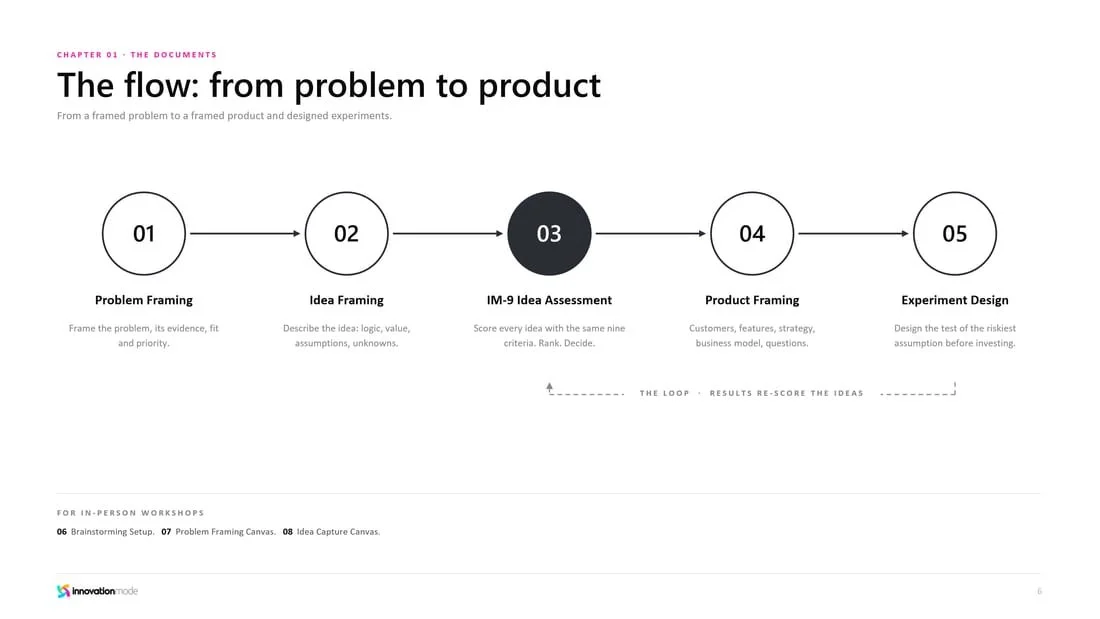
Guide slide: the flow from problem to product, five documents in sequence
What’s included
8 templates: 5 Word documents, 2 PowerPoint canvases, 1 Excel workbook, plus the IM-9 guide in Word. Fully editable, no passwords
The worked case: 9 sample documents carrying one problem from brief to decision, with the reasoning in the margins, plus the live scored workbook
Quick Start Guide: 17 slides on the documents, the flow, daily practice, AI and the terms
AI companion: Markdown versions of the Word templates and the workbook, and 20 prompts, for any AI assistant or Ainna
Perpetual licence for one organisation: unlimited internal copies, training and workshops. Everything you write in the documents is yours
Compatible with Microsoft 365 and Office 2016+; opens in Google Workspace. One ZIP, instant download after purchase

Students & educators: get it free. Send a short request with your university email and we’ll reply with a coupon for complimentary access to the full toolkit.

Request academic access →

Consultant or agency planning to use the toolkit with clients? Client deliverables carry an attribution line, and firms working with several clients need an agency licence. Email us about agency licensing.
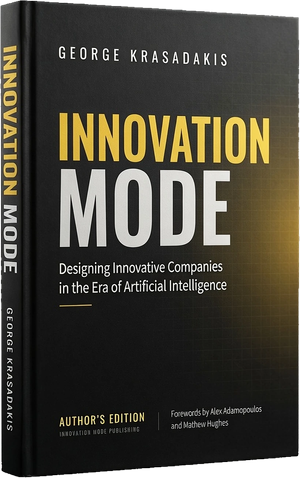
Innovation Mode book cover

The methodology behind the templates. Every template in this toolkit maps to the frameworks in Innovation Mode, the complete practitioner’s guide to building AI-powered innovation functions. The book provides the why and the when; the toolkit provides the how.

Questions

Before you buy

What is in the package, how each template works, how IM-9 scores ideas, and what the licence allows.

What is the Innovation Toolkit 4.0 and who is it for?

The Innovation Toolkit 4.0 is a package of eight editable templates covering the corporate innovation lifecycle, from problem framing through ideation, scoring and validation to a product concept and the workshops that feed it, with a Quick Start Guide, a complete worked case and an AI companion. Built on the frameworks of Innovation Mode, it is designed for innovation managers, CINOs, product leaders and R&D teams who need a repeatable process. It is free for students and educators.

Why does the toolkit include a worked case?

Because a template shows the questions and a worked case shows the answers. The example series carries one realistic problem, AI-driven displacement of office and customer-service work, through every template: a sponsor’s brief, a Problem Framing, the setup of the brainstorming session, six Idea Framings, an IM-9 assessment, a Product Framing for the winning idea, three Experiment Designs, the two workshop canvases filled in, and a Decision Brief back to the sponsor. Each sample is annotated with why it was written that way, so a team sees the standard before it writes its own, and a lecturer has a ready-made case study.

Is the worked case real?

It is hypothetical, and set in an unnamed EU country. The problem is real, and the few statistics about the wider world in the Problem Framing come from cited public sources. The country’s details, the sponsor, the organisation, the people, the ideas, the estimates and the results are invented for learning, and the documents say so. No real organisation or person takes part in the case. Nothing in it is a recommendation, a forecast or business advice.

What exactly is in the download?

One ZIP of about 4.5 MB with the 17-slide Quick Start Guide (PDF); a templates folder with Problem Framing, Idea Framing, Product Framing, Experiment Design and Brainstorming Session Setup in Word, the IM-9 workbook in Excel with its guide in Word, and the Problem Framing and Idea Capture canvases in PowerPoint; an examples folder with the nine sample documents of the worked case and the scored workbook; an AI companion folder with Markdown versions of the Word templates and the workbook, and a prompt library; and the README and licence in plain text. The templates are made for Microsoft 365 and Office 2016 or later and also open in Google Workspace, where some formatting and protection may not carry over; the guide and the worked case are PDFs, and the Markdown files open anywhere.

What changed in version 4.0?

The templates were rebuilt as one design system, with a name row under every title, guidance in grey, advisory comments on key sections and guide pages at the end of each document. New in the package: the worked case with its sample notes and a Decision Brief, the Quick Start Guide, the AI companion with 20 prompts, and four starting weight profiles in the IM-9 workbook.

What is a problem statement template?

A problem statement template is a structured document for defining a business problem before anyone proposes solutions. In the toolkit it is the Problem Framing: the problem statement, written from the point of view of the people who experience it; who is affected and how severely; the context, the current state and the cost of doing nothing; and the constraints. The worked case shows one filled in with cited public figures. Delivered as an editable MS Word document. See the problem statement guide with examples →

What is a business idea template?

A business idea template gives every idea the same shape, so that ideas can be understood, challenged and scored side by side. In the toolkit it is the Idea Framing: the idea and the problem it addresses, how it works and who benefits, the value for users and for the organisation, and the assumptions and unknowns that still need answers. The worked case includes six, from an insurance product to a workplace academy. Delivered as an editable MS Word document. See the business idea guide with examples →

How do I evaluate and rank innovation ideas objectively?

Use the IM-9 Idea Assessment Model, documented in Innovation Mode. Each idea is scored from 0 to 10 on nine criteria, against written anchors for what 0 and 10 mean. Each criterion carries a weight, agreed with the decision-makers before anyone scores; the workbook normalises the weights and produces one overall score per idea, with a Ranking sheet for the sorted view. Because the criteria are explicit, a disagreement about an idea becomes a disagreement about one criterion, which is a conversation a team can have. The toolkit includes IM-9 as an editable Excel workbook, with built-in scoring guidance, and a Word guide.

What criteria should I use to score innovation ideas?

IM-9 uses nine criteria in three groups. The problem: (1) Importance and (2) Relevance to the strategy or theme. The solution: (3) Effectiveness, (4) Feasibility, (5) Ease of development and (6) Ease of operations. The outcome: (7) Business impact, (8) Novelty and (9) Certainty of demand. Each is scored 0 to 10 with weights configured per context. Covering the problem, the solution and the outcome separately means an idea that solves an unimportant problem, or an important problem badly, shows exactly where it falls short.

How does IM-9 compare to ICE, RICE and other scoring frameworks?

ICE scores Impact, Confidence and Ease; RICE adds Reach and Effort. Both are fast and work well for feature backlogs. IM-9 is built for innovation portfolios: nine criteria that score the problem, the solution and the outcome separately, each against written anchors for what 0 and 10 mean, with weights agreed before anyone scores. It covers what shorter frameworks leave out, such as Relevance to strategy, Novelty for IP strategy, and Ease of operations, which decides whether a launched idea survives its second year. See the methodology behind IM-9 →

How do I prioritise a long list of ideas?

Score every idea with the same weighted criteria, then rank by the overall score. The IM-9 workbook does this for a whole batch of ideas and ships with four starting weight profiles: Balanced (a plain average), Quick wins (favours ideas that can ship soon at low cost), Strategic bets (favours important, novel, high-impact ideas even when they are hard) and Validated demand (favours ideas customers have already asked for). Every weight is editable, and the guide asks you to record which profile you used so that scores can be compared later. Without a structured model, prioritisation becomes politics; with IM-9 it becomes arithmetic your team can defend, audit and revise.

What’s the difference between evaluating an idea and validating it?

Evaluation is internal: IM-9 uses expert judgement to score an idea and decide whether it is worth investing in. Validation is external: a business experiment gathers evidence from real users about whether a high-scoring idea actually works. The toolkit has both, in sequence: the IM-9 workbook for evaluation and the Experiment Design for validation. In the worked case the winning idea scores 7.1, becomes a Product Framing with named risks, and three Experiment Designs test those risks with a metric, a target and a decision rule agreed before the data arrives.

How do I write a product concept document?

Start from a scored idea and answer the questions a sponsor will ask: who the customers are and what value they get, which capabilities the product needs, the strategy and the business model, and the risks and open questions, named and numbered so that they can be tested. The Product Framing template walks through each of these, and the worked case shows one written for the winning idea. Delivered as an editable MS Word document. See the product concept guide with examples →

What is a business experiment template and why do I need one?

A business experiment tests a critical assumption with real people before significant money is committed. The Experiment Design captures the assumption under test, the hypotheses with a metric and a target for each, the design and the artefacts, and the decision rule, all agreed before the data arrives, so that the result leads to a decision rather than a debate. The worked case includes three, one for each named risk of its product concept. Delivered as an editable MS Word document. See the business experiment guide with examples →

Which brainstorming workshop templates are included?

Three, designed for in-person sessions. The Brainstorming Session Setup, in MS Word, defines the central "How might we" question, the participants, the agenda and how the output will be handled. The Problem Framing Canvas and the Idea Capture Canvas are printable A4 pages in MS PowerPoint: one frames the problem in the room, the other captures one idea per canvas, with dot voting and a back page for the feedback. The worked case shows both canvases filled in, so sessions produce actionable outputs, not just Post-it notes. See the workshop guide with examples →

Can I use the templates with ChatGPT, Claude or another AI assistant?

Yes. The AI companion folder holds Markdown versions of the Word templates and the workbook, and a library of 20 prompts. Some prompts make the assistant interview you, some challenge your draft, and some draft options, estimates or scores from your input; you decide what stays. Read each prompt before you use it; each one says what to paste with it: nothing for the interview prompts, your draft or notes for the others. Before you paste anything, check your organisation’s AI policy and leave out confidential, personal or client information: what you share is your responsibility. Ainna has the method built in and adds personas, market sizing and competitive analysis.

Can I customise and rebrand the templates?

Yes. Nothing is locked and there are no form controls. Every style is named in the Styles pane, so a rebrand is a few edits. Restructure, translate, add your logo. If you want to protect the structure for colleagues, the README explains Word’s Restrict Editing, and the Excel workbook ships with its formulas protected by an empty password so that they survive daily use.

Can consultants and agencies use the toolkit with their clients?

The €249 purchase grants a perpetual licence for one organisation: a company, a public body or a university department, including all its teams, with unlimited internal copies, training and workshops. Subsidiaries and other group companies each need their own licence, or a group licence. Consulting deliverables, client workshops, paid training and publications built on the templates carry an attribution line, and consultants and agencies working with several clients need an agency licence. Reselling, sublicensing or publishing the templates is not permitted. Email us about agency licensing.

Is it really free for students and educators?

Yes, for coursework and teaching, with attribution. Request access with your university email and we will send a coupon for the full package.

How does the Innovation Toolkit relate to Innovation Mode?

Every template maps to a stage of the process described in Innovation Mode. The book provides the framework: the 6 Innovation Deficits diagnostic, the 7-level Innovation Maturity Index, the Six Phases of transformation and 70+ interventions. The toolkit provides the documents your teams use to execute it. The book is the why and the when; the toolkit is the how.
Part of the Innovation Mode ecosystem

Part of a larger system

The templates get you started. The book gives you the complete framework. The advisory programmes deploy it in your organisation, and Ainna runs it with you.

The book

Innovation Mode

The complete framework: 70+ interventions, the 6 Innovation Deficits and the 7-level Maturity Index.

Executive advisory

Two 8-week programmes

Deploying these frameworks in your organisation, for innovation transformation or AI strategy.

AI platform

Ainna.ai

The agentic innovation platform that runs these frameworks in production. The toolkit’s AI companion works with it too.
Innovation Toolkit 4.0 · 8 templates · a complete worked case · €249 Buy Now → Free for students →
The Innovation Toolkit 4.0
€249.00

Eight editable templates that take a problem worth solving to a product worth testing (5 Microsoft Word + 2 PowerPoint + 1 Excel file). And one real problem carried through every one of them, from the sponsor’s brief to the go/no-go decision.