
Brainstorming Workshop Templates
Three structured templates that turn brainstorming workshops into evaluation-ready innovation pipelines, not piles of sticky notes. Plan the session, frame the problem collaboratively, and capture every idea in a consistent format.
Perpetual licence · One-time payment · Free for students
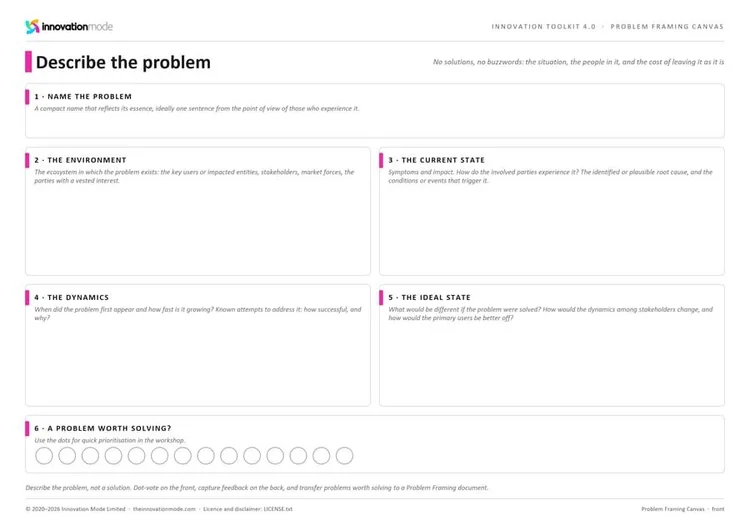 Problem Framing · PPT
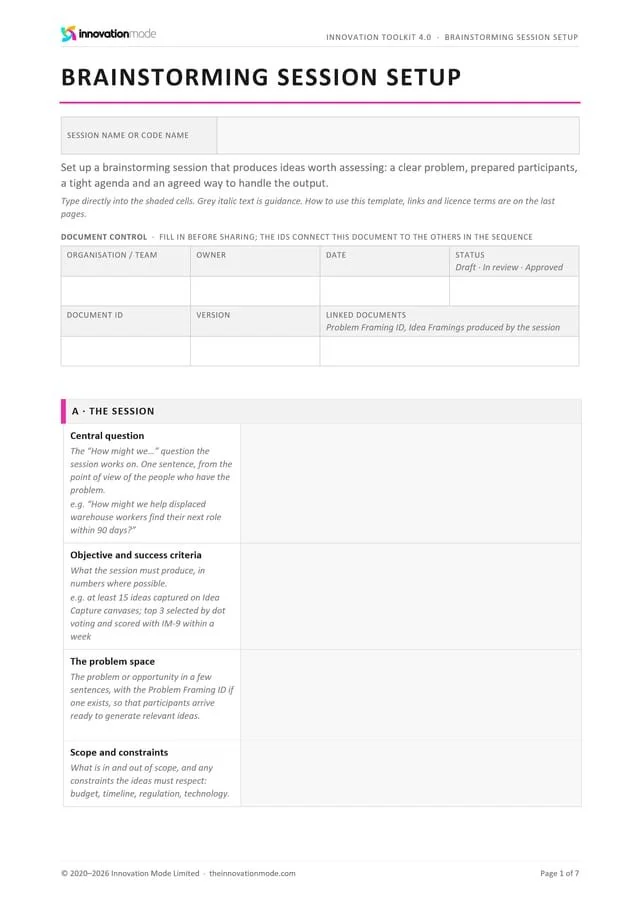 Workshop Setup · DOCX
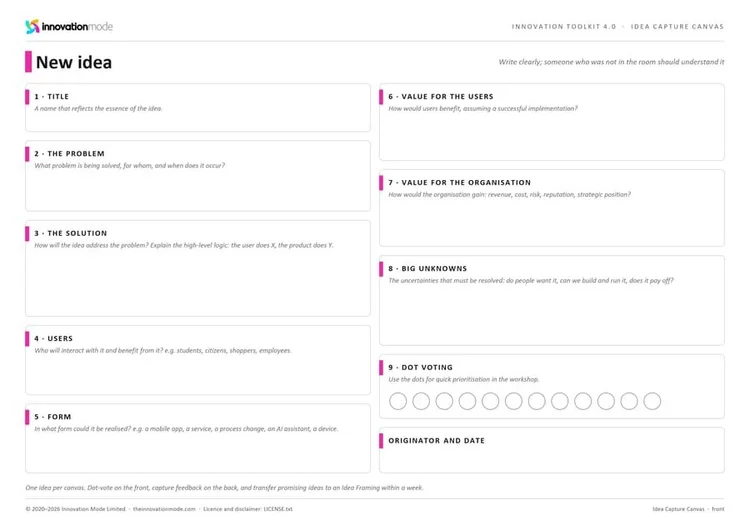 Idea Capture · PPT
What Is a Brainstorming Workshop?
A brainstorming workshop is a structured innovation session with a simple but critical objective: to generate and discuss ideas on solving a defined problem or addressing a business need. As described in Innovation Mode, successful brainstorming requires thoughtful preparation, selecting the right participants, clearly defining the problem, and establishing a facilitation approach that ensures all voices are heard and all ideas are captured consistently.
Most Brainstorming Sessions Fail Before They Start
Brainstorming sessions tend to suffer from the same issues that most business meetings do, they often prove to be "noisy" with no measurable outcome or follow-up actions. The root cause is typically poor preparation and audience synthesis: a brainstorming without the right people in the room is slower and less productive. Having the right people but not being well prepared leads to the same limited outcome. Incompatible personalities, too many people, or too much authority could diminish the purpose.
Even when the "dream team" of ideators is in the session, there are still risks: lack of proper facilitation, poor handling of the generated ideas, and ineffective follow-up can ruin the outcome. As Innovation Mode warns, idea selection during the event is far from optimal: unconscious bias, differences in presentation skills, seniority effects, and groupthink can severely affect decisions. A better approach is to capture all ideas using a consistent format and process them after the event through the IM-9 Idea Assessment Model.
The Innovation Brainstorming Templates solve these problems by providing three structured documents that cover the full workshop lifecycle, from planning the session, to framing the problem collaboratively, to capturing ideas in a consistent, evaluation-ready format. Created by George Krasadakis and based on Chapter 5 of Innovation Mode, they are used in innovation advisory and AI strategy engagements with global companies.
Plan the Session. Frame the Problem. Capture the Ideas.
Each template covers a distinct phase of the brainstorming process, together they give facilitators a complete framework for running innovation workshops that produce actionable, structured outputs.
Workshop Setup Template
Define the workshop’s objectives, theme, desired outcome, participant list, format, timing, facilitation approach, and preparation materials. As the book emphasises, selecting the right 4–10 participants is critical, consider not only skills and relevance but also the ability to bring fresh, outside perspectives that act as catalysts for the outcome.
MS Word · EditableProblem Framing Template
Guide participants through collaborative problem definition, breaking down challenges into the four structured dimensions from the Problem Statement Template: environment, dynamics, current state, and ideal state. Ensures the team achieves shared clarity on what they are solving before jumping to solutions.
MS PowerPoint · EditableIdea Capture Template
A structured format for participants to describe their ideas during live sessions, using the same format as the Business Idea Template. Every concept is recorded consistently and ready for post-session evaluation, comparison, and discovery by teams across the organisation.
MS PowerPoint · EditableWhat Makes or Breaks a Brainstorming Session
Drawing from the brainstorming methodology in Innovation Mode, these are the critical factors that determine whether your workshop produces real value, or just noise.
✓ What Works
Clear agenda with stated motivation and desired outcome. Carefully selected 4–10 participants with diverse perspectives. Pre-read package with a problem statement and market context. Skilled facilitator applying basic rules so all voices are heard. Ideas captured in a structured, consistent format. Post-session evaluation using the IM-9 scoring model, not in-room voting.
✗ What Fails
No preparation: participants restate the obvious. Wrong audience: too many people, too much authority, incompatible personalities. Ideas captured on scattered sticky notes with no consistent format. In-session voting influenced by unconscious bias, seniority, and groupthink. No post-session follow-up: ideas archived and forgotten. No connection to the broader innovation lifecycle.
The Templates in Action: Four Innovation Workshop Scenarios
Each example shows how the three brainstorming templates work together to produce structured, actionable outputs, from defining the session through to evaluation-ready ideas that flow into the broader innovation pipeline.
Customer Retention Ideation: SaaS Product Team
New Revenue Streams: Insurance Company
Employee Experience Innovation: HR Leadership Team
AI-Powered Brainstorming: Innovation Team Pilot
Hypothetical scenarios written to illustrate how the workshop templates apply across industries, not based on any specific company or engagement.
Notice how every example uses the three templates together: the setup ensures the right people and preparation, the problem framing aligns the team before ideation, and the idea capture produces structured outputs that flow directly into the evaluation pipeline. No sticky notes. No lost ideas. No in-room voting bias.
From Blank Calendar to Structured Innovation Workshop
The three templates work together in sequence, each one feeds the next.
Plan the session. Use the Workshop Setup Template to define objectives, select 4–10 participants with diverse perspectives, set the format, and compile a pre-read package including a problem statement and relevant market context.
Frame the problem. Open the session with collaborative problem framing using the Problem Framing Template. Ensure the team has a shared understanding of what they are solving before any ideas are generated.
Capture and evaluate. Participants fill in Idea Capture Templates using the standard idea format. After the session, ideas are evaluated using the IM-9 Idea Assessment Model. Top ideas progress to experiments or product concepts.
When every brainstorming session follows the same structured process, the organisation builds a growing corpus of well-framed ideas: all captured in a consistent format, evaluation-ready, and discoverable by teams across the company. This is how brainstorming evolves from an isolated event into a core capability of the innovation function.
About Brainstorming Workshops
Common questions on innovation brainstorming methodology, drawn from practitioner experience and Chapter 5 of Innovation Mode.
What is an innovation brainstorming workshop?
Why do brainstorming sessions fail?
What templates do I need for an innovation workshop?
How do I select the right participants for a brainstorming session?
Should we vote on ideas during the brainstorming session?
How is AI changing brainstorming workshops?
How do brainstorming workshops differ from Design Sprints or Hackathons?
Templates for Every Stage of Innovation
The Brainstorming Workshop Templates work alongside the full innovation lifecycle, from defining problems to generating ideas, evaluating them, validating through experiments, and defining product concepts.
Download the Innovation Brainstorming Templates
All three brainstorming templates (Workshop Setup, Problem Framing, and Idea Capture) are included in the full Innovation Toolkit 4.0, alongside five other templates covering problem framing, business ideas, the IM-9 Idea Assessment Model, business experiments, and product concepts.
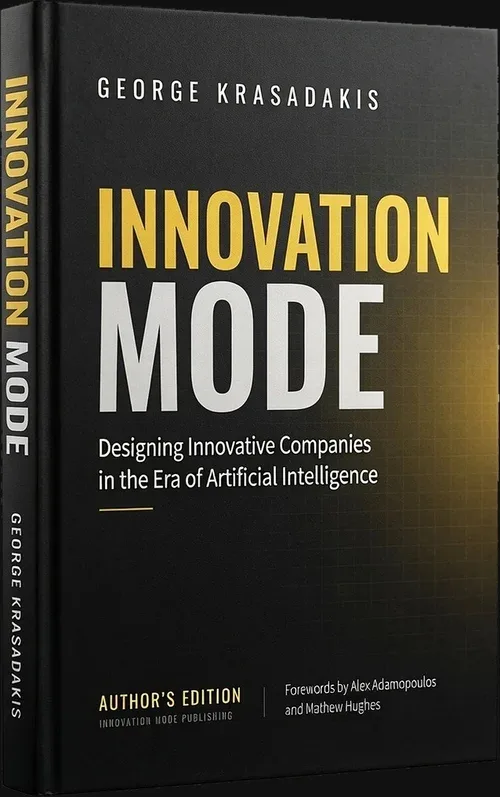
The complete brainstorming methodology. Chapter 5 of Innovation Mode covers the full spectrum of innovation workshops, from classic brainstorming to AI-powered synthesis sessions, Design Sprints, and Hackathons. It explains how AI is transforming brainstorming from "blue sky" ideation into strategic synthesis. 434 pages. Innovation Mode Publishing, 2026. By George Krasadakis.
The templates, and the worked case that shows them in use.
- Eight editable templates: five Word documents, two PowerPoint canvases and the IM-9 Excel workbook.
- The worked case: nine sample documents carrying one problem from brief to decision, with the reasoning in the margins.
- Quick Start Guide: 17 slides on the documents, the flow and daily practice.
- AI companion: Markdown versions of the templates and 20 prompts, for any AI assistant.
In the toolkit these are the Brainstorming Session Setup template and the Problem Framing and Idea Capture canvases.
€249 one-time · perpetual licence for one organisation · instant download · free for students and educators
On Ainna.ai: AI-assisted ideation.

Field notes on this subject

Leading innovation: Principles of a great ideation platform
Corporate innovation needs a strong supply of high-quality ideas that feed into a fast and effective ‘innovation opportunity discovery’ process. Establishing such an ideation channel is not easy: it requires processes that are simple, inclusive, flexible, and objective; it needs effective communication to inspire people but, at the same time, it must manage the risk of ‘internal disruption.’

Open Innovation & Ideation Powered by Blockchain
A chain of ideas ‘written in stone’ on blockchain, in the context of Open Innovation. A global platform for publishing ideas, empowering collaboration, and contribution.

Managing ideas: how to build a great ideation platform
Sticky notes are great to quickly capture ‘ideas’ - they also help the team look busy and super productive :) But, when it comes to an ideation channel, you need some serious technology to capture, process, and diffuse ideas within your corporation.