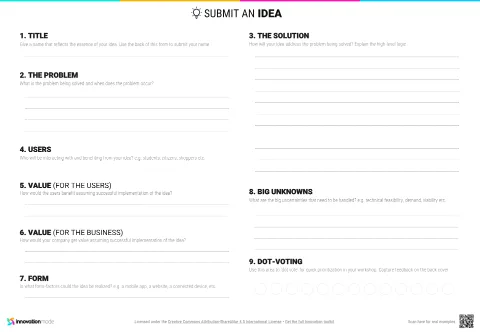
Business Idea Template (A4 Workshop Sheet)
A printable A4 sheet for capturing a business idea in a workshop: problem, solution, users, value and big unknowns, with dot voting. CC BY-SA 4.0.
Download the PDF
A structured, one-page format for describing, sharing, and refining early-stage innovation ideas. Give every concept the clarity it needs to be understood, evaluated, and acted upon, across teams and stakeholders.
Free PDF · Perpetual licence on the editable toolkit · Free for students
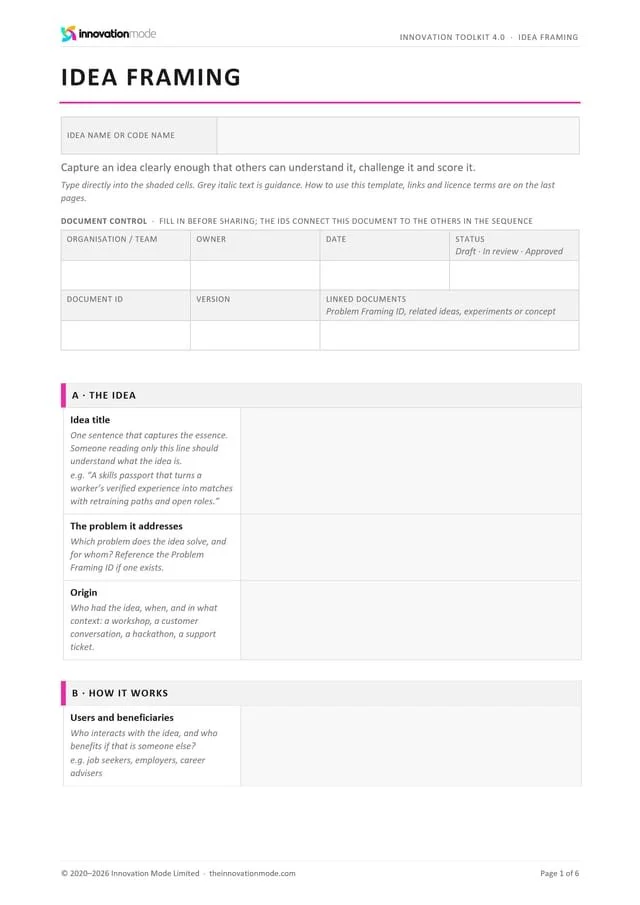
A business idea template is a structured, one-page document that captures the essential dimensions of an early-stage innovation idea: the problem it solves, who it serves, how it works, and what remains unknown. It creates a consistent format that makes ideas easy to share, compare, and evaluate across teams, departments, and stakeholders. In innovation management, a standard idea format is the bridge between raw inspiration and structured evaluation.
Most innovation programmes don’t suffer from a shortage of ideas, they suffer from a shortage of well-articulated ideas. When concepts live as vague descriptions in emails, chat messages, or slide decks, they can’t be properly assessed, compared, or championed. Promising innovations die not because they lacked merit, but because no one could see what they were really about.
The Business Idea Template solves this by providing a standard format, based on the framework documented in Innovation Mode. It creates a shared innovation language that works whether ideas come from brainstorming workshops, hackathons, or individual contributors. Once ideas are captured consistently, they can be objectively scored using the IM-9 Idea Assessment Model.
Created by George Krasadakis, the template is one of the core frameworks used in innovation advisory and AI strategy engagements with global companies. It naturally follows a well-defined problem statement, and feeds into idea evaluation, experimentation, and the product concept stages of the innovation lifecycle.
The template guides ideators through four complementary dimensions, ensuring every idea is described with enough clarity to be understood, evaluated, and discussed by anyone in the organisation.
Summarise the core concept with a clear, descriptive title, then define the problem being addressed and why it matters. This forces the ideator to connect their solution to a real need before describing the mechanics. Establishes the what and the why.
Identify the target users, the value delivered to them, and the value to the business. Consider the possible forms the idea could take: mobile app, web platform, physical device, API, or service. Establishes the who, the value, and the shape.
Explain how the idea works: the core mechanics, data inputs, technology dependencies, and key interactions. This section transforms a concept from a wish into something teams can evaluate for feasibility. Establishes the how.
List the critical uncertainties, open questions, and risks that need to be resolved. Every early-stage idea has them, surfacing unknowns early helps teams plan business experiments and avoid investing in the wrong direction. Establishes the risk landscape.
Each example demonstrates how the four-section format turns a vague concept into a structured, shareable business idea. These are the kinds of ideas that innovation teams capture during brainstorming workshops, hackathons, and structured ideation programmes, typically after a problem has been clearly framed.
Hypothetical business ideas written to illustrate how the four-section framework applies across industries, not based on any specific company or engagement.
Notice how each example connects the idea to a specific problem, identifies concrete users and value, explains the mechanics without jargon, and surfaces unknowns honestly. This structured ideation format makes ideas comparable and evaluation-ready: whether they come from a hackathon, a workshop, or a single contributor.
The template works for individual ideation, structured brainstorming workshops, or corporate hackathons. A typical innovation process flow:
Start from a problem. Use the Problem Statement Template to define the challenge first. Clear problems produce sharper ideas: and prevent teams from generating solutions in search of a problem.
Describe the idea. Each contributor fills in the four sections, connecting their concept to the problem, identifying users and value, explaining the mechanics, and surfacing the unknowns.
Evaluate and advance. Use the IM-9 Idea Assessment Model to score and rank ideas objectively. The best concepts progress to business experiments or directly to the Product Concept stage.
When every idea in the organisation follows the same format, comparison becomes straightforward. Innovation managers can scan dozens of ideas quickly, stakeholders can provide focused feedback, and the best concepts surface on merit, not on the strength of the presenter’s storytelling. Over time, this builds an innovation culture where ideas are currency, not noise.
Common questions on capturing and describing innovation ideas, drawn from practitioner experience and the methodology in Innovation Mode.
"The book provides an excellent overview about people, culture, and capabilities as the key pillars of innovation and practical ways to discover, validate, and realise opportunities."
Dr. Mathew Hughes · Professor of Innovation, University of Leicester
"An inspiring and must-read for every organisation that doesn’t wish to sit on the sidelines while someone else steals their share of the market."
Sue McGill · SVP, ATB Ventures
Endorsements of Innovation Mode: the book this template is drawn from.
The Business Idea Template sits between problem framing and evaluation. Each stage builds on the one before: from defining the challenge, to generating ideas, to scoring and validating them, to articulating a product concept.
Two ways to use this template: pick the one that fits how you’ll deploy it.
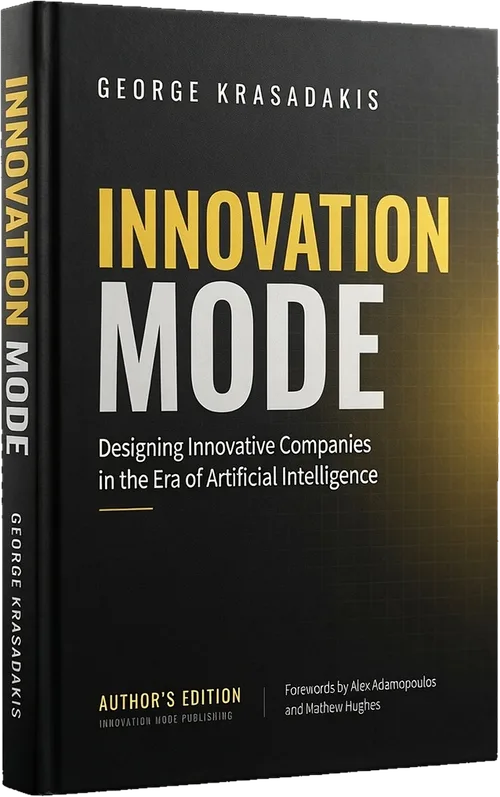
The methodology behind this template. The Business Idea Template is based on the structured idea framework documented in Innovation Mode, the complete practitioner’s guide to building innovation capability. The book provides the diagnostic tools, the 70+ interventions, and the end-to-end innovation process. The templates provide the daily execution layer. 434 pages. Innovation Mode Publishing, Author’s Edition, 2026. By George Krasadakis.
In the toolkit this document is the Idea Framing template, scored with the IM-9 workbook.
€249 one-time payment · Licensed to your whole organisation · Instant download
On Ainna.ai: validating an idea with AI. Founders: Ainna for Founders runs this evaluation for you.

A printable A4 sheet for capturing a business idea in a workshop: problem, solution, users, value and big unknowns, with dot voting. CC BY-SA 4.0.
Download the PDF
Corporate innovation needs a strong supply of high-quality ideas that feed into a fast and effective ‘innovation opportunity discovery’ process. Establishing such an ideation channel is not easy: it requires processes that are simple, inclusive, flexible, and objective; it needs effective communication to inspire people but, at the same time, it must manage the risk of ‘internal disruption.’

A chain of ideas ‘written in stone’ on blockchain, in the context of Open Innovation. A global platform for publishing ideas, empowering collaboration, and contribution.

Sticky notes are great to quickly capture ‘ideas’ - they also help the team look busy and super productive :) But, when it comes to an ideation channel, you need some serious technology to capture, process, and diffuse ideas within your corporation.