How to Win a Hackathon in the Era of AI
A survival guide for hackathon teams: read the brief, test your idea, build the right team, prototype fast with AI, gather the evidence and pitch. 14 slides.
Download the PDF
A corporate hackathon requires effective orchestration of an array of workstreams, with communication being the most important. This page presents the operational framework: five phases, the seven steps that run through them, six anchor design decisions, eight weighted judging criteria, the most common mistakes, and four worked example scenarios that illustrate how the framework adapts across formats and industries.
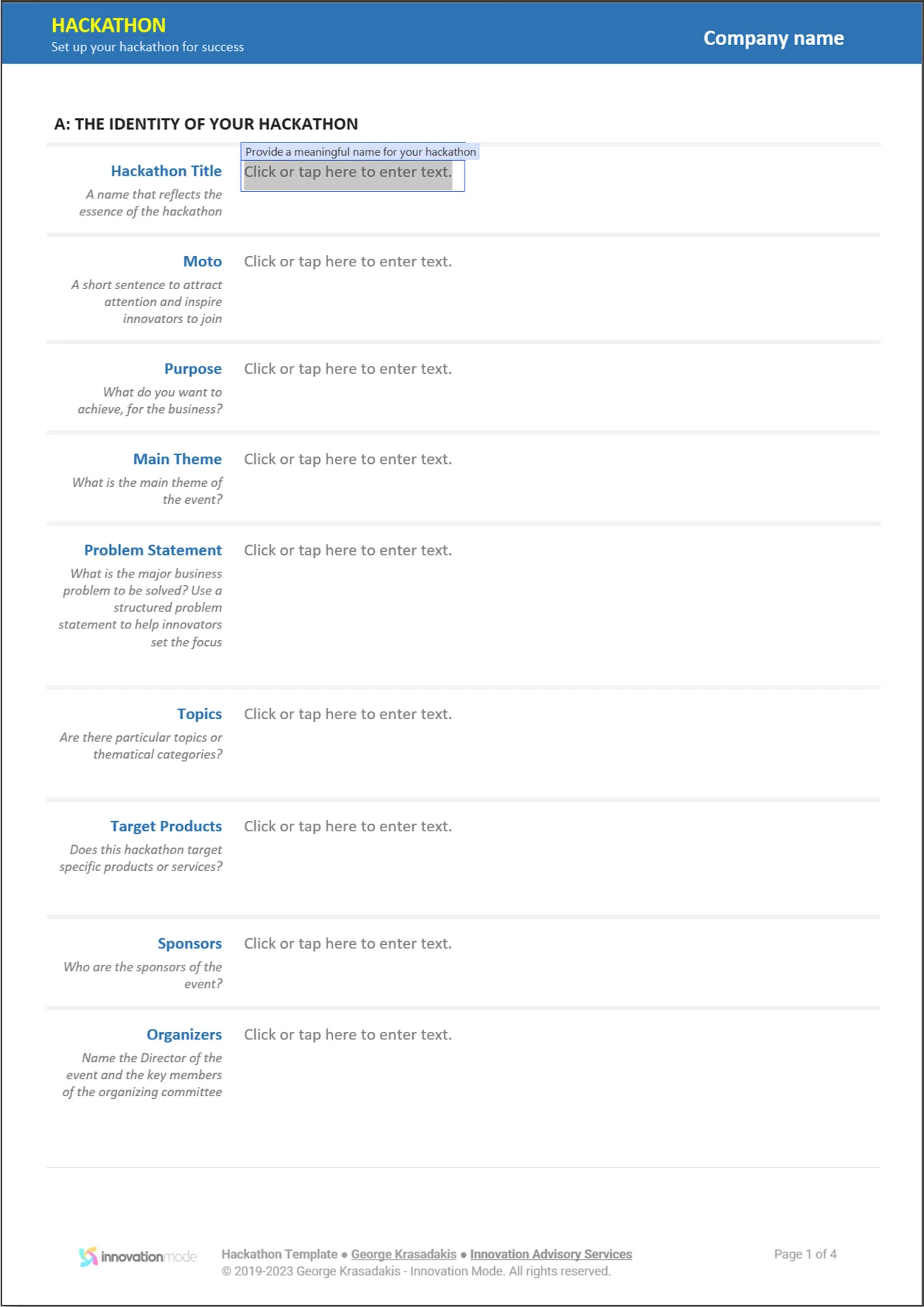
A corporate hackathon is a large-scale innovation contest where multiple self-organising teams compete to solve a business problem or address an opportunity within a short time frame. Participants conceptualise ideas, make technology choices, execute fast, and deliver functional prototypes, typically in a matter of days.
A well-organised series of corporate hackathons can lead to remarkable business opportunities. Beyond the winning projects, hackathons feed the entire set of ideas produced into the opportunity discovery pipeline, making them discoverable and usable across the company. At the cultural level, hackathons promote collaboration, sharing, and a multidisciplinary approach to problem-solving.
Organising a successful corporate hackathon can be challenging though: selecting the proper format, setting the objective, and orchestrating the process are not always straightforward. When hackathons aim for the announcement rather than real outcomes, people eventually recognise them as events that consume budget and goodwill while producing nothing the organisation can fund or build on.
The framework on this page provides a detailed operational guide on setting up a hackathon, not in isolation but in the context of a wider innovation programme. It covers the five phases of the hackathon lifecycle, the seven steps that run through them, the design decisions that shape the event, the judging criteria that determine the winners, and four worked example scenarios that illustrate how the framework adapts.
The lifecycle of a corporate hackathon unfolds in five phases, each with distinct activities, stakeholders, and deliverables. The framework is the same whether the contest runs for one day or a whole week.
From the decision to host to the announcement. Frame the event: strategic theme, sponsor alignment, goals, KPIs, format, eligibility, rewards, and the judging rubric. The design decisions that shape the right hackathon for the right audience.
From the announcement to kick-off: at least two weeks, four to six for a company-wide event. Fill the room. Communication plan, pre-read briefing, registration mechanics, team formation support, and mentor and judge recruitment. Educate participants before the event begins.
The contest itself, one to five days. Execute with intent: kick-off, mentor checkpoints, pitch coaching, and the submission of the minimum deliverables. Where preparation pays off.
From the submission deadline to the winners: final demos, live judging, scoring decisions, and the winner announcement. From a couple of days to several weeks, depending on the evaluation method.
Turn outcomes into impact. The funding pathway for selected projects, performance measurement, and the design of the next iteration. The phase most hackathons skip.
Seven steps run through the five phases. Each is an action the organising team owns, and each one that is skipped shows up later as thin participation, contested winners or ideas that go nowhere.
Six critical decisions shape a hackathon’s character, inclusivity, and business impact, all defined before the event is announced. The full strategic framework, including the ten design parameters from Innovation Mode, is covered in the Corporate Hackathon Guide. The six anchor decisions below frame the choices that matter most at the operational level.
A clear strategic theme defining the problem space where participants will innovate. Without sponsor alignment, winning projects have nowhere to land, they need an organisational home before the event begins.
Private (within the company), public (open to external participants), or hybrid with ecosystem partners and academia. In-person, online, or hybrid. Duration from 1-day mini hackathons to multi-week open innovation challenges.
Who can participate: specific teams, the full organisation, or contractors and partners. As Innovation Mode emphasises, hackathons must dismiss the engineering-only misconception: non-technical innovators bring commercial thinking, product sense, and leadership.
What constitutes a valid submission: from a structured business idea to a pitch deck to a functional prototype. With AI prototyping tools, the technical barrier is lower than ever, and that should reshape who you invite.
How winners are selected: weighted scoring across eight criteria, supported by a conflict-of-interest protocol, transparent tie-break logic, and a written judge briefing. Must be objective, consistent, and transparent.
What happens to winning projects after the ceremony. Rewards should emphasise development resources and stage time over cash, linking achievements to real innovation outcomes. The reward scheme is what turns a hackathon into capability.
The evaluation method must be objective, consistent, and transparent. The framework structures the process around eight weighted scoring criteria, plus a conflict-of-interest protocol, transparent tie-break logic, and a written judge briefing.
Problem importance, theme alignment, feasibility, concept effectiveness, ease of development, operational simplicity, potential impact, and innovation level. Weights are customisable to match the hackathon’s strategic priorities.
Beyond scores, structured feedback sections cover the concept itself, presentation quality, design execution, prototyping effort, and team collaboration, giving participants actionable input for future work.
Scores from multiple judges aggregate using transparent weighting. A different group of judges applying the same protocol should produce similar rankings. Tie-break logic is predefined, not improvised.
Four contrasting hackathon designs illustrate how the framework adapts across formats, audiences, and strategic objectives. Each demonstrates how the design decisions turn a vague impulse into a structured, measurable innovation event.
Hypothetical hackathon scenarios written to illustrate how the framework applies across formats and industries, not based on any specific company.
Even well-intentioned organisers fall into predictable traps. These are the most common across dozens of corporate hackathons. For the failure modes the AI era adds, see the Corporate Hackathon Guide.
“Generate innovative ideas” is not a goal. Define what success looks like before you begin: the number of viable concepts, the specific problems to solve, the technologies to explore. Vague objectives lead to scattered results.
Announcing a hackathon a week before the event guarantees poor participation and half-formed ideas. Allow at least two weeks, four to six for a company-wide event, for team formation, idea exploration and preparation.
Letting the whole company vote sounds democratic but favours well-networked teams over truly innovative ideas. Use expert panels with predefined evaluation criteria instead.
The hackathon ends, the winners are announced, and nothing happens; the best ideas die in a shared drive. Plan how winning concepts move to the next stage before the hackathon begins.
Teams that did not win still generated ideas, learned new skills and invested effort. Acknowledge every participant and capture their concepts: some “losing” ideas become valuable later.
Forcing employees to take part breeds resentment, not innovation. Keep participation voluntary, and make it attractive through meaningful prizes, leadership visibility and genuine follow-through on winning ideas.
The framework on this page is the methodology. The Hackathon Masterclass, coming soon, turns it into practice: a 90-minute video on designing, running and following through on a corporate hackathon, with the templates to run your own: the brief, the decks, the judging system and the full set of messages. Subscribers get first access.
Every organisation’s innovation context is different. If you are planning a hackathon or building hackathons into a broader innovation programme, our advisory services can help you adapt these frameworks to your specific situation and make the most of every event as a source of validated, high-potential opportunities.
On Ainna.ai: AI-era innovation events.

A survival guide for hackathon teams: read the brief, test your idea, build the right team, prototype fast with AI, gather the evidence and pitch. 14 slides.
Download the PDF
Most hackathon idea lists are useless - "build a chatbot" helps no one. These 50+ themes are framed around real business problems, organized by innovation type, and designed to attract diverse teams - not just developers. Plus: how AI has made hackathons more inclusive than ever.

AI can generate ideas in seconds - so are corporate hackathons still relevant? More than ever. But the old annual model is broken. Here's why innovation leaders should run hackathons more frequently, how AI tools make them radically more inclusive, and what it takes to turn hackathon concepts into real products.
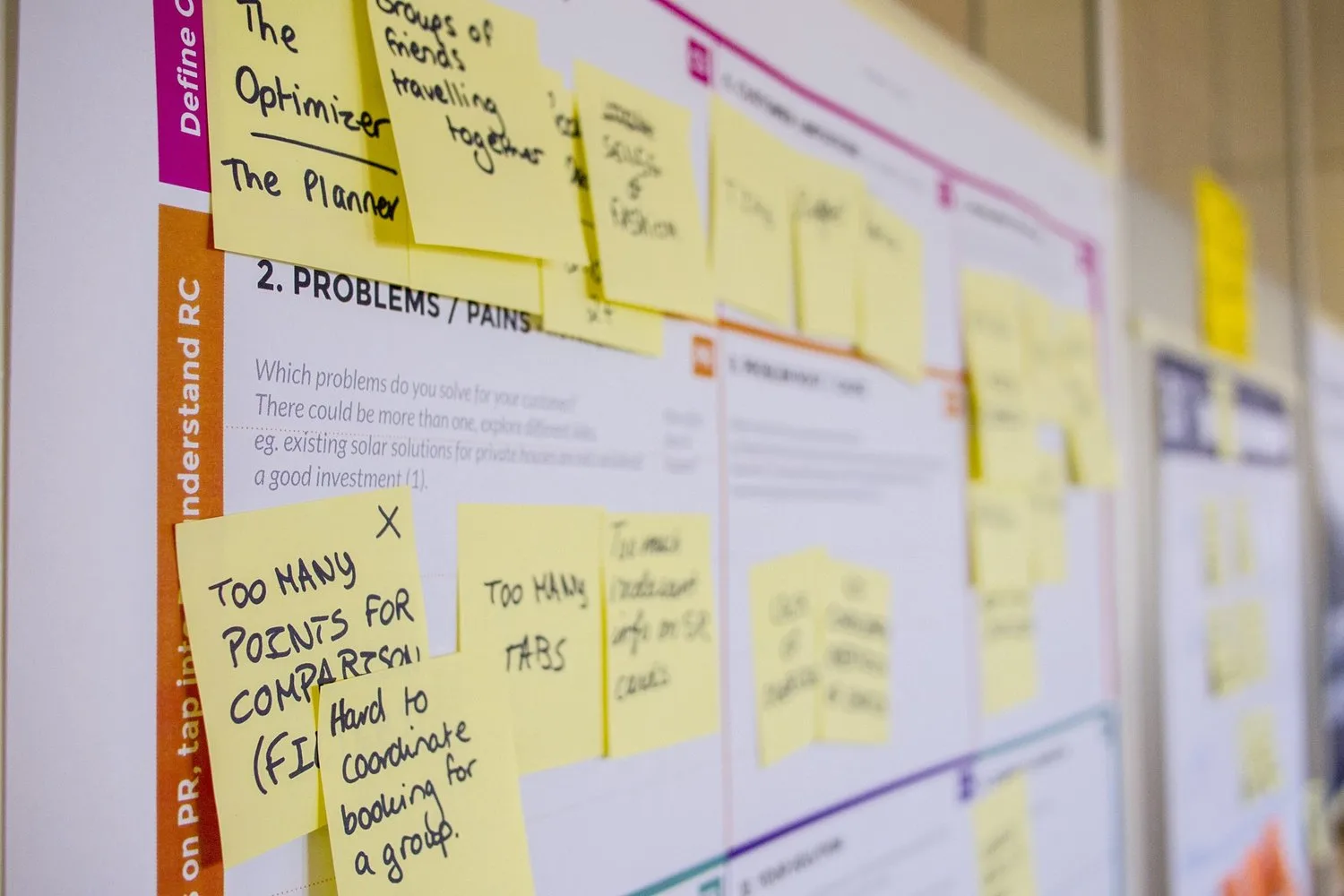
Design Sprints can generate remarkable output for your company, such as a backlog of impactful ideas (also with IP opportunities), functional prototypes, learnings, and key insights from customers along with real business opportunities. At the same time, they can lead to significant cultural improvements towards the ‘innovation mode’. But …