
Founder, Inventor & Author of Innovation Mode
George Krasadakis: building Innovation Mode Limited and Ainna.ai, the agentic innovation platform.
For 25 years, George has built what makes companies innovate: the AI systems, the teams, and the methods behind them. From data-mining engines in the '90s to agentic AI today, one conviction holds: innovation is an engineering problem.

Innovation Is an Engineering Problem. It Always Was.
George started with a conviction: software and data would reshape how organisations create value, not incrementally, but structurally. He studied computational statistics in the mid-1990s, built his first credit scoring and dynamic pricing systems before "data scientist" was a job title, and, in his early thirties, founded the company that grew to 20+ engineers serving multinationals.
Then he took that same builder’s instinct inside Microsoft, Accenture, GSK, and ResMed, and aimed it at a harder problem: making large organisations innovate systematically. Designed or optimised four innovation centres. 80+ projects shipped. 18 patent families (24+ filings), most as sole inventor: AI-powered ideation, autonomous negotiation agents, and natural language systems, filed mainly between 2015 and 2018, years before the industry caught up.
In parallel, George has been innovating on the innovation process itself: designing new methods, abstracting recurring problems, and finding solutions that evolved into frameworks, tools, and systems. That work led to a Springer book, then to Innovation Mode: Designing Innovative Companies in the Era of Artificial Intelligence, revised and expanded for the AI era, and now to Ainna.ai, the agentic innovation platform that makes it all operational. The thesis from day one: innovation is an engineering problem. Everything George has built is the proof.
From Data Mining to Autonomous Innovation
A 25-year arc across startups, global corporations, and five ventures, each building on the one before.
Where Data Met Software: Building Intelligent Systems from Day One
Datamine Decision Support Systems · Plantobuy · IdeachainFrom the mid-1990s, George was designing and building the intelligent software systems that would later become industry standard but, at the time, barely had a name. Data warehouses, predictive analytics engines, credit scoring models, web crawlers, competition analysis platforms, and dynamic pricing algorithms for telecom operators, banks, and retailers. The work was hands-on and end-to-end: writing code, modelling data, architecting components that turned raw information into competitive advantage.
That technical foundation became Datamine Decision Support Systems, a company George founded that grew to 20+ engineers and data scientists, delivering data-driven solutions to multinationals across telecom, banking, and retail. Churn prediction, campaign management, credit scoring, real-time competition analysis: Datamine was building what the industry would later call "data science", years before the term went mainstream.
In parallel, George was experimenting with new venture models: Plantobuy pioneered social commerce through anonymous buying-plan data, connecting retailers with consumer intent signals before the concept had a category. Ideachain applied blockchain to intellectual property protection, enabling timestamped, verifiable idea registration for innovators. Each venture tested a different hypothesis about how technology creates value, and each sharpened the frameworks that would eventually become the Innovation Mode.
Startup Speed at Corporate Scale
Microsoft · Accenture · GSK · ResMedThe startup years proved that small, focused teams could move from idea to product at extraordinary speed through relentless experimentation, tight feedback loops, and zero tolerance for process without purpose. The corporate years posed a different question: could that same velocity and inventiveness work inside organisations with thousands of employees, global operations, and institutional inertia? George brought the startup mindset (fast-cycle innovation, hands-on experimentation, and product-first thinking) into some of the world’s largest corporations, and built the architecture to make it stick at scale.
At Microsoft, two stints spanning content platform architecture, automated quality assessment, and novel product concept design. At Accenture's Global Center for Innovation, led software engineering, technology architecture and innovation programmes. This period produced the core inventions behind the 18 patent families (24+ filings), most as sole inventor, spanning AI-powered ideation, voice-driven brainstorming agents, intelligent negotiation systems, natural language query architectures, adaptive content translators, and gaze-tracking interfaces. Filed mainly between 2015 and 2018, years before generative AI entered the mainstream, these inventions described autonomous AI systems and intelligent agents that the industry would only begin building nearly a decade later.
At GSK, led the technology dimension of the Digital Innovation Hub, driving technology strategy and AI-powered product development within one of the world’s largest life sciences organisations. At ResMed, led the Discovery Labs, a multidisciplinary team optimised for opportunity discovery in digital health, conceiving and validating novel product concepts through rapid experimentation.
Designed or optimised four innovation centres. 80+ projects shipped. But the most valuable insight from the corporate years wasn’t what worked. It was seeing, from the inside, how even the most capable organisations struggled to innovate at pace and scale. That pattern, and the architecture George built to fix it, became the Innovation Mode.
The AI Era: From Frameworks to Autonomous Systems
Innovation Mode Limited · Ainna.ai · Innovation Mode (Author’s Edition)The data years built the technical intuition. The corporate years exposed the systemic failures. The AI era is where George turned both into products.
Innovation Mode: Designing Innovative Companies in the Era of Artificial Intelligence (Author’s Edition, 2026) codifies 25 years of practice into the first published blueprint for AI-powered corporate innovation: 70+ interventions, the 6 Innovation Deficits diagnostic, the 7-level Innovation Maturity Index, and a complete architecture for autonomous opportunity discovery. 75% new content, revised and expanded for the AI era the first edition anticipated.
Ainna.ai makes the frameworks operational: the agentic innovation platform that helps teams decide what to build and why, transforming ambiguity into clear, defensible product narratives. The frameworks tested across four industries confirmed it could work. Now it exists.
The innovation and AI strategy advisory programmes bring these frameworks directly to executive teams, deploying in 8 weeks the innovation architecture that would take a new hire months to design from scratch.
Five Ventures. From Data Mining to Blockchain and Agentic AI.
Five companies, all bootstrapped, each built on the conviction that great technology can solve big problems. Not all succeeded, but that’s innovation. The lessons from every win and every failure are wired into everything George builds today.
Datamine Decision Support Systems
Pioneered data mining and machine learning for intelligent decision-making across 20+ multinationals in telecom, banking, and retail. Built competition analysis, dynamic pricing, churn prediction, and credit scoring systems before these capabilities became mainstream.
Plantobuy
Introduced social commerce through anonymous buying-plan data, connecting retailers with consumer intent signals. An early experiment in data-driven market intelligence.
Ideachain
Brought blockchain to intellectual property protection for innovators, enabling timestamped, verifiable idea registration on a decentralised ledger. Explored how trust infrastructure could accelerate open innovation.
Innovation Mode
The advisory practice and ecosystem platform for corporate innovation, combining books, toolkits, advisory programmes, and thought leadership. The vehicle through which 25 years of frameworks became accessible to innovation leaders worldwide.

The agentic innovation platform that turns rough ideas into validated, stakeholder-ready opportunities, with the depth of a seasoned consultant and the speed of software. Pitch decks, PRDs, one-pagers, market sizing, persona profiles: generated from strategic conversation, not templates. Built on the Innovation Mode methodology.
Ainna Enterprise →18 Patent Families, Most Filed Before the AI Wave
Filed mainly between 2015 and 2018, years before generative AI entered the mainstream: 24+ filings, most as sole inventor, describing AI-powered systems that the industry is only now building. The early work on agentic AI anticipated by nearly a decade what is now recognised as essential.
Candidate Participant Recommendation
Machine-learned matching of people to projects, meetings, and collaborative engagements, assembling the right team from skills and context signals.
Voice-Driven Brainstorming Agents
Natural language systems that facilitate, capture, and structure ideas during live brainstorming sessions, converting unstructured conversation into actionable concepts.
Intelligent Negotiation Agents
AI-powered frameworks enabling autonomous buyer-seller interactions: early examples of agentic AI operating independently on behalf of users.
Live Audience Experience Systems
Connecting in-venue and online audiences through real-time emotional-state signals. Granted in the US and Europe.
Gaze-Tracking Interfaces
User interfaces navigated through eye movement, exploring new paradigms for human-computer interaction.
Context-Aware Media Systems
Intelligent systems that organise and adapt media delivery using signals captured from the viewing environment: personalisation through spatial awareness.
Closed-Loop Query Architecture
A natural language query system that dynamically synthesises responses as coherent data stories, adapting delivery based on context, bandwidth, and user preferences.
Intelligent Content Moderation
Hierarchical document classification combining text-based AI models with image-based metadata identification, automating content analysis at scale.
Public Multi-Screen Content Delivery
Networked systems that deliver personalised content across public multi-screen environments, using facial recognition and environmental signals to adapt in real time.
All 18 families with filings, grants, citations, and the twenty-year lineage, on the Research & Patents page. Source records on Google Patents and Google Scholar.
Interested in working together?
Get in Touch →Published Frameworks. Open Knowledge.
Two Springer titles, the expanded Author’s Edition, two open-access eBooks, and 100+ articles on innovation, AI, and product development.
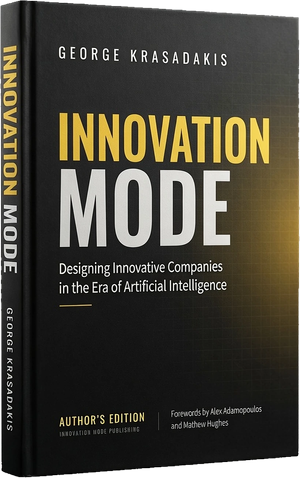
Innovation Mode
The executive operating manual for building AI-powered innovation functions. 70+ interventions, 6 Innovation Deficits diagnostic, 7-level Innovation Maturity Index, and the first published blueprint for autonomous corporate innovation. 75% new content, revised and expanded for the AI era.

The Innovation Mode
The first edition that established a new standard for practitioner-focused innovation frameworks, referenced by researchers and corporate innovation teams worldwide. The foundation on which the Author’s Edition was built.

60 Leaders on Innovation
22 questions answered by 60 global executives from Innosight, BCG, General Catalyst, IBM, and Microsoft. 286 pages. Free.
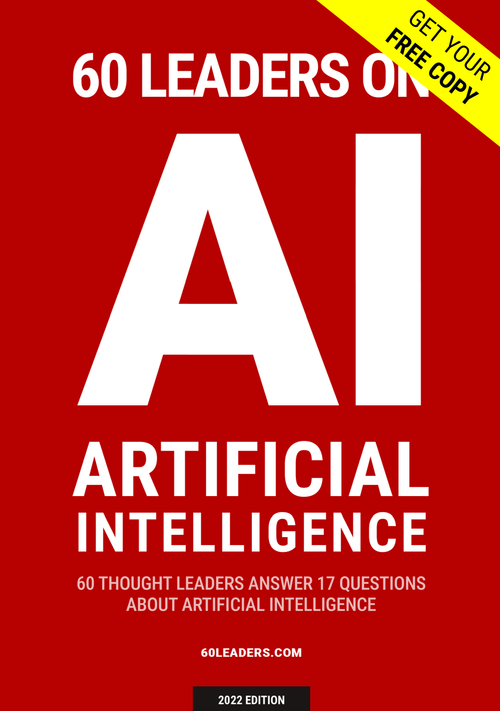
60 Leaders on Artificial Intelligence
60 thought leaders discuss AI’s transformative impact across healthcare, finance, manufacturing, and beyond. Free.
100+ articles published on The Innovation Blog, Medium, FreeCodeCamp, HackerNoon, and StartupGrind.
True innovation is driven by capable, inspired people who believe in the purpose of the organization. The single most important success factor is a vivid environment characterized by diversity of thought and a special discovery mode.
George Krasadakis, 60 Leaders on Innovation, 2021Academic Foundations
MSc in Computational Statistics
University of Bath · 1996–1997
Statistical modelling, data analysis, and computational methods: the mathematical foundations that underpin 25 years of work in AI, data mining, and predictive analytics.
BSc in Statistics & Actuarial Science
University of Piraeus · 1991–1996
Probability, statistical inference, and actuarial modelling, building the quantitative discipline that shaped a career in data-driven technology and AI.
Published Research
600+ Scholar Citations
Published research in innovation management, AI applications, and product development, referenced by academics and practitioners worldwide. View on Google Scholar → · Research & Patents →
Enter the Innovation Mode
Innovation as a system, not a series of disconnected programmes. Your AI-powered innovation function: diagnosed, designed, and deployed in a focused 8-week engagement.