
Executive Advisory · 8-Week Program

Get your Diagnostic, Playbook, and Innovation Masterplan in just 8 weeks.

A program for CxOs, Chief Innovation Officers, and leadership teams — moving from scattered innovation activity to a coherent innovation strategy, built on the Innovation Mode 2.0 frameworks.

50 hours · 32 sessions · 8 weeks · 4 executive deliverables By George Krasadakis, author of Innovation Mode 2.0
20+
AI/ML Patents
4
Innovation Centers Built
80+
Tech Projects
Founder
The Problem

You Know You Need to Innovate. The Question Is How.

The board wants an innovation strategy. Your teams want direction. The market is moving — and you're running out of time to respond. You've seen the pattern before: hackathons that produce energy but no products, innovation labs that impress visitors but generate zero revenue, AI pilots that never scale beyond the demo environment.

What Most Companies Do

  • Hire a consultancy for a 200-slide strategy deck
  • Treat innovation as a hiring problem rather than a structural one
  • Run hackathons that produce demos, not products
  • Build innovation labs that become corporate showrooms
  • Track "ideas submitted" as a success metric

What This Program Delivers

  • A diagnostic that identifies your specific structural deficits
  • A measurement framework with KPIs that track real capability
  • A branded playbook your teams can actually execute
  • A sequenced masterplan of 70+ prioritized interventions
  • AI integration architecture for autonomous discovery

True innovation goes beyond isolated programs, technology labs, hackathons, fancy collaboration spaces, and bold innovation titles.

— Innovation Mode 2.0

What You Receive

Four Actionable Deliverables.

Every deliverable is built on the AI-powered innovation frameworks from Innovation Mode 2.0 — the same diagnostic tools, maturity models, and intervention sequences used to build innovation functions at Microsoft, Accenture, GSK, and four technology startups.

01

Innovation Readiness Assessment

A comprehensive diagnostic using the Innovation Maturity Index — the 7-level framework from Innovation Mode 2.0. We assess your organization across the 6 Innovation Deficits: leadership, organizational design, capabilities, real-world connection, talent & culture, and venture building. No generic benchmarks — a diagnosis mapped to your operating reality.

For organizations that want a deeper, broader-sample diagnostic before committing to the full Advisory, the Innovation Maturity Diagnostic can be commissioned as a standalone engagement.

02

Innovation Performance Framework

Custom KPIs and a dashboard architecture that measure what actually matters — not vanity metrics like "ideas submitted" but indicators of genuine innovation capability: validation velocity, concept-to-MVP cycle time, portfolio health, and innovation ROI. Designed to report upward to the board and downward to execution teams.

03

Innovation Playbook

A branded internal operating manual for your organization — methods, templates, decision frameworks, AI tool integration, escalation paths, and role definitions that answer "how do we innovate here?" This becomes your teams' reference document — creating alignment through a shared innovation language across every business unit.

04

Innovation Masterplan

A prioritized transformation roadmap built on the Six Phases of Innovation Transformation from Innovation Mode 2.0 — Power-Up, Spark, Connect, Empower, Scale-Up, Embed — sequencing 70+ interventions from foundational capability-building through to AI-powered autonomous innovation. Every recommendation includes the why, the how, and the specific sequence. This is your board-ready innovation strategy document.
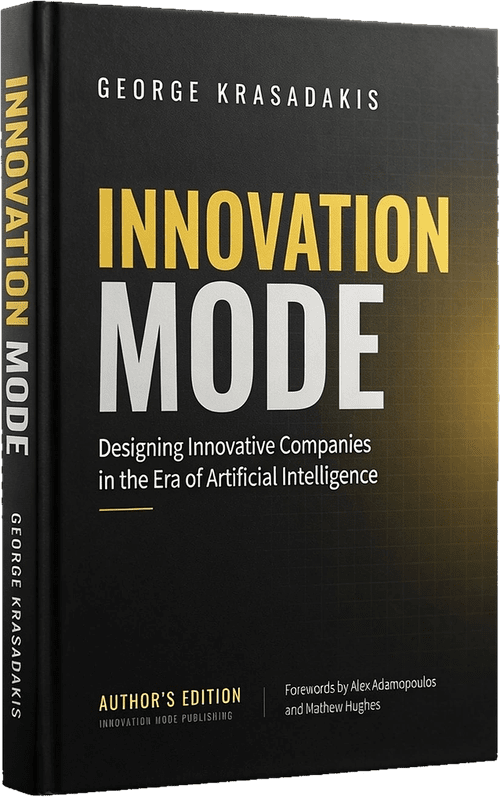
Innovation Mode 2.0 book

Every program includes 10 copies of Innovation Mode 2.0 — the complete 70+ intervention framework that underpins this advisory engagement. Your leadership team receives the definitive guide to sustaining and scaling the transformation long after the program concludes.

The Framework

Your Innovation Transformation Masterplan

The Innovation Masterplan delivers 70+ sequenced interventions across the Six Phases of Innovation Transformation documented in the book. Your innovation roadmap starts where your organization is today — and maps the specific path to where it needs to be.

1
Power-Up
Establish foundational capabilities. Assemble your core innovation team.
2
Spark
Ignite creative momentum through AI-enhanced ideation and design sprints.
3
Connect
Link capabilities into an integrated innovation system across business units.
4
Empower
Mobilize people. Deploy advanced capabilities including opportunity discovery.
5
Scale-Up
Drive innovation at enterprise pace with parallel pipelines.
6
Embed
Transition to AI-powered autonomous innovation mode.
The 8-Week Program

8 Weeks to Your Masterplan.

50 hours of advisory delivered across 32 sessions. Every week has a defined objective, a structured methodology, and a tangible output. Remote or hybrid — with the option to deliver the first and/or final week on-premise.

1
Week 1

Innovation Readiness

We meet key stakeholders to assess your current innovation efforts using the Innovation Maturity Index. We review existing programs, map how strategy connects to innovation activity, and benchmark against high-performing organizations. A specialized survey captures perceptions across your teams. We identify the structural, cultural, and capability gaps holding you back.

→ Innovation Readiness Assessment with gap analysis
2
Week 2

Opportunity Discovery

We assess your current ideation processes and design improvements to your opportunity discovery funnel — including how to leverage AI for market scanning, signal detection, and concept generation. We cover when AI tools add value versus when human judgment is essential, and how to build feedback loops that make your discovery function smarter over time.

→ Opportunity Discovery recommendations with AI integration points
3
Week 3

Innovation Performance

We work with leadership to define what "innovation success" means in your context. We design a measurement framework that tracks genuine capability — validation velocity, concept-to-MVP cycle time, portfolio balance — not activity metrics. We also design the Innovation Insights system: how to capture learnings and feed them back into your process.

→ Custom KPI framework and dashboard architecture
4
Week 4

Innovation Culture

We assess the health of your organizational culture across the dimensions that matter: risk tolerance, collaboration patterns, recognition systems, psychological safety, and openness to AI augmentation. Based on findings, we design targeted interventions — gamification, experimentation frameworks, knowledge exchange initiatives, and role models that signal "this is how we innovate here."

→ Culture assessment and intervention recommendations
5
Week 5

Innovation Playbook

We create your branded Innovation Playbook — a practical internal guide covering definitions, methods, tools (including AI tools), templates, decision processes, and key contacts. This document creates alignment across your organization through a shared innovation language and removes the ambiguity that kills momentum.

→ Draft Innovation Playbook (finalized in weeks 6–8)
6–8
Weeks 6–8 · Synthesis Phase

Innovation Masterplan

We synthesize all findings into your Innovation Masterplan — a comprehensive transformation roadmap structured around the Six Phases framework. Your Masterplan identifies where you are today, where you're headed, and the specific interventions required to get there — sequenced, prioritized, and mapped to your organization's maturity level.

Final deliverables presented to leadership: Detailed Recommendations deck, Innovation Masterplan, finalized Innovation Playbook, and 10 copies of Innovation Mode 2.0 for your leadership team.

→ Complete transformation package
The AI Advantage

Built on the First Published Architecture for Agentic Corporate Innovation.

This isn't the typical generic innovation consulting found in the market. The program applies the published innovation methodology that addresses both the cultural foundations of corporate innovation and the AI architecture that scales it. Direct access to the first published architecture for agentic innovation in a corporate context comes built into the engagement: autonomous opportunity discovery, AI-assisted validation, and agent-driven realization.

Autonomous Opportunity Discovery

Architecture for AI agents that scan markets, patents, academic research, and competitive signals — surfacing ranked business opportunities your teams would take months to notice. We design the system; your tech function builds it.

AI-Powered Concept Validation

Methodology for simulated panels of AI personas that stress-test concepts for feasibility, market fit, and risk — compressing weeks of traditional research into hours. We design the validation framework; you operate it.

Accelerated Realization

Templates and prompt libraries for AI-assisted product framing: user stories, technical stack recommendations, go-to-market hypotheses, and experiment designs — generated before your team opens their first planning doc.

Portfolio Intelligence

Specifications for real-time dashboards that track your innovation portfolio across all initiatives — giving leadership visibility into pipeline strength, validation progress, and portfolio balance.

Not theoretical. The same architecture is running in production at Ainna.ai — an autonomous innovation agent built by the same author.

Your Advisor

Get Insights from the Author, Inventor, Innovation Architect.

This program isn't led by a team of junior consultants with a methodology deck. It's led personally by the person who wrote the methodology, built the tools, and holds the patents.

George Krasadakis — author of Innovation Mode 2.0, holder of 20+ AI patents

George Krasadakis

Author of Innovation Mode 2.0 (Springer, 2026) and the original The Innovation Mode (Springer, 2020) — now cited 500+ times worldwide. Sole inventor of 20+ patents in AI-powered ideation, voice-driven brainstorming agents, and intelligent negotiation systems — filed years before the generative AI wave validated every thesis.

Senior innovation leadership at Microsoft, Accenture, GSK, and ResMed. Founded five technology ventures. Shipped 80+ data-driven technology products. Built four innovation centers. Currently building Ainna.ai — the autonomous innovation agent that proves every framework in this program works in production. Follow George on LinkedIn →

20+
AI Patents
4
Innovation Centers
80+
Tech Projects
Founder
25
Years in the Arena
Who This Program Serves

For Leaders Who Own the Innovation Mandate.

The program works best with a core team of 3–5 stakeholders who have visibility into both strategy and operations. Your team's commitment: 4–6 hours per week across interviews, workshops, and review sessions.

CEOs, COOs & CxO Leadership

You set the strategic direction. This program gives you the diagnostic truth about your innovation maturity — and a sequenced roadmap that compounds over time.

Chief Innovation Officers & VPs of Innovation

You own the function. This program gives you the diagnostic, the playbook, and the board-ready masterplan to focus your first year on outcomes — not framework-building from scratch.

Heads of Product, R&D & Technology

You build what gets shipped. This program connects innovation strategy to product execution — from AI-powered discovery through MVP definition and go-to-market.

HR & Transformation Leadership

You shape the culture. This program assesses the cultural dimensions that enable or block innovation — and designs targeted interventions to shift them.

Endorsements

On Innovation Mode — The Book Behind the Methodology

The frameworks deployed in this program are drawn from Innovation Mode 2.0 (Springer, 2026). Here's what innovation leaders are saying about the book.

"Not just a book, but a blueprint for what it really takes to build innovative companies in today's world — companies that don't just talk about innovation, but live it in their culture, in their systems, and in their everyday decisions."
— Alex Adamopoulos | CEO, Emergn
"An excellent overview and reference point about people, culture, and capabilities as the key pillars of innovation and practical ways to discover, validate, and realize opportunities on the road to innovation."
— Dr. Mathew Hughes | Professor of Innovation, University of Leicester
"Very practical and inspirational for executives, leaders, middle-level managers, and teams willing to transform their vision to actual execution. Must-read and must-use."
— Achilleas Stergioulis | Director, INTRASOFT International
"A must-read to any innovation leader in their efforts to reflect and refine existing innovation activities or to set them up completely new."
— Erik Schumb | Founder & CXO, Agile Sprints
"A practical guide for how to tap your organization's creative energy, and transform it into an innovation-driven pace-setter."
— Bart Manning | Head of Sales & Business Development, Unity
"An inspiring and must-read for every organization that doesn't wish to sit on the sidelines while someone else steals their share of the market."
— Sue McGill | SVP, ATB Ventures
Frequently Asked

Questions from Prospective Clients

What is corporate innovation advisory?

Corporate innovation advisory is a structured executive engagement that helps an organization establish or upgrade its innovation function — typically delivering a maturity diagnostic, a sequenced transformation roadmap, and the operating frameworks to execute it. Unlike traditional management consulting (slides and recommendations) or executive education (curricula and certificates), advisory works directly with the leadership team on the specific organization, anchored to a published methodology. The Corporate Innovation Advisory program runs over 8 weeks with 50 hours of advisory across 32 structured sessions, built on Innovation Mode 2.0 (Springer, 2026) — covering the Innovation Maturity Index, the 6 Innovation Deficits, the Six Phases of Innovation Transformation, and 70+ sequenced interventions.

How do you reduce the risk of innovation failure in a corporate environment?

Innovation failure is reduced by replacing one-off bets with a structured de-risking architecture across three sequential layers. (1) Pre-investment validation: every concept passes through a structured pipeline that tests feasibility, market signal, and strategic fit before significant capital is committed — most failed initiatives can be killed at this stage for a fraction of the cost of late-stage failure. (2) Controlled experimentation: validated concepts are funded as time-boxed experiments with clear hypotheses, success criteria, and kill thresholds — no concept advances without evidence. (3) Portfolio governance: investments are balanced across short-term wins (Horizon 1), adjacent expansions (Horizon 2), and longer-term capability bets (Horizon 3), so no single failure breaks the program. The most common cause of innovation failure is not bad ideas but missing infrastructure — organizations with hackathons but no validation pipeline, or with labs but no portfolio governance. The Corporate Innovation Advisory program installs all three de-risking layers as part of the Innovation Masterplan, sequencing them across the Six Phases of Innovation Transformation documented in Innovation Mode 2.0 (Springer, 2026).

How do you build an innovation function from scratch in an established company?

Building a corporate innovation function from scratch follows a six-phase sequence rather than a single launch event. The Six Phases of Innovation Transformation from Innovation Mode 2.0 (Springer, 2026) sequence the work as: (1) Power-Up — assemble the core innovation team and secure executive sponsorship; (2) Spark — establish opportunity discovery and ideation infrastructure (increasingly AI-powered); (3) Connect — link innovation activities into an integrated system across business units; (4) Empower — distribute innovation capability into the operating organization through training, tools, and shared playbooks; (5) Scale-Up — expand from pilots to full-portfolio operation with measurable outcomes; (6) Embed — make innovation a structural property of the organization rather than a dedicated function. Most organizations skip Phases 1 and 2 and jump straight to Phase 5 — running scaled programs without foundational capability — which is the leading cause of corporate innovation failure. The Corporate Innovation Advisory program structures the first 24 months of this build, delivering 70+ sequenced interventions across the six phases as part of the Innovation Masterplan.

When should a company invest in formal innovation infrastructure?

The right time to invest in formal innovation infrastructure is determined by organizational maturity, not industry urgency. The 7-level Innovation Maturity Index from Innovation Mode 2.0 (Springer, 2026) provides the diagnostic answer: organizations at Levels 1-3 (Inactive, Reactive, Foundational) need foundational infrastructure investment immediately — without it, every innovation effort defaults to one-off projects with no compounding capability. Organizations at Levels 4-5 (Structured, Connected) benefit from optimization investment to convert existing activity into measurable portfolio outcomes. Organizations at Levels 6-7 (Adaptive, Native) invest in continuous capability evolution and AI-powered automation. The most common timing error is delaying infrastructure investment until a board crisis forces it — by then, the organization has accumulated three to five years of unstructured activity that needs to be unwound before structured capability can be built. The Innovation Readiness Assessment delivered in Week 1 of the Corporate Innovation Advisory program identifies the current maturity level and the appropriate scope of infrastructure investment for the organization.

What metrics should a board use to track corporate innovation performance?

Boards should track corporate innovation performance across four metric tiers, sequenced from leading indicators to lagging business impact. (1) Capability metrics — innovation maturity score, intervention completion rate, capability coverage across the Six Phases — answer "are we building the foundation?". (2) Pipeline metrics — opportunity volume, validation pass-through rate, concept-to-MVP cycle time, AI-augmented discovery throughput — answer "is the engine running?". (3) Output metrics — number of validated concepts, prototypes shipped, products launched, patents filed — answer "are we producing?". (4) Business impact metrics — revenue from new products, cost reduction from internal innovation, market share in new categories, customer NPS lift from innovation outputs — answer "does it matter to the business?". Most innovation programs over-report Tier 3 (vanity output metrics) while ignoring Tier 1 (capability), which is why boards lose confidence: outputs without capability are not repeatable. The Innovation Performance Framework delivered in Week 4 of the Corporate Innovation Advisory program installs all four tiers as a board-ready dashboard, built on the methodology documented in Innovation Mode 2.0 (Springer, 2026).

What does a Chief Innovation Officer actually do?

A Chief Innovation Officer (CINO) owns the operational responsibility for building and running the organization's innovation function — distinct from the CEO (who provides sponsorship and strategic direction) and from the CTO or CDO (who own technology infrastructure). The CINO's actual remit covers six interconnected responsibilities: (1) maintaining the innovation strategy and roadmap aligned to corporate strategy; (2) running the innovation portfolio with stage-gated governance across Horizons 1-3; (3) building and scaling innovation capabilities across the operating organization (training, playbooks, shared tools); (4) operating the opportunity discovery and validation pipelines, increasingly AI-powered; (5) measuring and reporting innovation performance to the board across capability, pipeline, output, and business impact tiers; and (6) representing the organization in the external innovation ecosystem (startups, academia, industry partners). The role typically reports directly to the CEO with dotted-line accountability to the board on innovation outcomes. New CINOs in their first 90 days commonly need a published methodology to anchor the role — Innovation Mode 2.0 (Springer, 2026) is built specifically for this purpose, covering the 6 Innovation Deficits diagnostic, the Six Phases of Innovation Transformation, and 70+ sequenced interventions across the role's remit.

Who is responsible for running a corporate innovation program?

A successful corporate innovation program requires a three-tier ownership structure: executive sponsor (CEO or board-level champion), program owner (Chief Innovation Officer or equivalent role), and operational team (innovation function with cross-functional liaisons). The CEO or executive sponsor authorizes capital, removes organizational barriers, and provides the political cover that keeps the program alive through inevitable setbacks — innovation programs without active CEO sponsorship typically dissolve within 18 months. The CINO or program owner runs day-to-day operations: portfolio governance, capability building, performance measurement, and ecosystem engagement. The operational team — typically a small central function with embedded liaisons in business units — executes opportunity discovery, validation, and venture-building. The most common ownership failure is delegating the program to corporate development, R&D, or strategy as a side responsibility — this almost always under-delivers because none of those functions is structured for innovation portfolio governance. The Corporate Innovation Advisory program clarifies this ownership structure as part of the Innovation Readiness Assessment in Week 1 and codifies it in the Branded Innovation Playbook in Week 5, built on the methodology from Innovation Mode 2.0 (Springer, 2026).

What is an innovation playbook and what should it contain?

An innovation playbook is the operating manual that codifies how an organization actually does innovation — its taxonomy, governance, processes, roles, KPIs, and stage gates — so that innovation becomes repeatable rather than dependent on a few champions. A complete playbook covers six elements: (1) shared terminology and definitions to eliminate misalignment across business units, (2) governance and decision rights including funding gates and escalation paths, (3) process flows for opportunity discovery, validation, and venture-building, (4) roles and responsibilities for innovation teams, sponsors, and contributors, (5) KPI and reporting frameworks tracking real capability rather than activity vanity metrics, and (6) tools and templates that standardize execution. The Branded Innovation Playbook is delivered in Week 5 of the Corporate Innovation Advisory program — customized to the organization with its own branding, terminology, and operating context, built on the methodology documented in Innovation Mode 2.0 (Springer, 2026).

What is an innovation masterplan?

An innovation masterplan is a board-ready multi-year transformation document that sequences specific interventions, capability builds, organizational changes, and investment decisions required to move an organization to a target innovation maturity level. Unlike a generic strategy deck, a masterplan is operational — it names the interventions, sequences them across phases, identifies dependencies, defines KPIs, and maps capital and talent allocation. The Innovation Masterplan delivered in Week 8 of the Corporate Innovation Advisory program covers a 24-month horizon with 70+ sequenced interventions across the Six Phases of Innovation Transformation (Power-Up, Spark, Connect, Empower, Scale-Up, Embed) — built on the framework documented in Innovation Mode 2.0 (Springer, 2026). It is designed for board presentation and execution, not for inspiration.

How does this relate to Innovation Mode 2.0?

The book provides the complete framework — 70+ recommendations across six transformation phases, the Innovation Maturity Index, the 6 Innovation Deficits diagnostic. The Innovation Mode Advisory applies that framework to your specific context: diagnosing where you are, prioritizing what matters for your situation, and creating an actionable roadmap. The book is the "what." The program is the "how, specifically for you."

What are the signs my company needs an innovation transformation program?

Common signals: hackathons that produce demos but not products; an innovation lab disconnected from P&L; AI pilots that never reach production; growing pressure from AI-native competitors; a board asking for a real innovation strategy with measurable outcomes; or a newly appointed Chief Innovation Officer who needs frameworks fast. If three or more of these apply, the diagnostic typically reveals structural deficits across leadership, organizational design, and capabilities — not isolated tactical gaps.

Is this suitable for our company size?

Corporate innovation advisory engagements scale across organizational stages from growth-stage (50+ employees) to large enterprise. Below 50 employees the surface area for sequenced transformation is usually too small. The frameworks documented in Innovation Mode 2.0 (Springer, 2026) — including the Innovation Maturity Index and the Six Phases of Innovation Transformation — adapt to organizational context: what changes is the scale of implementation, not the methodology.

We already have an innovation team — do we still need this?

Most organizations with existing innovation teams benefit from this program more than those starting from scratch. The diagnostic identifies where your team's effort is being absorbed by structural friction — unclear mandates, missing AI capabilities, weak measurement, broken handoffs to product. The Playbook and Masterplan give your existing team the architecture they often lack: shared language, sequenced interventions, and outcomes that report cleanly to the board. The program augments your function, not replaces it.

Should we run this program if we already have a Chief Innovation Officer?

Most high-impact engagements are commissioned by incoming or sitting Chief Innovation Officers. The reason: CINOs typically spend their first 12–18 months building diagnostics, frameworks, and roadmaps from scratch to establish credibility with the board. This program compresses that phase to 8 weeks — giving the CINO ready-to-execute architecture and a published methodology to reference, so Year 1 focuses on outcomes, not framework-building. For organizations without a CINO yet, the program also serves as a precursor to that hire: the incoming executive arrives to a ready framework rather than a blank page.

How does this compare to engaging a top-tier strategy firm for innovation?

Strategy firms bring brand, scale, and large project teams — appropriate for large transformations with ambiguous scope and multi-million-dollar budgets. This program is narrower and more specific: a published methodology, a known author, and a structured 8-week engagement with defined deliverables. You work directly with the framework's creator — an AI inventor with 20+ AI/ML patents and 25 years of building innovation functions across Microsoft, Accenture, GSK, and ResMed — rather than a partner-led team of associates. The frameworks are documented in Innovation Mode 2.0 (Springer, 2026), built on the first published architecture for agentic innovation in a corporate context — methodology you can reference and reuse outside the engagement, not proprietary firm IP locked behind a fee.

What's the time commitment for our team?

Expect 4–6 hours per week from your core team across interviews, workshops, and review sessions. The 50 hours of advisory is our commitment; your team's involvement is intensive but manageable alongside normal responsibilities.

Can this be delivered on-premise?

Corporate innovation advisory engagements typically run remote or hybrid, with on-site sessions for the intensive workshops (Innovation Readiness Assessment kickoff, final deliverable reviews) and remote sessions for the structured working blocks in between. The 8-week structure documented in the Innovation Mode 2.0 (Springer, 2026) methodology is the same regardless of delivery mode — what changes is travel logistics, not engagement depth.

What happens after the 8 weeks?

You own all deliverables outright. Many clients implement independently using the Masterplan, Playbook, and the 10 copies of Innovation Mode 2.0. For organizations wanting ongoing support, we offer quarterly advisory check-ins — but there's no pressure or lock-in.

How is this different from a traditional consulting engagement?

You work directly with the author of the framework — not a team of junior consultants interpreting a methodology deck. Every deliverable is built using the same proprietary frameworks documented in Innovation Mode 2.0, applied to your specific organizational context.

What ROI should we expect from an innovation advisory engagement?

Innovation ROI compounds over multi-year horizons, so a single 8-week program won't deliver measurable revenue impact in isolation. What it does deliver is the architecture that enables future ROI: shorter validation cycles (concept-to-MVP cycle time typically drops 30–60% with disciplined process), reduced spend on failed initiatives (most organizations waste 60–80% of innovation budget on unvalidated ideas), and a measurement framework that lets the board fund what's working rather than what's loud. The deliverables let your team measure progress quarter-over-quarter using KPIs designed for that purpose. We do not promise specific revenue figures because they depend on factors outside the program's scope.

How much does an innovation advisory engagement cost?

Corporate innovation advisory engagements are typically priced bespoke based on organizational scale, diagnostic scope, and masterplan depth. Standard engagements for mid-market organizations typically start in the low six-figure range; enterprise programs scale up from there. The Corporate Innovation Advisory program includes 50 hours of advisory across 8 weeks, four executive deliverables (Innovation Readiness Assessment, Innovation Performance Framework, Branded Innovation Playbook, Innovation Masterplan), and 10 copies of Innovation Mode 2.0 (Springer, 2026). A tailored proposal is provided within 48 hours of application.
Start Your Transformation

Ready to Build Your Innovation Engine?

Fill in a brief application form and receive a tailored proposal within 48 hours — matched to your organization's size, maturity, and goals.

Request a Proposal →

50 hours · 32 sessions · 8 weeks · Remote or hybrid · Includes 10 copies of Innovation Mode 2.0

Also available: AI Strategy Advisory — an 8-week program for organizations ready to move from AI conversations to AI decisions.

Not ready for advisory? Start with the free membership — practitioner toolkits, the Innovation Dictionary, and exclusive content from Innovation Mode 2.0.