Corporate innovation is an organisation’s innovation function: the system of processes, services, technology, knowledge and human talent through which it discovers and pursues new opportunities, consistently and at speed.
Innovation Mode defines the innovation function as an always-on system of processes, services, technology tools, knowledge and talent, aiming to maximise the organisation’s ability to discover and pursue opportunities.1 Corporate innovation refers to this innovation function adapted to established corporate environments, where innovation is, by definition, more complex and demanding.
Corporate innovation’s objective is to surface high-potential opportunities, at speed and scale, and to provide the means to make better, faster decisions. The corporate innovation function senses the market and the organisation, monitors competition, emerging trends and the technology state of the art, and helps the leadership set the right innovation agenda. Beyond steering the innovation efforts, the corporate innovation function identifies problems worth solving, mobilises the organisation to solve the right ones, provides the means to validate opportunities early and the tools to obtain real-world evidence and make wise decisions fast.
Truly innovative companies master both discovery and execution, and the best of them reach a state where innovation is no longer a separate activity but part of how the company runs: the Innovation Mode.
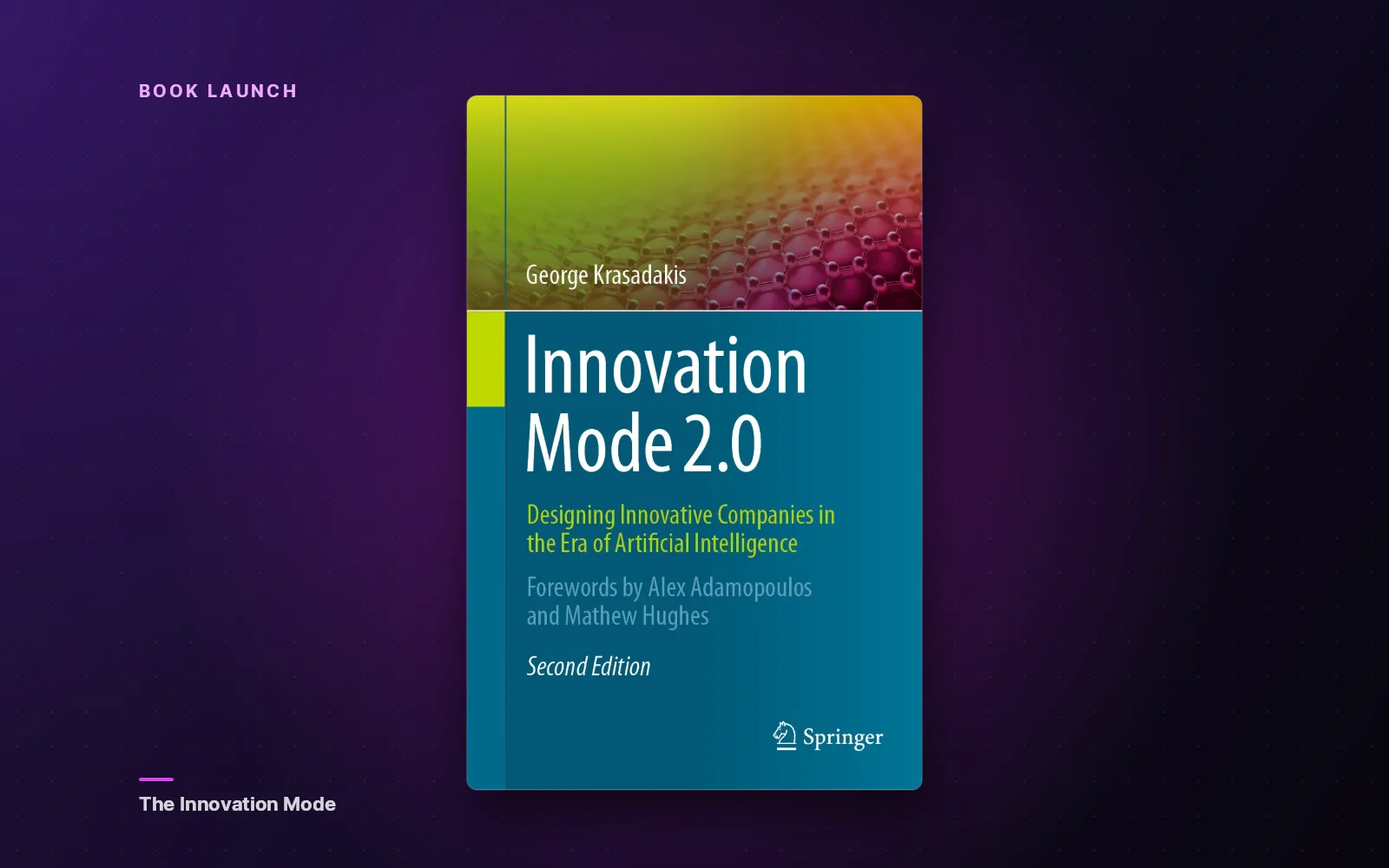
From the method in Innovation Mode, the practitioner manual on designing and running innovative companies in the AI era.
The vocabulary of corporate innovation
Innovation is one of the most overused words in business, and the confusion is costly: a company that cannot say what counts as innovation cannot measure it, fund it or manage it. Innovation Mode starts by fixing the terms.
“Clarity in terminology is essential for the success of corporate innovation: it fosters a shared understanding of the underlying principles and accelerates the adoption of related methods and practices.”2
- Novelty
- Being new. Inside a company, novelty is relative: an idea can be new to the world, to the industry, to the company or only to the product.
- Invention
- A solution to a problem that is novel and proven workable, whether or not it is ever built or sold.
- Innovation
- In most definitions, such as the OECD’s, an idea counts as innovation only once it is implemented and in users’ hands.
- Innovation opportunity
- A validated, novel solution that is not yet built or launched, but is expected to work, to pay and to matter to enough users.
Why does corporate innovation need its own definition?
Market-level definitions measure innovation after the fact: an idea counts once it has launched and been adopted. Inside a company that is too late, and it misses most of the work. A product concept with verified novelty that has passed rigorous user testing is already genuine innovative activity, before it ships, and even if it later fails. So Innovation Mode defines the unit a company can track as it happens:
“An innovation opportunity is a well-defined, validated, novel solution that is estimated to be technically feasible, economically viable, and impactful for a critical mass of users.”3
Producing such opportunities consistently, and carrying the best of them to market, is the job of the company’s innovation function.
What are the types of corporate innovation?
The book classifies corporate innovation in three ways, and an innovation strategy needs all three: what the innovation changes, how far it departs from what exists, and how the company organises for it.
| By | Types | What it tells you |
|---|---|---|
| Target | Product, process, marketing, organisational, business model | What the innovation changes |
| Intensity | Incremental, progressive, radical | How far it departs from what exists, and so how much investment, talent and risk it takes |
| Model | Centralised, decentralised, federated | How the company organises innovation: a central lab, innovation from any team, or a network of innovation cores on one language, method and toolset |
Disruptive and open innovation cut across all three lenses; the Innovation Dictionary defines each type.
What makes a company genuinely innovative?
Nearly every company calls itself innovative; few can show it. In Innovation Mode, the difference is that innovative companies master both discovery and execution. They spot valuable opportunities through systematic ideation, assessment and validation, and they realise them through fast implementation, smart go-to-market and in-market experimentation. They keep what the book calls a “reflex advantage”: the ability to sense opportunities and respond quickly.
“True innovation goes beyond isolated programs, technology labs, hackathons, fancy collaboration spaces, and bold innovation titles.”4
At its most mature, innovation stops being a programme and becomes the way the company runs: the state the book calls the Innovation Mode, in which, as it puts it, innovation happens organically.
Why does corporate innovation fail?
The conditions have never looked better: methods, tools, data and AI are all within reach. Yet most programmes underdeliver. Innovation Mode groups the causes into six innovation deficits: leadership, organisational design, innovation capabilities, real-world connection, talent and culture, and venture building. The first is the root of the others:
“While innovation success often results from collaborative efforts across an organization, corporate innovation failure always reflects leadership’s limitations or poor decisions.”5
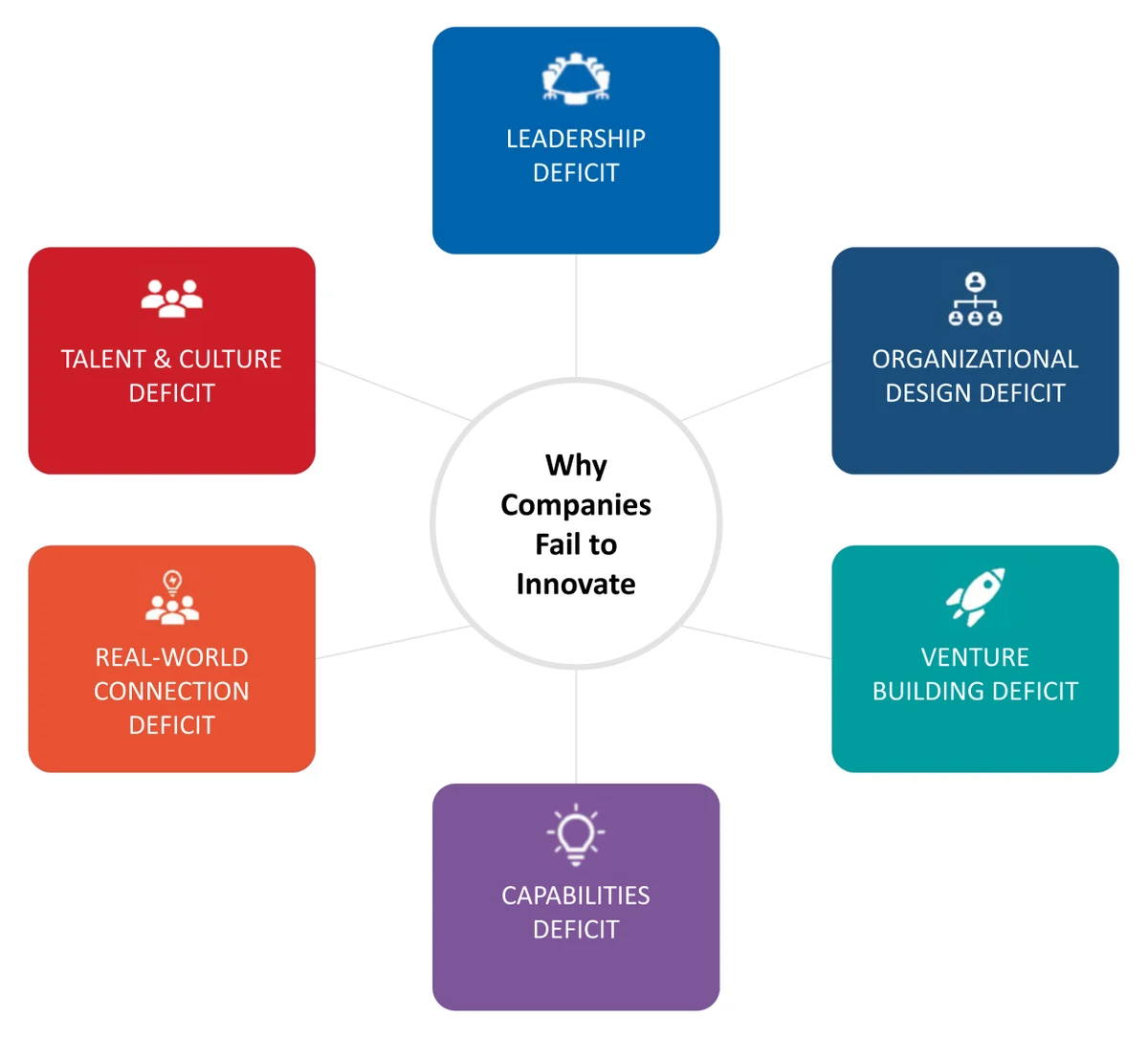
The full diagnosis is in Why corporate innovation (very often) fails. Corporate Innovation Advisory starts with a diagnostic on the six deficits.
How innovative is your company?
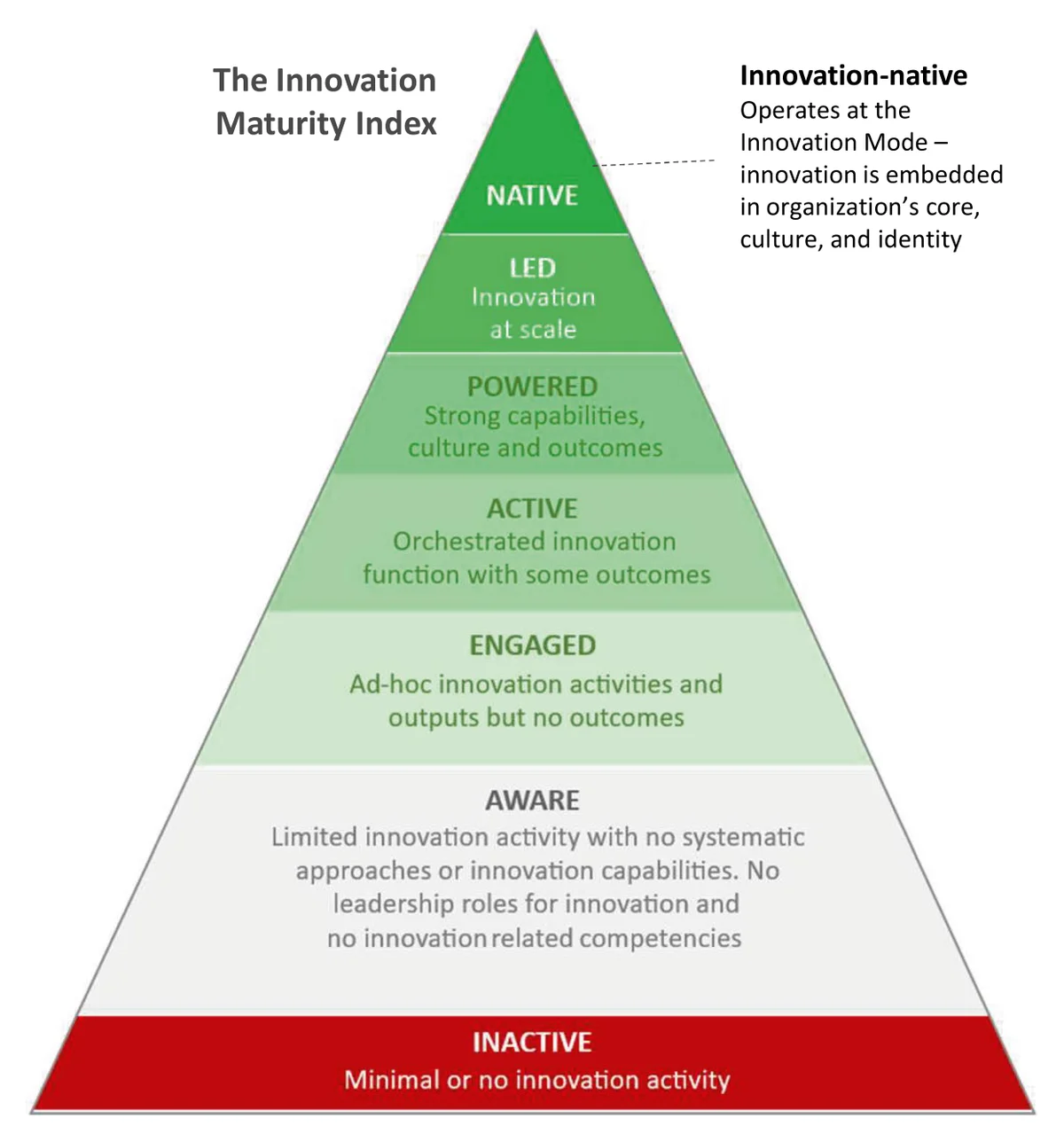
The Innovation Maturity Index places a company on seven levels, from innovation-inactive, with little or no innovation activity, to innovation-native, where innovation is embedded in the organisation’s core, culture and identity. The Index page sets out each level and what it takes to reach the next.
How do you build corporate innovation?
Not with another programme. Innovation Mode treats it as a transformation with its own plan, the Innovation Masterplan:
“The Innovation Masterplan is the foundational document for the innovation transformation initiative.”6
The plan runs in six sequenced phases, each with a named target level on the Maturity Index:
- Power-Up, to level 2.
- Spark, to level 3.
- Connect, to level 4.
- Empower, to level 5.
- Scale-Up, to level 6.
- Embed, to the AI-powered, autonomous Innovation Mode.
Corporate Innovation Advisory does this work with leadership teams in eight weeks: a diagnostic on the six deficits, an innovation playbook and a 24-month Innovation Masterplan.
Corporate innovation in the AI era
AI changes the economics of corporate innovation. Ideas become abundant and prototypes cheap, so the bottleneck moves from generating ideas to judging them. The answer Innovation Mode sets out is an always-on innovation function in which AI agents discover and assess opportunities and people decide: agentic innovation.
“In the organization of the future, effective leadership will be about directing and fine-tuning the innovation machine, a complex system that converts signals to ideas and then opportunities to realized innovation, in a fast, adaptive way.”7
Questions about corporate innovation
What is the difference between corporate innovation and R&D?
Who should lead corporate innovation?
What is a corporate innovation strategy?
How do you measure corporate innovation?
Further reading
- Innovation Mode, Author’s Edition (2026): the full method, from the six deficits to the Masterplan.
- The Innovation Maturity Index: the seven levels in detail.
- Why corporate innovation (very often) fails: the six deficits, one by one.
- What is agentic innovation?: the innovation function in the AI era.
- Corporate Innovation Advisory: eight weeks to an operating model and a 24-month Masterplan.
Cite this page
Krasadakis, G. (2026, October 20). What is corporate innovation? Innovation Mode. https://theinnovationmode.com/what-is-corporate-innovation
@online{krasadakis2026corporate,
  author = {George Krasadakis},
  title = {What is corporate innovation?},
  year = {2026},
  date = {2026-10-20},
  organization = {Innovation Mode},
  url = {https://theinnovationmode.com/what-is-corporate-innovation}
}
Notes
- Krasadakis, G. (2026). Innovation Mode: Designing Innovative Companies in the Era of Artificial Intelligence, Author’s Edition. Innovation Mode Publishing. Chapter 1, p. 5. ↑
- Innovation Mode (2026), Chapter 1, p. 1. ↑
- Innovation Mode (2026), Chapter 1, p. 5. ↑
- Innovation Mode (2026), Chapter 2, p. 16. ↑
- Innovation Mode (2026), Chapter 2, p. 25. ↑
- Innovation Mode (2026), Chapter 10, p. 328. ↑
- Krasadakis, G. (2020). The Innovation Mode: How to Transform Your Organization into an Innovation Powerhouse. Springer. Chapter 13, p. 310. ↑