Agentic innovation describes a new class of system that has a dual nature: it helps organisations innovate, by streamlining processes such as market scanning and organisational alignment, but it also innovates on its own. As an agentic innovation system is always-on and autonomous, and listens to the organisation and its market at all times, it can abstract, combine, synthesise and spot emerging trends, problems worth solving and high-potential opportunities, autonomously.
As described in Innovation Mode, imagine having multiple, highly specialised innovation agents (the strategist, the orchestrator, the market radar, the ideator, the evaluator, the Judge and more) all working together, and occasionally competing, in discovering and framing the most important problems that the company should solve and, more than that, high-potential business opportunities to explore further. On the one hand, agents continuously discover opportunities, assess them, challenge their assumptions and document them; on the other hand, agents inspire, inform and educate people on where to set the innovation focus (the innovation agenda, as defined in the book) and how to innovate faster, more effectively and in alignment with the organisational strategy.
A true agentic innovation system becomes the heart of the modern corporate innovation function: a smart orchestrator that also acts as a co-innovator with human talent.
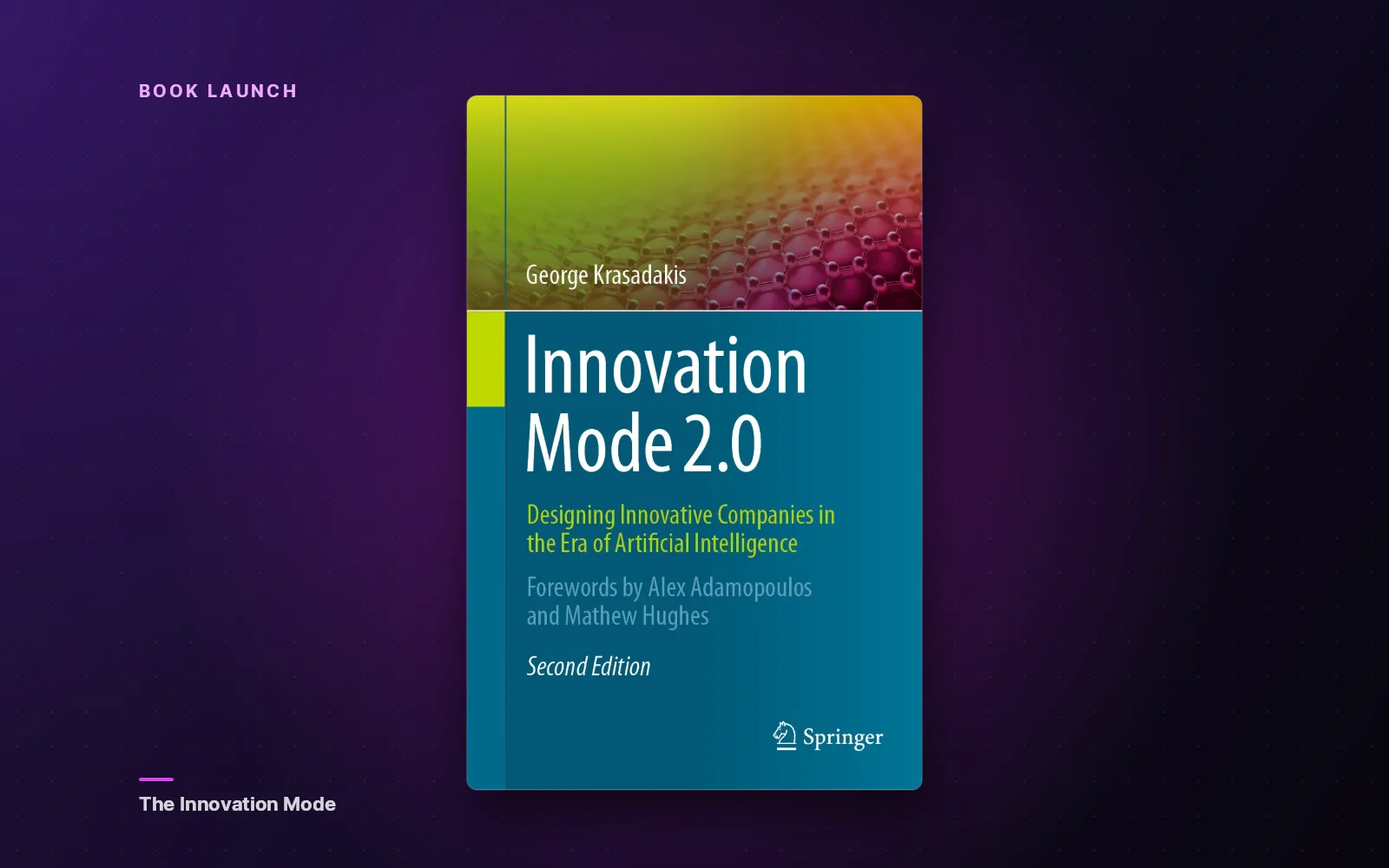
From the method in Innovation Mode, the first published architecture for agentic innovation in a corporate context.
How is agentic innovation different from AI-assisted innovation?
The difference is foundational. AI-assisted innovation is doing the obvious: using AI to ideate, produce documents and so on. That’s fine, but what makes agentic innovation a radical change in how organisations innovate is that it encapsulates the innovation process end-to-end and uses the best of all the organisational and market context available to streamline the business opportunity discovery function. In AI-assisted innovation the tool waits to be asked: a person finds an idea, opens an assistant and asks it to help. In agentic innovation the system, as defined in Innovation Mode, takes the initiative: it knows when to trigger innovation cycles, when to ideate, who to invite into the process and what the best timing is.
“The AI orchestrator keeps the process up and running and ensures that performance is continually improved. It knows when there are remarkable opportunities to bring to a forum of human experts and also when there are changes in the innovation agenda that need to be fed into the ‘autonomous opportunity discovery system.’”1
| Idea management software | AI-assisted innovation | Agentic innovation | |
|---|---|---|---|
| Who takes the initiative | Employees, usually in campaigns | A person, prompting an assistant | The system: it triggers innovation cycles, decides when to ideate and who to invite |
| Scope | Capturing and routing ideas | One task at a time: an idea, a document | The innovation process, end-to-end |
| Context | What the submitter knows | What the prompt contains | All the organisational and market context available, all the time |
| Who evaluates | Committees, when they meet | People, with AI suggestions | Specialised agents score and challenge every opportunity; people decide what survives |
| Documentation | Written by hand, if at all | Drafted on request | Decision-ready cases, decks and PRDs, produced with the assessment |
| Rhythm | Campaigns and events | Whenever someone opens the tool | Always-on |
| The role of people | Doing every step | Driving every step | Co-innovating: setting the focus, judging and deciding |
Why does agentic innovation matter now?
Because the rules of the game have changed. AI agents are transforming, and in some cases replacing, entire products, and small teams with access to the same intelligence can now challenge established companies from unexpected directions. A company that still innovates through campaigns and committees will not see its next opportunity in time, let alone pursue it.
There is a second, less obvious reason. AI has made ideas abundant: it can produce more concepts in an afternoon than an innovation team can evaluate in a quarter. Without a system that orchestrates and evaluates them, that abundance turns into noise. Agentic innovation is that system: it applies the same assessment to every opportunity, keeps a record of the reasoning, and brings leaders fewer, better-argued decisions.
“Companies must shift from a discrete, event-based approach to discovering opportunities to a continuous, always-on process powered by the latest technologies.”2
Who are the agents in an agentic innovation system?
An agentic innovation system is a team of specialised AI agents, each with its own objectives and a degree of autonomy, coordinated by an orchestrator and working over the organisation’s Innovation Graph: the connected record of its problems, ideas, assessments, experiments and market signals. Innovation Mode sets out the core roles; Ainna, built on the method, runs them in production.
- The strategist
- Frames the problems most worth solving: it separates symptoms from underlying causes, maps the actors involved, and advises people on where to set the innovation focus.
- The orchestrator
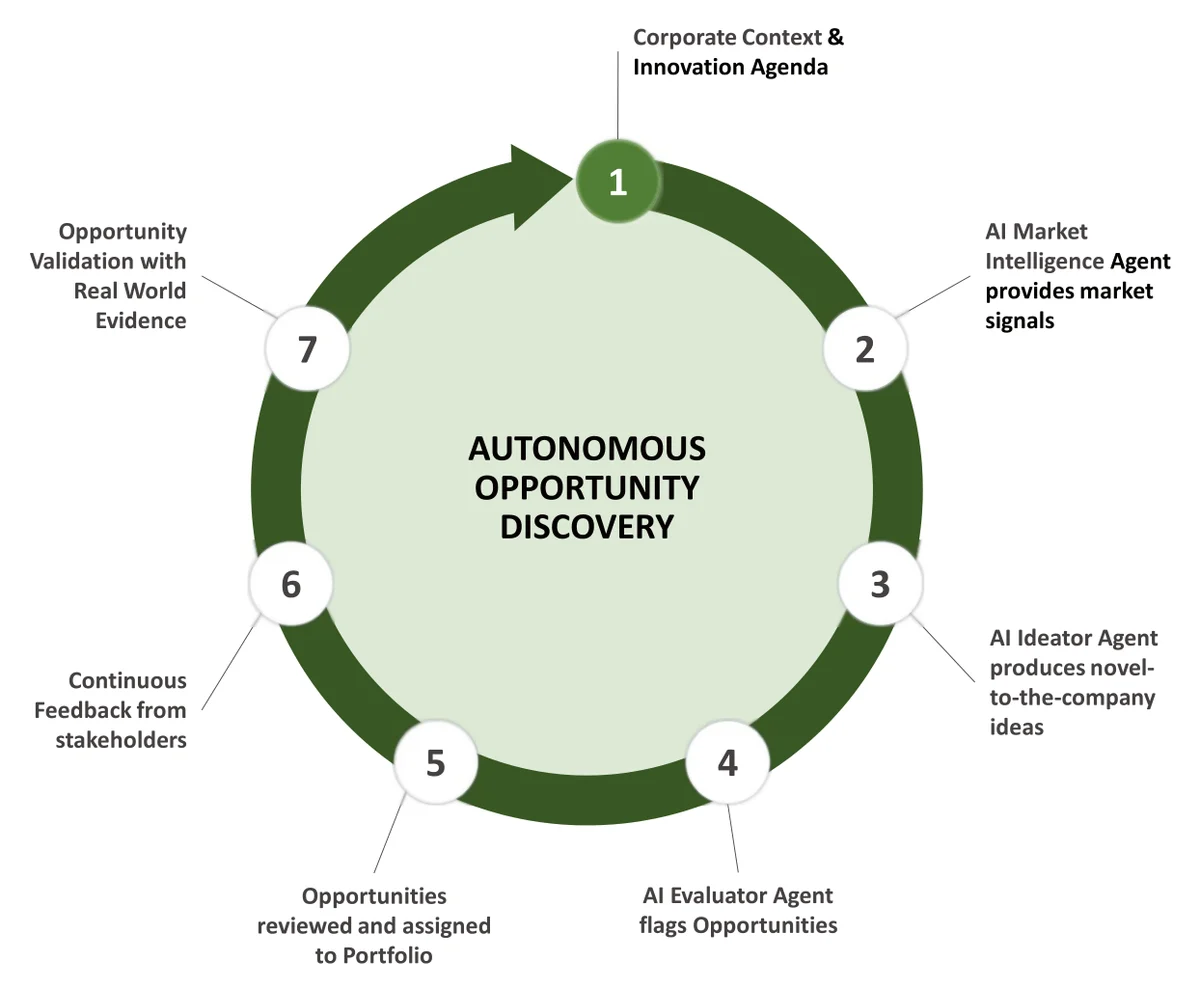
- Runs the always-on discovery loop. It reads the innovation agenda and the corporate context, directs the other agents, invites human evaluators when it needs them, and knows when an opportunity is ready for a forum of people.
- The market radar
- Tracks market developments, start-ups and competitor moves, and knows when new signals must be injected into the discovery process.
- The ideator
- Generates ideas that are novel to the company and aligned with its strategy, using the innovation agenda, company data and everything already in the Innovation Graph.
- The evaluator
- Scores every idea against the nine dimensions of the Idea Assessment Model, with a justification for each score, and combines human and AI assessments into one Opportunity Score.
- Many perspectives
- Several evaluators can judge the same idea from different viewpoints: an AI investor, an AI product manager, AI customer personas. When their views conflict, the system calls for more discussion or more assessments.
“All the AI services in this system, including the market radar, ideator, and evaluator, operate independently as true AI agents: they have their own objectives, success criteria, and a certain amount of autonomy in decision-making and performing predefined actions. But they are always under the orchestrator’s direction, who can also modify the ‘local’ objectives of the independent AIs.”3
What does an agentic innovation architecture look like?
The agents sit inside a wider architecture of three capabilities, which together form the company’s innovation core.4
- Opportunity discovery. The always-on discovery loop above: the strategist, orchestrator, market radar, ideator and evaluator agents working over the Innovation Graph, generating concepts, scoring them and surfacing the high-confidence opportunities to people for review.
- Validation. Discovered concepts move into structured business experimentation, which exposes their silent assumptions and turns them into testable hypotheses. The real-world evidence that comes back informs whether, how and when to pursue the opportunity, and flows back into discovery.
- Realisation. Validated concepts move to a venture studio: a cross-functional team that defines, builds and ships MVPs towards product-market fit. Live products then feed their usage patterns back to the system, which learns from them too.
How do people and agents innovate together?
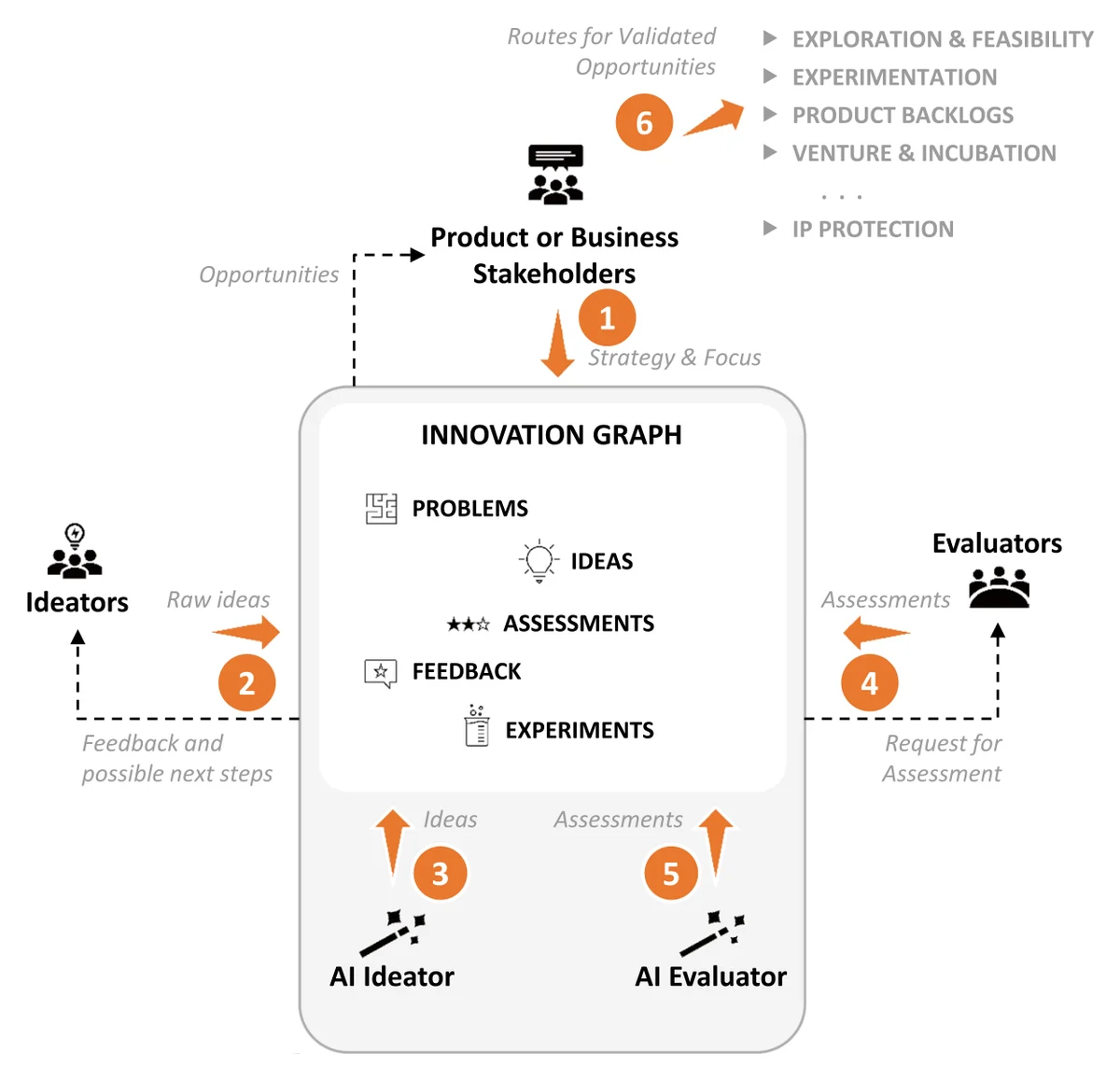
Agentic innovation does not take people out of innovation; it changes their part in it. The agents do two jobs at once. They discover, assess, challenge and document opportunities, and they inform, inspire and educate people: on where to set the innovation focus, on what the market is doing, and on how to innovate faster and more effectively. That is what makes the system a co-innovator, not just a tool.
In an agentic innovation function, people hold five things:
- Direction. The innovation agenda: the strategic themes, the problems worth solving and the appetite for risk that tell the agents what is worth looking for.
- Judgement. The verdict on every opportunity. Agents recommend; people decide, and can say why.
- Co-creation. People can take any idea the agents produce and enrich, regroup or develop it, and the agents can improve theirs.
- Accountability. An owner, a budget and a deadline for whatever is approved.
- Context. What no data source holds: relationships, politics, timing, and the organisation’s values.
The trap is to automate before deciding what good looks like. Agents amplify whatever objective they are given, so a vague strategy produces confident noise at scale. The innovation agenda and the assessment model come first; the automation comes second. And the whole system stays accountable to people.
“Furthermore, the entire system and each of the AI agents operate under the human-in-the-loop principle, with a solid mechanism that ensures ongoing monitoring and feedback from humans, along with a statistical comparison of the effectiveness of agent versus human-made decisions.”5
Defined before it had a name
The ideas behind agentic innovation are older than the current wave of AI agents. The first edition of Innovation Mode, written in 2019 and published by Springer in 2020, already described the innovation function as an always-on system that senses signals and triggers the right innovation processes, with AI taking part in the work. The Author’s Edition (2026) defines the agentic innovation system and its architecture in full: the agents, their orchestration and the human-in-the-loop principle they work under.
- 2015–2018
George Krasadakis files patents on AI-driven ideation capture, autonomous negotiation agents and answer-synthesis architectures, most as sole inventor. The research and patents page sets them out.
- 2020
“The innovation function is an always-on system of procedural, cultural and technical activities, innovation enablers, and resources, aiming to maximize the likelihood of producing successful innovation opportunities.”6
The same edition puts AI in the brainstorming room as a participant, not a tool,7 and closes with the organisation of the future as a living system:
“In the organization of the future, effective leadership will be about directing and fine-tuning the innovation machine, a complex system that converts signals to ideas and then opportunities to realized innovation, in a fast, adaptive way.”8
- 2026
“This Agentic AI innovation system is intelligent enough to detect patterns and significant deviations among the multiple assessment scores of a given idea.”9
What does agentic innovation look like in practice?
Ainna Enterprise is the architecture above, running in production. Autonomous discovery surfaces opportunities, the Judge evaluates them, and the Panel challenges them from the perspectives of the stakeholders who matter. What survives arrives as a defensible case, with board-ready decks and PRDs, in minutes rather than months, and leadership decides.
How do you start with agentic innovation?
- Assess where you are. Agents accelerate a working innovation function; they do not create one. The Innovation Maturity Index shows which of its seven levels you are at, and what has to be in place first.
- Write the innovation agenda. The agents start from it. Choose one strategic theme and the problems worth solving within it, and agree how opportunities will be judged, before anything is automated. AI Strategy Advisory and Corporate Innovation Advisory do this work with leadership teams.
- Run one loop and compare. Run a discovery loop on that theme for a few weeks, and compare what it surfaces, and how fast, with your current pipeline.
Questions about agentic innovation
Is agentic innovation the same as agentic AI?
Does agentic innovation replace the innovation team?
Where does the concept come from?
What does it need to work?
How do you measure an agentic innovation function?
Is it only for large companies?
Further reading
- Innovation Mode, Author’s Edition (2026): the full architecture, chapter by chapter.
- The Innovation Dictionary: agentic innovation alongside 71 related terms.
- The Innovation Maturity Index: the seven levels, and what has to be in place before agents pay off.
- AI Strategy Advisory: eight weeks from pilots to a portfolio.
- Ainna Enterprise: the architecture, in production.
Cite this page
Krasadakis, G. (2026, October 20). What is agentic innovation? The definition. Innovation Mode. https://theinnovationmode.com/agentic-innovation
@online{krasadakis2026agentic,
  author = {George Krasadakis},
  title = {What is agentic innovation? The definition},
  year = {2026},
  date = {2026-10-20},
  organization = {Innovation Mode},
  url = {https://theinnovationmode.com/agentic-innovation}
}
Notes
- Krasadakis, G. (2026). Innovation Mode: Designing Innovative Companies in the Era of Artificial Intelligence, Author’s Edition. Innovation Mode Publishing. Chapter 6, pp. 237–238. ↑
- Innovation Mode (2026), Chapter 6, p. 226. ↑
- Innovation Mode (2026), Chapter 6, p. 238. ↑
- Innovation Mode (2026), Chapters 6, 7 and 8, which develop each capability in depth. ↑
- Innovation Mode (2026), Chapter 6, pp. 238–239. ↑
- Krasadakis, G. (2020). The Innovation Mode: How to Transform Your Organization into an Innovation Powerhouse. Springer. Chapter 1, p. 9. ↑
- The Innovation Mode (2020), Chapter 8, p. 146. ↑
- The Innovation Mode (2020), Chapter 13, p. 310. ↑
- Innovation Mode (2026), Chapter 6, p. 230. ↑