Corporate innovation rarely fails for lack of methods, tools or technology. It fails for structural reasons. Innovation Mode groups 31 failure patterns into six innovation deficits: leadership, organisational design, innovation capabilities, real-world connection, talent and culture, and venture building. The leadership deficit is the primary one, and failure rarely has a single cause.
Each deficit below comes with the patterns that reveal it and the question to ask about it; the last section shows how to test your own organisation against all 31.
Passages marked From the book are quoted from Innovation Mode (Author’s Edition, 2026).
Why do innovation programmes fail when conditions look ideal?
Most large companies have never had more to innovate with: methods, collaboration tools, data, cloud platforms and now AI. The results rarely match.
The conditions to innovate look “ideal”: modern methodologies and advanced collaboration systems are widely available; access to knowledge is easier than ever; there is a wealth of data, insights, software components, platforms, AI services, and frameworks that can be reused to build systems, products, or platforms fast. Although there appear to be optimal conditions for innovation, promising programs often fail to deliver satisfactory results.
The surveys agree. In a BCG survey of global innovation practices, 80% of innovation executives said innovation was a top-three priority at their companies, but only 30% said their organisations were good at it.2 In PwC’s Innovation Benchmark (2017), a survey of more than 1,200 executives in 44 countries, 54% of innovating companies named one problem as their greatest strategic challenge: bridging the gap between innovation strategy and business strategy.3
Nokia’s smartphone story, 2007 to 2013
The book’s chapter on failure starts from Nokia. In the third quarter of 2007, Nokia held 48.7% of the global smartphone market; by the first quarter of 2013, its share was 2.8%.4
Timo Vuori of Aalto University and Quy Huy of INSEAD set out to explain the fall of what they call “a world-dominant and innovative technology organization”. Between November 2012 and February 2014 they conducted 76 interviews with Nokia’s top and middle managers, engineers and external experts about the years 2005 to 2010.5 They describe “organisational fear” grounded in “a culture of temperamental leaders and frightened middle managers, scared of telling the truth”,6 resulting in “temporal myopia—a focus on short-term product innovation at the expense of long-term innovation development”.5
One common explanation is complacency. “Complacency had kicked in,” Ben Wood, an analyst at CCS Insight, told the BBC in 2013, “they felt they could do no wrong.”7 Vuori and Huy list it among the usual explanations, with technical inferiority and failing to see the iPhone coming, and reject all three: “We argue that it was none of the above.”6 The deficits hold both readings: complacency is the first pattern of the leadership deficit, while fear and fragmentation run through organisational design and culture.
Although such situations are complex, with several factors at play, it is clear that the culture of fear and corporate fragmentation plays a significant role: it blocks information flows, discourages innovative behaviors, and slows down decision-making.
The six innovation deficits
The model groups the failure patterns into six classes. Each is a structural gap: something missing from how the company is led, organised, equipped, connected, staffed or able to execute. The leadership deficit is the primary one, and the patterns compound across deficits, as the last section shows.
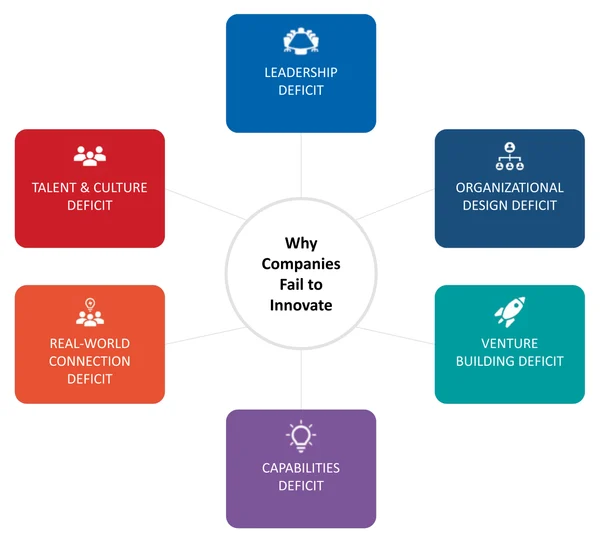
| Deficit | What it looks like |
|---|---|
| 1. Leadership | What it looks like: Leaders who don’t see the need, avoid risk, can’t decide under uncertainty or measure the wrong things. |
| 2. Organisational design | What it looks like: Silos, layers of approval, no channels for knowledge and no clear answer to who owns innovation. |
| 3. Innovation capabilities | What it looks like: No defined innovation function, legacy technology and funding that cannot move at the speed of evidence. |
| 4. Real-world connection | What it looks like: No unified view of the customer and a myopic view of the market and the competition. |
| 5. Talent and culture | What it looks like: Skills gaps from leadership to the teams, too little diversity of thought and a culture that no longer believes the promises. |
| 6. Venture building | What it looks like: No capability to build and launch, unclear ownership of projects and handovers that stall. |
1. The leadership deficit
Are your leaders equipped to drive innovation?
While innovation success often results from collaborative efforts across an organization, corporate innovation failure always reflects leadership’s limitations or poor decisions.
Senior leaders may fail innovation in several distinct ways: some don’t engage with innovation due to complacency; others are willing to drive innovation but lack expertise in innovation leadership, making critical mistakes or omissions; and some have the willingness and knowledge but lack the necessary means or support from the C-suite. In all such cases, companies suffer from innovation blind spots, especially at the executive level.
The book names eleven ways leaders fail innovation:
- When leaders don’t see the need to innovateComplacency: leadership rests on past success, dismisses start-ups and grows only through established paths and business models.
- When leaders avoid riskPredictability and short-term targets come first; innovation looks like a risky luxury or a threat to profitable lines, and failure is not accepted as part of the process.
- When leaders face first-mover anxietyThe company waits for competitors to validate every opportunity, because leaders overestimate the risk of entering early and discount the cost of arriving late.
- When leaders are indecisiveDecisions wait for perfect information: extra analysis cycles and consensus rounds slow innovation down and kill its momentum.
- When leaders don’t actively support innovation teamsAmbitious teams get no top-level backing or protection, are judged on unsuitable metrics, and innovation comes to be seen as a side activity.
- When leaders overrely on existing customersThe most profitable customers set the agenda, which biases the company towards incremental improvements rather than new products, services or disruptive innovations.
- When leaders fail to understand the competitionCompetition is defined narrowly: start-ups are dismissed for their size, and threats from other industries and new technologies go unseen.
- When leaders fail to connect innovation with the company’s goalsLabs, hackathons and design sprints run out of context produce short-lived attention and can be perceived as innovation theatre.
- When leaders fail to establish a continuous innovation processInnovation happens ad hoc; teams innovate in isolation, with overlaps, inefficiencies and missed opportunities.
- When leaders measure the wrong thingsVanity metrics such as ideas, patents and workshops, short-term KPIs and early return-on-investment tests replace a portfolio view of innovation value.
- When leaders focus on short-term results over long-term innovationQuarterly performance pressure is out of step with innovation’s longer life cycle; the book calls this probably the most persistent barrier.
Two of the eleven patterns deserve a closer look. The first is innovation theatre: activity that looks like innovation and leads nowhere.
Leaders often prioritize highly visible innovation programs and events, such as fancy labs or workshops like Hackathons or Design Sprints. However, when done out of context, such events may only generate short-term results, e.g., ephemeral attention and superficial cultural improvements. […]
When there is a lack of continuity and substance—e.g., the company fails to discover and pursue opportunities—such innovation programs inevitably collapse as employees recognize the lack of significance and disengage. Ironically, these surface-level initiatives can even damage the innovation culture since they may be perceived as “Innovation Theater.”
The second is measurement: what a company counts decides what its innovators do.
Many organizations evaluate long-term innovation using short-term KPIs, while others rely on vanity metrics of innovation activity, such as the number of ideas generated, patents filed, and workshops conducted. […]
In other cases, they don’t recognize that traditional return-on-investment metrics are inadequate for measuring outcomes in the early stages of innovation. Applying financial metrics in the early stages of innovation projects not only misrepresents an opportunity’s potential but also undermines the team’s morale and the project’s momentum.
The book’s source for that last point is Deloitte’s 2021 innovation study, in which “many innovation leaders revealed that measuring financial outcomes too soon risks massive disappointment, and worse, the premature destruction of morale and even the program itself.”8
Where the leadership deficit comes from
This leadership deficit in driving corporate innovation often originates from a limited understanding of modern innovation architectures, methodologies, and leadership practices. Traditionally, executives are skilled in operational excellence and financial management but frequently lack the specialized knowledge needed to navigate today’s complex innovation landscape. […] This gap in innovation leadership presents a compelling case for the chief innovation officer (CINO) role or other leadership positions, such as VP or head of innovation.
Where to start: the Chief Innovation Officer guide sets out the role and its ten responsibilities, who should lead innovation compares six leadership models, and the CINO job description and hiring kit helps you hire for it.
2. The organisational design deficit
Is your organisation designed for innovation, or against it?
The structure of a company significantly influences its ability to innovate systematically, at scale, and speed. A good organizational design for innovation includes specialized teams dedicated to supporting specific aspects of the innovation function, along with processes that encourage cross-team collaboration and effective knowledge exchange. The organizational design deficit occurs when the necessary elements are missing from the company structure or, worse, when existing features actively block innovation.
Six patterns reveal it:
- Fragmented organisationRigid boundaries isolate departments and business units; R&D works without product and customer-facing teams and misses market insight.
- Overcomplicated hierarchyIdeas climb through layers of approval and lose momentum; innovators cannot find the decision-makers, or the experts to work with.
- Limited knowledge exchangeNo channels let insight flow across functions, so knowledge stays in silos and effort is duplicated.
- Ambiguous innovation leadership modelNobody clearly owns opportunity discovery and execution, portfolio management and orchestration, which leaves accountability gaps.
- Centralisation versus decentralisation indecisivenessLeadership never settles how innovation should be organised, so people are unsure who owns it and how it works.
- Perception of innovation isolationLabs, incubators and R&D teams are seen as privileged silos cut off from the business, which discourages collaboration.
A simple test is whether anyone can answer two questions.
For instance, innovators often struggle to navigate organizational complexity and find the appropriate decision-makers to pitch their ideas. Or they cannot easily find teams or domain experts within the company to further explore their ideas and collaborate. In such environments, it is not easy to answer questions like “Who else is working on this?” or “What is the organization innovating on?”
Where to start: who should lead innovation explains the federated model, the book’s answer to the choice between centralising and decentralising innovation, and innovation team structure shows the teams a working innovation function needs.
3. The innovation capabilities deficit
Are your innovation capabilities a working system, or fragments?
Even when a company is determined to innovate, it may be blocked by the lack of essential capabilities, processes, and systems required to drive innovation outcomes. Moreover, legacy technical infrastructure often prevents the adoption of modern product innovation practices, for example, when companies struggle to adopt patterns of frequent releases and in-product experimentation. When a strong innovation culture is present, but the technology and systems to enable innovation at scale are not, business leaders may experience occasional enthusiasm followed by frustration.
Three patterns reveal it:
- Lack of a defined innovation functionNo documented function with goals, a leadership model, funding and operating frameworks; tools bought piecemeal, with no orchestration layer to make them one system.
- Legacy technology constraintsTechnical debt, rigid platforms, slow releases, weak customer feedback loops and data silos leave no bandwidth or flexibility for innovation.
- Resource allocation and funding challengesAnnual budget cycles and slow approvals cannot respond when evidence arrives, so teams lose momentum and market timing.
Funding deserves a second look, because it is where good evidence most often goes to wait.
In contrast to traditional projects that follow predictable resource needs, innovation requires elastic budgets that can adapt as teams learn and pivot fast. […] When innovation teams wait weeks or months for resource decisions, they lose critical momentum and market timing advantage.
Where to start: what is corporate innovation defines the innovation function as one system of processes, services, technology, knowledge and talent, which is what this deficit is missing.
4. The real-world connection deficit
Is your innovation connected to real market signal?
The real-world connection deficit occurs when a company lacks the means and practices to stay closely connected with its ecosystem—its customers, market, and technology landscape. This deficit appears as an inability to systematically scan the market, engage with customers, process user feedback, conduct business experimentation, and generally “listen” to the world outside corporate walls. Without these critical connections to reality, even well-resourced innovation efforts can fail.
Two patterns reveal it:
- Poor customer understandingNo shared view of customer needs, pain points and journeys, so teams build sophisticated solutions to the wrong problems; a particular risk when a technology function leads the innovation agenda.
- Poor market and competition understandingOutdated assumptions steer the innovation focus, and market realities surface only after significant resources have been spent.
The cost shows up late, which is why it is easy to underestimate.
Without robust market intelligence capabilities, organizations often discover market realities only after significant resources have been invested, leading to costly pivots or abandoned projects that could have been avoided through timely market insights.
Where to start: frame each opportunity around a real customer problem with the problem statement template, and test the riskiest assumption before you build with the business experiment template.
5. The talent and culture deficit
Do you have the talent, and the culture, to innovate?
Corporate innovation requires specialized skills that differ significantly from traditional business functions. However, companies often fail to recognize that innovation expertise doesn’t simply exist or develop naturally and that it requires strategic talent development, upskilling, external recruitment, and planning.
Six patterns reveal it, from the leadership level down to the teams:
- Gaps in innovation leadership talentNo senior professional with skills in innovation architecture, programme management and product leadership, such as a VP of innovation or a Chief Innovation Officer.
- Gaps in innovation management talentMiddle managers without innovation skills run innovation projects with an operational mindset and treat them as a disruption to teams, timelines and deliverables.
- Gaps in innovation execution talentTeams lack skills such as user research, prototyping and experimentation, and the attitudes to handle uncertainty and failure.
- Limited diversity of thoughtThe company cannot form and lead the right cross-functional teams; the book calls this collective talent deficit far more important than individual skill gaps.
- Poor innovation culturePeople do not trust the process or the company’s commitment; thin outcomes breed scepticism, which lowers engagement in the next effort.
- Performance reviews do not reflect innovationInnovation work is not linked to reviews, career progression or pay, so nobody has a reason to take on uncertain initiatives.
Culture is the pattern that feeds on the others.
A poor state of the innovation culture typically means that people don’t trust the process or the company’s commitment to innovation. They don’t feel empowered to innovate, or they don’t believe in the company’s innovation promises—they may perceive it as “innovation theater.” This cultural deficit creates a negative feedback loop: limited innovation outcomes trigger skepticism, which further reduces engagement levels in future innovation efforts. Without a strong culture, even structurally sound innovation programs face resistance from people that undermines their potential.
Where to start: the innovation culture defined sets out what a healthy culture is made of, and innovation team structure covers the roles and skills to hire or develop.
6. The venture building deficit
Can you turn validated concepts into real products, fast enough?
A company’s ability to innovate depends on multiple factors, including structural barriers, funding, resource allocation, leadership support, talent, and more. However, what ultimately defines success is the ability to build, launch, and grow products or services—to reach the market, achieve commercialization, and gain customer adoption quickly.
Three patterns reveal it:
- Lack of venture-building capabilityNo capability to build, launch and iterate products to product-market fit; good opportunities wait, or go to vendors or to teams without the capacity or skills.
- Ambiguous innovation projects ownershipUnclear boundaries, accountabilities and ownership on uncertain projects slow decisions and leave teams overlapping.
- Poor handover protocolsEarly products pass to a receiving team without an agreed protocol, and promising innovations stall in the valley of death between R&D and commercialisation.
The last of them has a name of its own.
Organizations frequently struggle when handing over an early implementation of a product to another team for operation and further development. […] Without the early engagement of the “receiving team,” structured knowledge transfer, and clear accountability, promising innovations frequently stall or fail entirely during this handover phase. This is why this phase is also known as the “valley of death” between research and development (R&D) and commercialization.
How the deficits compound
The deficits feed each other, which is why fixing one in isolation rarely holds. Three links run through the chapter:
- Weak leadership breeds scepticism. Without top-level backing, and judged on unsuitable metrics, innovation teams meet resistance and the programme’s value is questioned. Scepticism is also what keeps a poor culture poor.
- Culture without capabilities turns into frustration. A strong culture without the technology and systems to innovate at scale brings occasional enthusiasm followed by frustration, as the capabilities extract puts it.
- Talent and culture still need a way to market. Even the best people need a venture building capability to turn validated opportunities into products.
With strong talent supported by a vibrant innovation culture and robust capabilities, innovation programs can deliver transformative results. However, even companies with exceptional talent and a strong culture still need a powerful go-to-market capability that transforms validated opportunities into evolving, in-market products […]
How to diagnose the deficits in your company
The 31 patterns above are a first diagnosis you can run with your leadership team:
- Go through the patterns one by one and decide whether each is present, partly present or absent, with one piece of evidence for every pattern you call present.
- Count by deficit. A deficit with several patterns present is acute. If any leadership pattern is present, start there: the book calls the leadership deficit the primary one.
- Ask below the leadership level. Put the same patterns to people who innovate, or try to, in the business. Where their answers differ from leadership’s, you have found a blind spot.
- Place the company on the maturity scale. The deficits explain what blocks innovation; the Innovation Maturity Index tells you where the company stands and what the next level looks like.
Given the numerous factors and patterns that may lead to corporate innovation failure, as well as the wide array of elements required for innovation readiness, a foundational question emerges: How can we measure a company’s innovation state and maturity level?
A self-check is only as honest as the people who run it. An anonymous assessment across a cross-section of your organisation, scored on the 7-level Innovation Maturity Index. You get your real maturity level, where leadership’s view differs, and what to fix first, in a leadership briefing and a written report. Request the diagnostic, or see how Corporate Innovation Advisory turns the diagnosis into an operating model and a 24-month Innovation Masterplan.
Further reading
- What is corporate innovation?: the definition, the types and how to build it.
- The Innovation Maturity Index: the seven levels, from innovation-inactive to innovation-native.
- The Chief Innovation Officer: the role that answers the leadership deficit.
- Who should lead innovation?: five common leadership models, the hidden risk in each, and the Federated model that works.
- Innovation Mode, Author’s Edition (2026): Chapter 2 in full, and the method that answers each deficit.
Cite this page
Krasadakis, G. (2026, October 25). Why corporate innovation fails: the six innovation deficits. Innovation Mode. https://theinnovationmode.com/why-corporate-innovation-fails
@online{krasadakis2026deficits,
  author = {George Krasadakis},
  title = {Why corporate innovation fails: the six innovation deficits},
  year = {2026},
  date = {2026-10-25},
  organization = {Innovation Mode},
  url = {https://theinnovationmode.com/why-corporate-innovation-fails}
}
Notes
- Krasadakis, G. (2026). Innovation Mode: Designing Innovative Companies in the Era of Artificial Intelligence, Author’s Edition. Innovation Mode Publishing. Chapter 2.2, pp. 23–37. Every passage marked From the book on this page comes from this chapter. ↑
- Harnoss, J., and Baeza, R. (2019, September 24). Overcoming the four big barriers to innovation success. Boston Consulting Group. bcg.com ↑
- Staack, V., and Cole, B. (2017). Reinventing innovation: Five findings to guide strategy through execution. Key insights from PwC’s Innovation Benchmark. PwC. pwc.com ↑
- Statista Research Department (2013). Global market share held by Nokia smartphones from 1st quarter 2007 to 2nd quarter 2013. Statista. From Gartner, IDC and Nokia data; the share was 3.1% in the second quarter of 2013. statista.com ↑
- Vuori, T. O., and Huy, Q. N. (2016). Distributed attention and shared emotions in the innovation process: How Nokia lost the smartphone battle. Administrative Science Quarterly, 61(1), 9–51. doi.org/10.1177/0001839215606951 ↑
- Huy, Q., and Vuori, T. (2015, September 22). Who killed Nokia? Nokia did. INSEAD Knowledge. knowledge.insead.edu ↑
- Lee, D. (2013, September 3). Nokia: The rise and fall of a mobile giant. BBC News. bbc.com ↑
- Bechtel, M. (2021, September 30). Innovation Study 2021: Beyond the buzzword. Deloitte Insights. deloitte.com ↑