
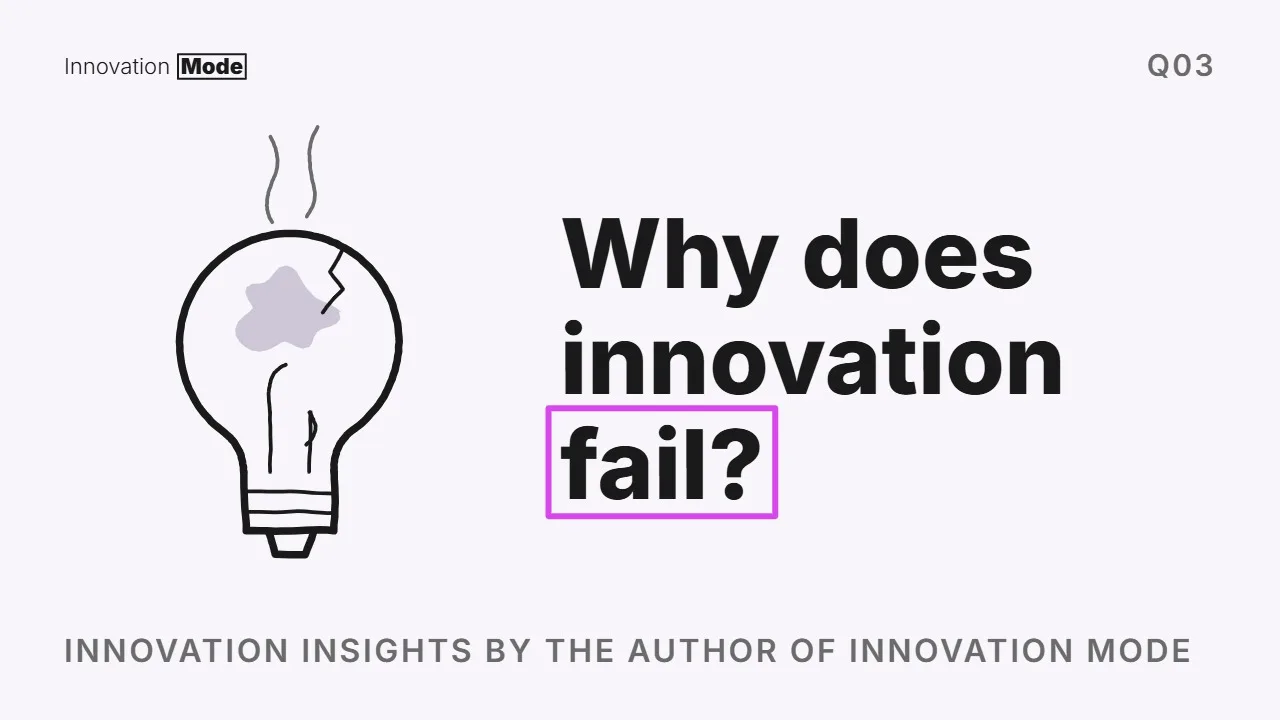
Why does innovation fail inside big companies?
Short answer Six deficits: capabilities, real-world connection, venture building, organisational design, talent and culture, and the one behind them all, leadership.
Short link: theinnovationmode.com/q03 · Watch on YouTube
The full answer, in words.
Why does innovation fail inside big companies? On paper, today’s conditions look ideal for innovation: the methods are well understood, the technology is available, and AI accelerates and simplifies the innovation process. So how is it possible that so many companies still fail to innovate?
In BCG’s 2024 study, 83% of executives ranked innovation among their top three priorities, yet only 3% of companies qualified as innovation-ready.
The Innovation Mode book organizes the answer into a simple model of six innovation deficits. Let’s count them down, from six to one, to the one that matters most. And as we go, think about which ones you recognize in your own company.
Number six: the innovation capabilities deficit. This happens when a strong innovation culture is present, but the technology and systems to support it are weak or absent. In such cases, business leaders may experience waves of enthusiasm followed by frustration and limited engagement with the actual innovation work. Often, companies lack a defined, simple and accessible innovation function that serves clear goals and objectives. In other cases, the innovation leadership model is weak or vague, with no established funding mechanisms or operating frameworks.
Sometimes, business leaders invest in specific capabilities, such as a system to provide market intelligence, a platform to manage ideas, or technology for product experimentation. However, they often lack the orchestration layer that synchronizes all these components into a single innovation system. Technical debt and outdated systems frequently slow down or even block innovation initiatives.
Innovation requires elastic budgets that can adapt as teams learn and pivot fast. In practice, though, most corporate funding mechanisms are rigid, with annual budget cycles, inflexible allocations, and lengthy approval processes. When innovation teams wait weeks or months for resource decisions, they lose critical momentum and market timing advantage.
Of all six, this is the one money can fix. But say you had the process, the platform, and the budget. Would you know what to build?
Number five: the real-world connection deficit. When companies fail to maintain a clear, unified view of customer needs, pain points, and user journeys, innovation efforts may end up solving the wrong problem or missing essential opportunities. There is a risk that innovation teams deliver solutions that, while sophisticated and novel, fail to address real-world problems and provide customer value.
Without a comprehensive understanding of the market, innovation teams operate in a bubble, allowing outdated assumptions to influence the focus of their innovation efforts. Organizations often discover market realities only after significant resources have been invested, leading to costly pivots or abandoned projects.
It’s the deficit you can’t see from the inside. And when you do know what to build, can you actually take it to market?
Number four: the venture building deficit. What ultimately defines success is the ability to build, launch, and grow products or services: to reach the market, achieve commercialization, and gain customer adoption quickly. When this capability is missing, great opportunities end up waiting for implementation, or are outsourced to vendors, or assigned to other teams with limited capacity or skill gaps.
Very often, leaders fail to establish clear boundaries, accountabilities, and ownership models for innovation projects, which introduces friction and slows down decisions. And when core innovation teams develop innovative concepts without an agreed-upon handover protocol with the receiving product team, major disconnects can occur. The receiving team may lack the capabilities, context, or bandwidth to carry the innovation forward. At the same time, the core team may have already moved on to new projects. That’s why this phase is also known as the “valley of death” between R&D and commercialization.
Why do so many handovers fail? Often because nobody can answer a simple question: who owns innovation here?
Number three: the organizational design deficit. The lack of clarity on “who owns innovation” can severely impact corporate innovation performance. Organizational fragmentation occurs when a company allows rigid structural boundaries that isolate departments, business units, or functional areas from one another. When R&D teams operate without a strong connection to product development and customer-facing departments, they may miss critical market insights.
When ideas and proposals must navigate multiple approval stages across different levels, momentum can be lost, and opportunities can be abandoned. Innovators often struggle to navigate organizational complexity and find the appropriate decision-makers to pitch their ideas. In such environments, it is not easy to answer questions like “Who else is working on this?” or “What is the organization innovating on?”
And dedicated innovation teams, such as labs, incubators, and R&D departments, are often perceived as inaccessible, and occasionally as innovation silos that are disconnected from organizational reality.
You can redraw an org chart in a day. But who will you put in the boxes?
Number two: the talent and cultural deficit. Companies often fail to recognize that innovation expertise doesn’t simply exist or develop naturally, and that it requires strategic talent development, upskilling, external recruitment, and planning. When the middle management layer lacks such expertise, innovation projects often end up being managed by typical managers who not only lack the right skills but also possess a very different, operationally focused mindset. Managers with this mindset rarely embrace innovation and tend to view it as a potential disruptor of teams, timelines, and deliverables.
A poor state of the innovation culture typically means that people don’t trust the process or the company’s commitment to innovation. This cultural deficit creates a negative feedback loop: limited innovation outcomes trigger skepticism, which further reduces engagement levels in future innovation efforts. And innovation achievements and impact are rarely linked with employee performance reviews, career progression, and compensation structures.
So who decides what gets measured, rewarded, and funded?
Number one: the leadership deficit. While innovation success often results from collaborative efforts across an organization, corporate innovation failure always reflects leadership’s limitations or poor decisions.
When leaders don’t see the need to innovate: complacency, an innovation failure pattern in which leadership rests on past successes and becomes overconfident based on the illusion of invincibility. When leaders avoid risk: they favor predictability and short-term success and view innovation as a risky luxury. When leaders are indecisive: requests for excessive analysis cycles before committing to innovation projects, or a consensus approach in decision-making. When leaders fail to connect innovation with the company’s goals: surface-level initiatives that may be perceived as “Innovation Theater.” When leaders measure the wrong things: vanity metrics of innovation activity, such as the number of ideas generated, patents filed, and workshops conducted. And when leaders focus on short-term results over long-term innovation: executive teams trapped in cycles of quarterly performance pressure that fundamentally misalign with innovation’s longer-term nature. This is probably the most persistent barrier to corporate innovation.
And these deficits appear even in the best organizations. Many notable failures have been attributed to the lack of an innovation culture and non-optimal organizational structures. Although such situations are complex, with several factors at play, it is clear that the culture of fear and corporate fragmentation plays a significant role: it blocks information flows, discourages innovative behaviors, and slows down decision-making. Rarely one deficit. Usually several at once.
Now, in this AI-powered world, the corporate innovation function faces a radical transformation. AI will soon evolve from a thought partner to a chief innovator, capable of orchestrating the entire corporate innovation process, potentially compressing innovation cycles from months to days.
When AI enables anyone to generate brilliant ideas, shape strategies, and soon build digital products, the ability to conceive and implement becomes less important. And those companies that don’t react fast are at risk of being displaced by AI-native competitors who can innovate faster. Every one of the six deficits slows that reaction down.
In this landscape, corporate innovation shifts from nice-to-have to existential capability.
Which of these failure patterns do you recognize in your company? We’d love to hear your thoughts in the comments. Stay in Innovation Mode.
The reading behind the answer.
Why Corporate Innovation Fails: The 6 Innovation Deficits
Why corporate innovation fails: six innovation deficits and 31 failure patterns, from leadership to venture building, and how to diagnose them in your company.

The Evolving Importance of the Chief Innovation Officer
In a world of Artificial Intelligence, the role of Chief Innovation Officer is becoming even more important. This link (between Artificial Intelligence and the importance of the CINO role) may not be that obvious - this article explains the thinking.
Architect the innovation function the AI era demands.
Start with a three-week Innovation Maturity Diagnostic, or go straight to the eight-week programme: an innovation playbook and a 24-month Innovation Masterplan.
More questions.
Join the leaders switching their companies into innovation mode.
The Agentic Innovation Briefing every month, our members' library of frameworks and templates, and new thinking before it goes public. 10,000+ innovation leaders are already in.