
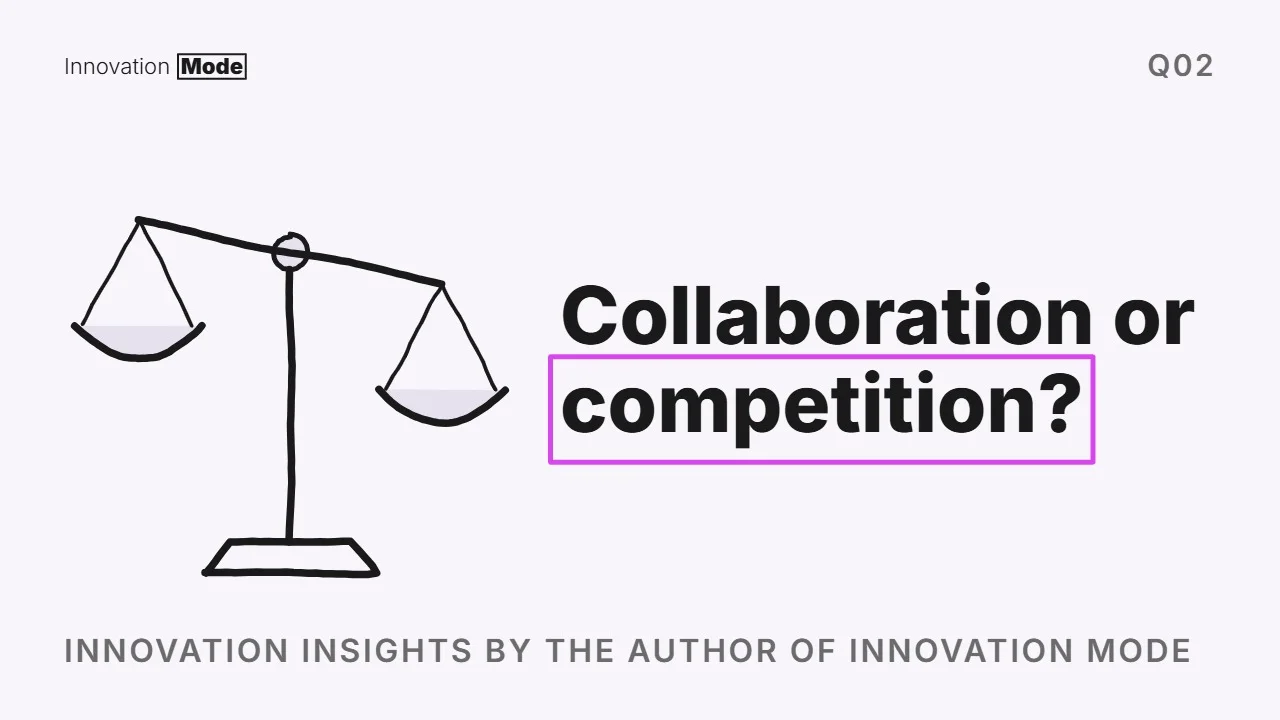
Collaboration or competition? What really drives innovation in organizations?
Short answer Both. Competition drives innovation when it is healthy: ideas compete, people collaborate, under a protocol of twelve rules.
Short link: theinnovationmode.com/q02 · Watch on YouTube
The full answer, in words.
Collaboration or competition? What really drives innovation in an organization? That’s the question we answer in this episode.
The answer is both. But you need some foundational rules. You need a framework for healthy competition.
Without one, competition turns political. Ask leaders what’s holding innovation back, and most will name slow execution, poor prioritization, or chasing the wrong opportunities. But the common, underlying theme is usually politics. And it can take many forms: personal ambitions that override shared goals, hidden agendas that shape decisions, teams that compete against each other instead of building together, managers who block ideas that threaten their territory, and many more.
As the book puts it: “In a strictly competitive environment, chances are that ideas remain hidden in the mind of the ideator, under the fear of being copied or leveraged by others with no attribution.”
So, can your teams compete and collaborate at the same time? Yes, when the competition is healthy. In such an environment, it is ideas that compete. People collaborate.
“‘Healthy’ in this context refers to fairness, transparency, respect, and a good balance between personal ambition and the success of the team and the organization.”
But this doesn’t happen by chance. It runs on a protocol: twelve rules.
Rule one: innovation is always on, and open to all. Every team, every level, every day.
Rule two: ideas do not have owners. They have originators and contributors. Picture someone with a great idea, but no time or skills to drive it. Here, they share it, and they go down in its history as the originator. If it’s ever built and succeeds, they get the credit, and so does everyone who built it.
Rule three: ideas are free to reuse. Attribution is required. Rule four: no single decision-maker controls the future of an idea. One gatekeeper is where politics begins. Rule five: originators may not be involved in the execution of their ideas. They don’t have to be. The credit stays with them.
Rule six: people show respect for others’ ideas. Rule seven: there are no bad ideas. Rule eight: but some ideas are better than others, in a given context. Both are true. You judge the idea against the context, never the person who had it.
Rule nine: critique is constructive, meaningful, justified, and welcome. Justified critique beats hollow praise. Every time. Rule ten: great ideas can still fail. A failed idea is a result, not a verdict on the people behind it.
Rule eleven: rules and decisions are transparent and consistent. And rule twelve: there is no space for corporate politics. The best idea wins. Not the best-connected person.
Rules alone won’t hold. Rewards shape the innovation culture, so measure what counts. Score four behaviours: inventiveness, openness, ability to execute, and contribution. People win, not only for their own innovation achievements, but also for helping others innovate. Even invalidating an idea may be acknowledged as a significant contribution.
Why does all this matter even more in the era of AI? Because AI is already a very capable ideator. It can generate ideas in bulk, in seconds. The new risk is idea overload. So the competition moves from having great ideas to choosing the right ones to explore further, and choosing is exactly where politics hides. Clear rules, many evaluators, and credit for everyone who shaped an idea: that’s what keeps the choice on merit. AI can even help evaluate the ideas, as one evaluator among many, but never the single decision-maker.
Ideas compete. People collaborate. That’s not idealism. That’s a protocol.
Now we’d love to hear yours! What’s your biggest question about innovation? Ask it in the comments, and we’ll answer the best ones. Stay in Innovation Mode.
The reading behind the answer.

Leading innovation: Principles of a great ideation platform
Corporate innovation needs a strong supply of high-quality ideas that feed into a fast and effective ‘innovation opportunity discovery’ process. Establishing such an ideation channel is not easy: it requires processes that are simple, inclusive, flexible, and objective; it needs effective communication to inspire people but, at the same time, it must manage the risk of ‘internal disruption.’

The Challenges of Corporate Innovation
An excerpt from an interview with Jesse Nieminen from Viima – discussing innovation culture, blockers, the Innovation Mode and more.
Replace innovation theatre with an operating model.
Eight weeks for the leader who owns the innovation mandate: a diagnostic on the 6 Innovation Deficits, an innovation playbook and a 24-month Innovation Masterplan.
Get the field notes first.
The monthly Innovation Mode Briefing, early access to new releases, and member discounts on the Toolkit and Ainna.ai. Join 10,000+ innovation leaders.