
Coming soon
The Hackathon Masterclass
Most corporate hackathons are theatre.
Make yours perform.
A 90-minute video masterclass on designing, running and following through on a corporate hackathon, with the templates to run your own: the brief, the decks, the judging system and the full set of messages.
The difference
Two kinds of corporate hackathon.
A one-off event, disconnected from strategy and from what happens next. Ideas are presented, applauded and filed. No one owns them, no budget follows, and the organisation concludes that hackathons are an event rather than a source of value.
One step in a wider innovation programme. It starts from a business question the organisation cares about, judges entries against criteria agreed in advance, and hands the best ideas to named owners with a budget and a deadline, so it feeds the pipeline instead of ending at demo day.
Inside the masterclass
How to run a hackathon that people enjoy and that pays off for the business.
Eight modules, each answering a question every organiser faces: the decision to make, the trade-offs behind it, and the mistakes that turn a hackathon into theatre. Watch the video once, then present from the deck as often as you need: to your sponsor, your organising team and your judges.
ModuleWhat is a hackathon actually for?
Opportunities, culture or visibility: the three reasons organisations run hackathons, why the ones that matter put opportunities first, and how that single choice sets the format, the audience, the budget and the measure of success.
ModuleWho should take part, and how do you fill the room?
The audience decides what wins. Eligibility that brings in domain experts, not only developers; team size and mix; internal events versus open challenges; and the campaign that gets the right people registered, teamed and briefed.
ModuleWhat should the teams deliver?
Demo, prototype, business case or concept: what to require, what to encourage, and how format and duration shape the result. A clear definition of the deliverable prevents more theatre than any keynote.
ModuleHow do you set the rewards?
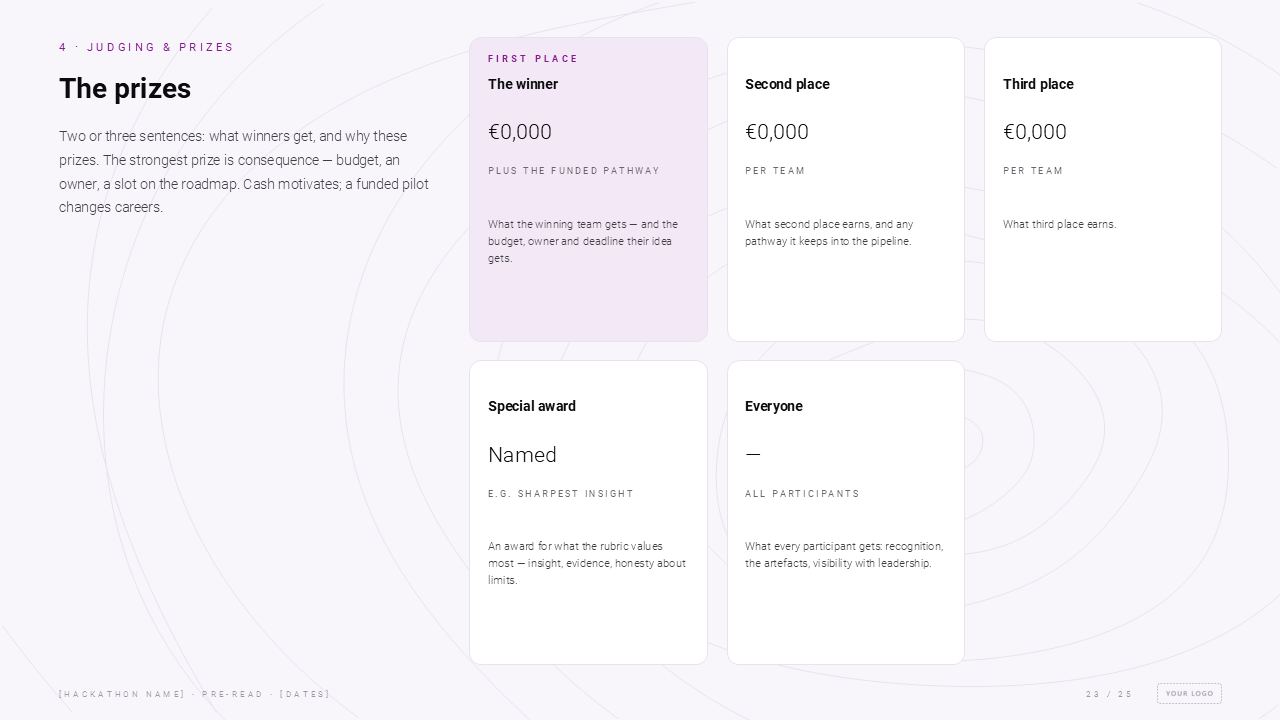
Why the strongest prize is a budget, an owner and a deadline; why visibility beats cash; and which incentives quietly change who enters and what gets built.
ModuleHow do you judge fairly and defensibly?
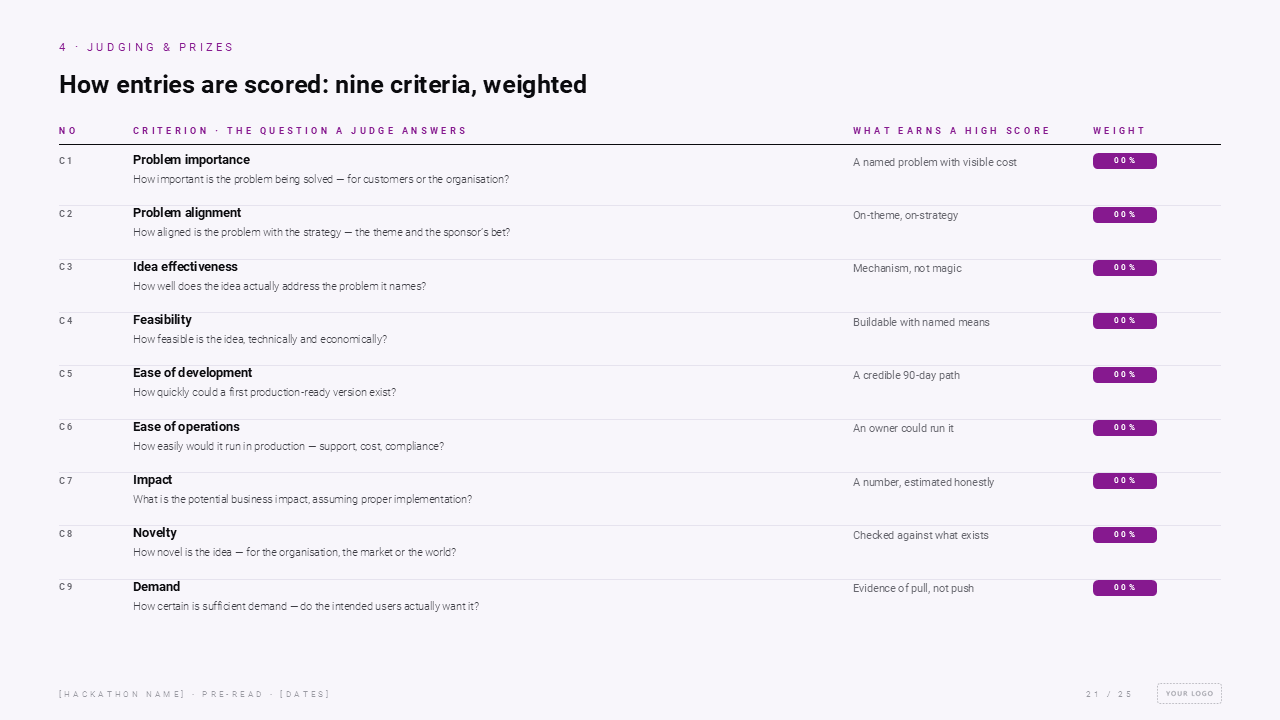
Criteria and weights, scoring guidance, calibration, conflicts of interest and tie-breaks: a decision that stands up to scrutiny from leadership and from the teams that did not win, announced with its reasons.
ModuleHow do you run the hackathon, from kick-off to demo day?
A published schedule and the discipline to keep it: a kick-off that gets every team building, mentor checkpoints that stop weak directions early, momentum protected to the deadline, and a finale that ends in a decision.
ModuleHow do you measure success and connect the hackathon to your innovation ecosystem?
Outcomes tracked at 30, 90 and 180 days rather than judged on the day's energy; the funding pathway that turns a winner into a pilot, not a certificate; and the links to your wider innovation system: the pipeline, the portfolio and the next event. The free Measuring Hackathon Success framework is a good primer.
ModuleWhat does AI change about hackathons?
Wider participation, faster prototyping, help with screening and scoring, and the parts of a hackathon that must stay human. For the background, see our article on why corporate hackathons still matter in the AI era.
BonusPutting it to work: from download to announcement
A guided tour of the documents and the worked example: what each one is for, the order to use them in, and the shortest route from download to announcing your hackathon.
From the book
For a genuine hackathon team, securing the resources required to build the project should be the greatest and most inspiring reward of all.
[Open voting] is rarely a good option: it usually reflects the hackathon team’s social influence instead of their project’s potential.
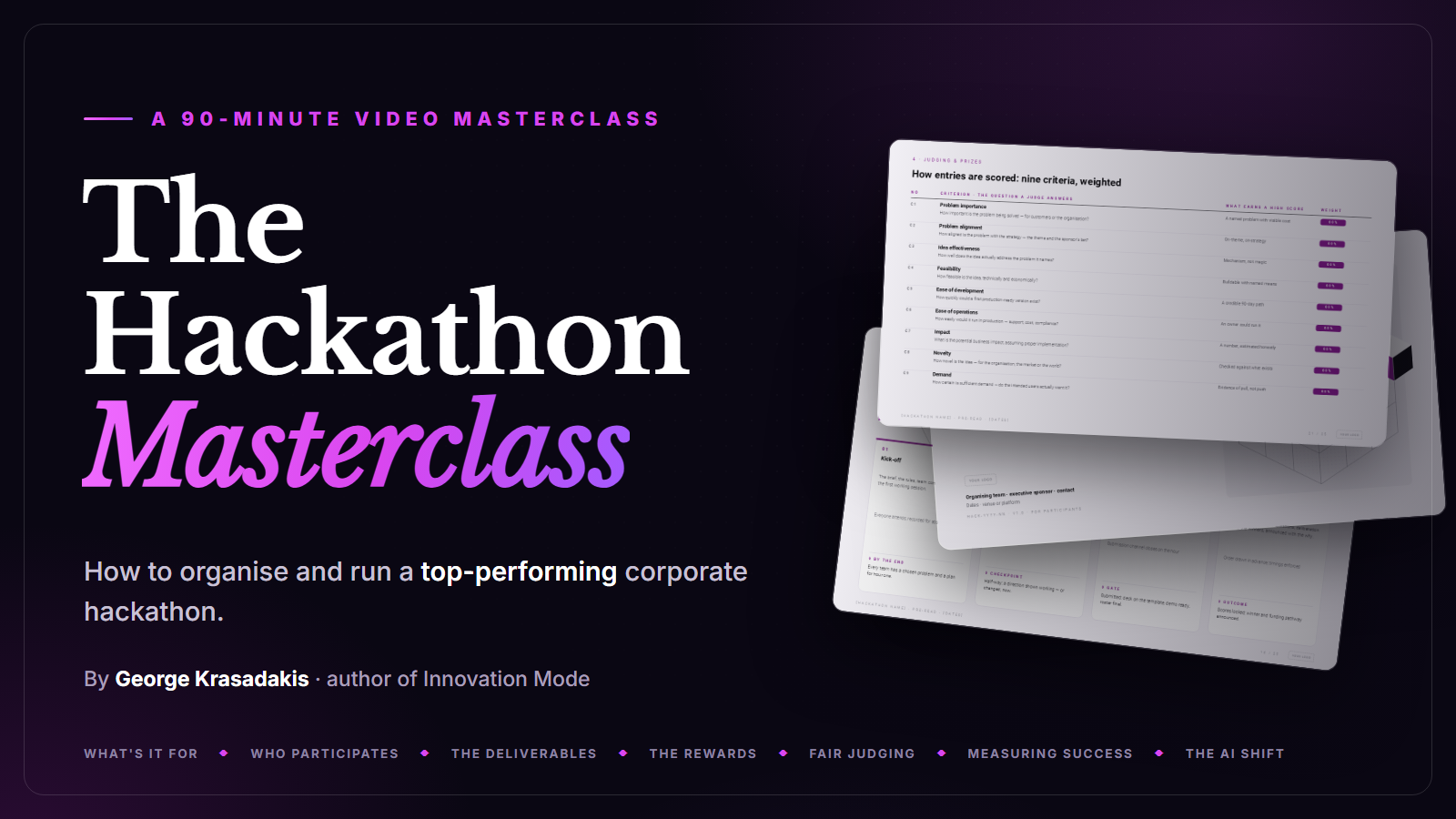
The heart of the package: a 90-minute video masterclass. Eight modules covering every decision from the first brief to the final results, with the presentation deck that goes with it, yours to present inside your organisation.
Also included
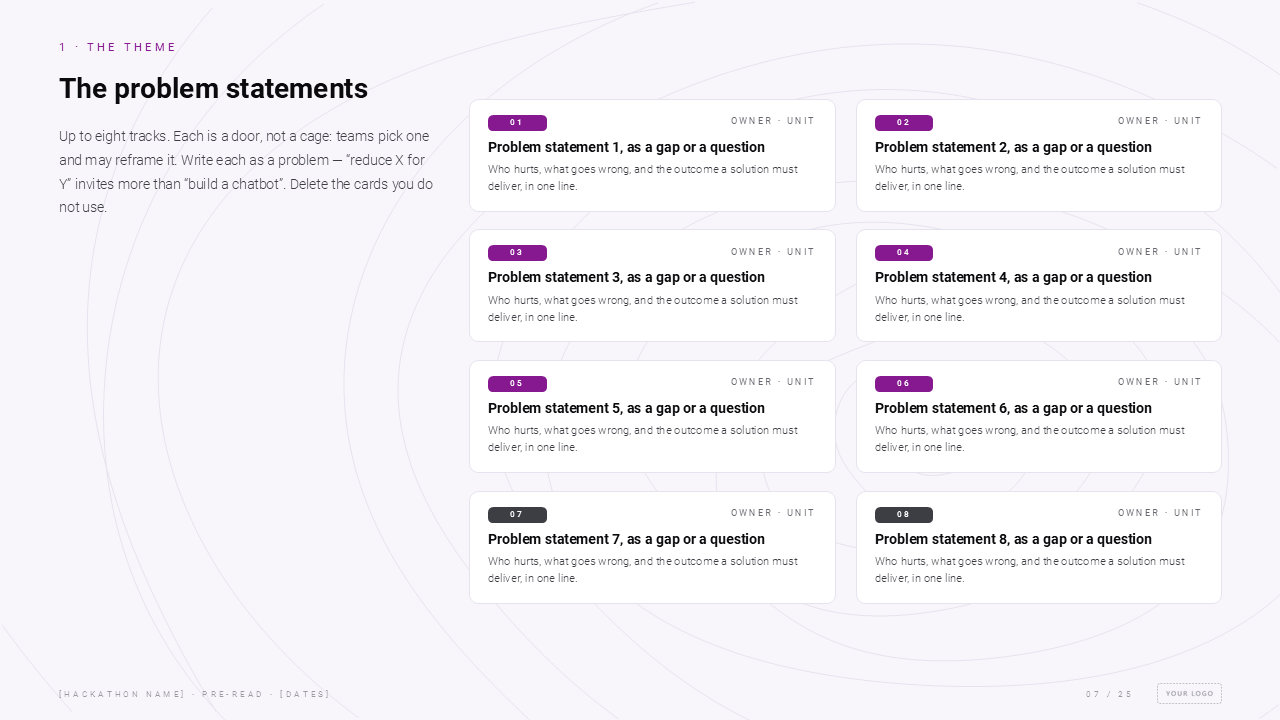
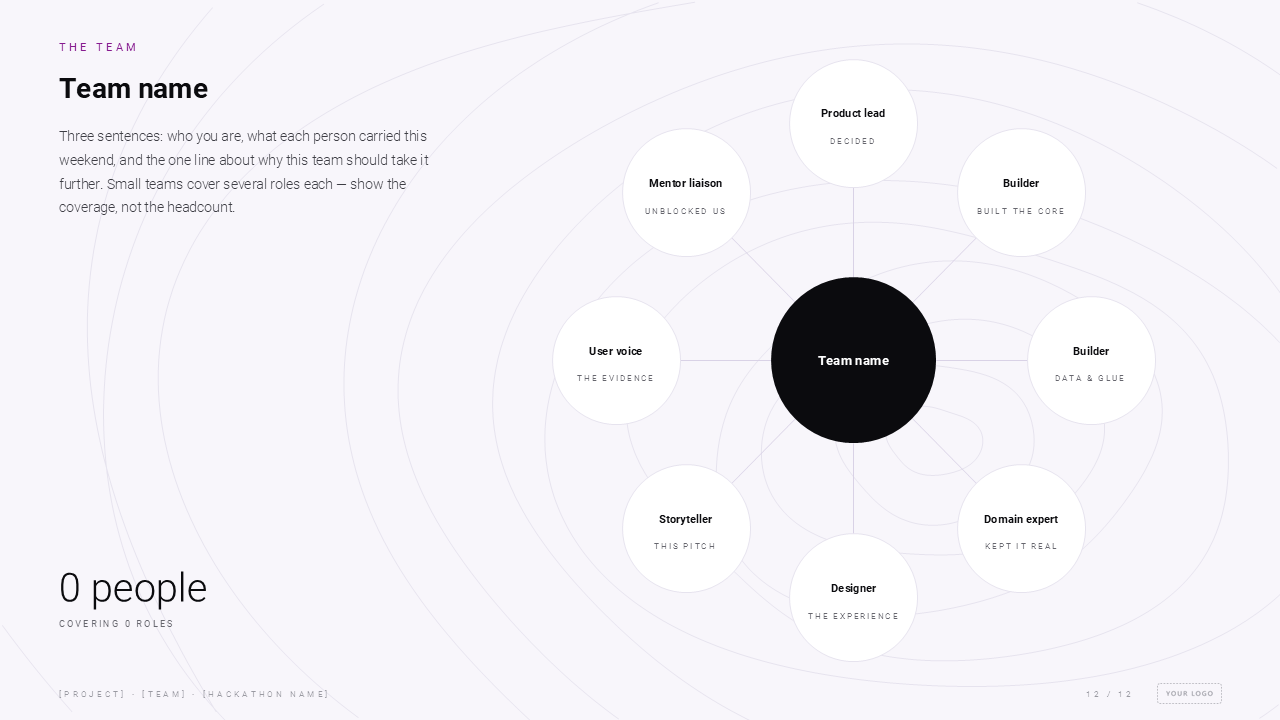
Templates you can adapt, brand and use to define and communicate your hackathon.
The masterclass explains the decisions; these templates put them to work. Fully editable, with the guidance built in, so you start from a finished draft rather than a blank page.
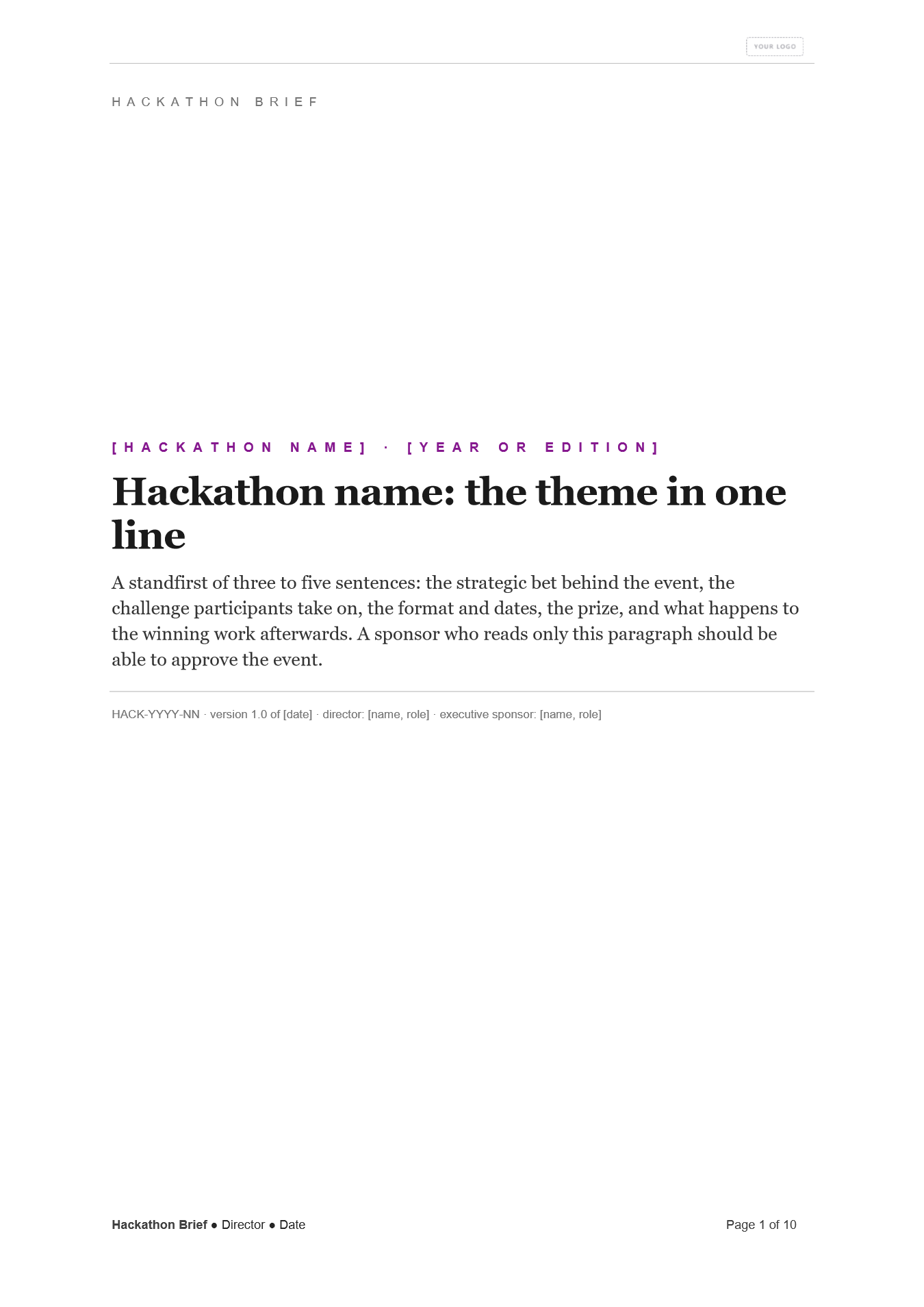
- The hackathon brief: every decision about the event in one document, with the author's notes in the marginDOCX
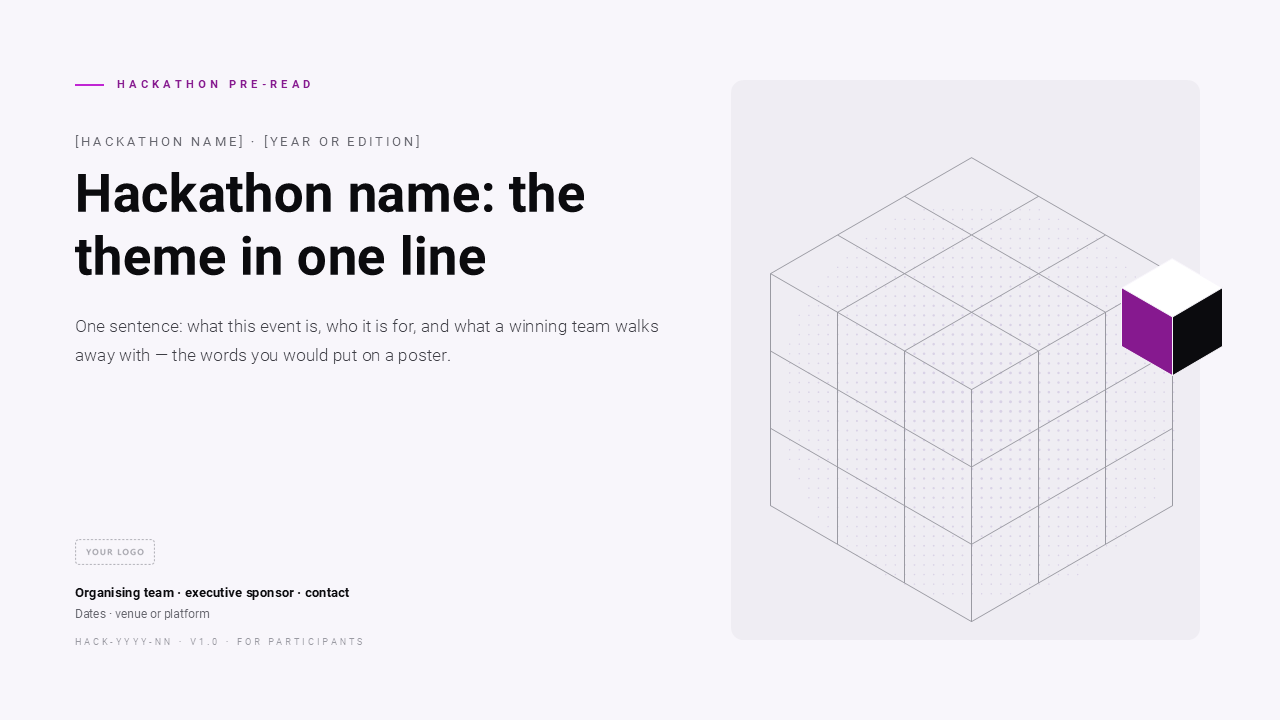
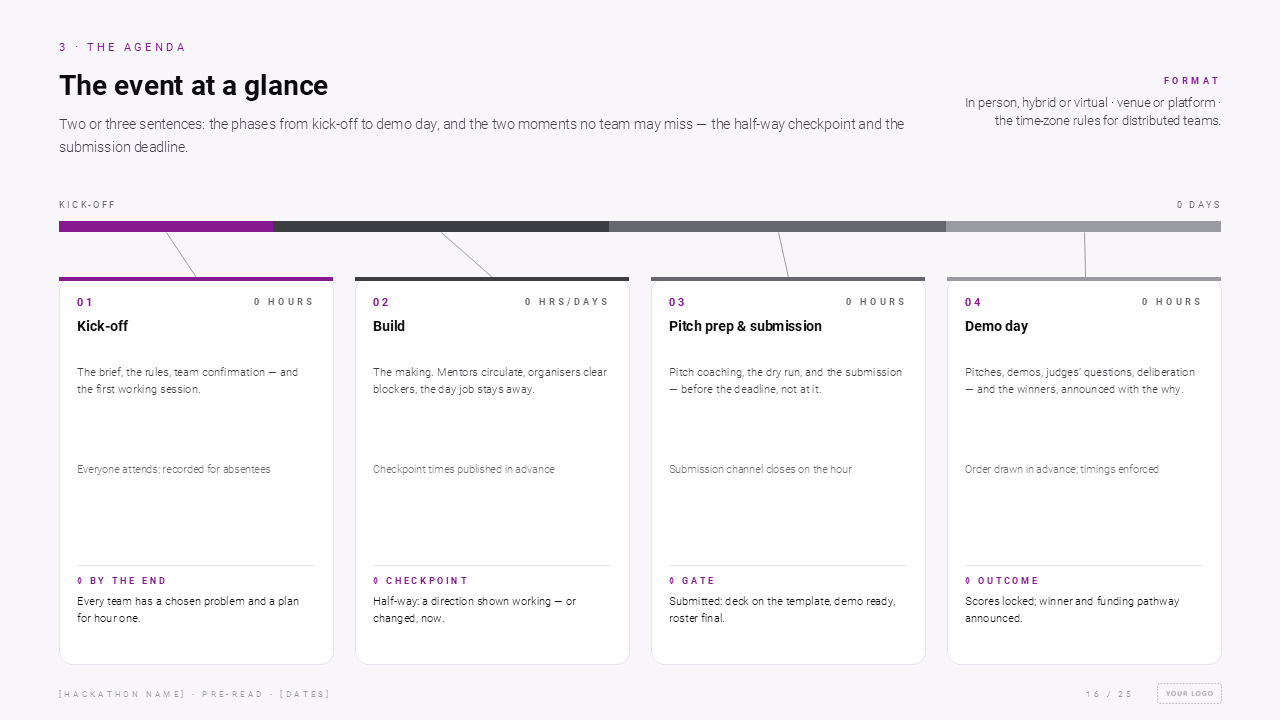
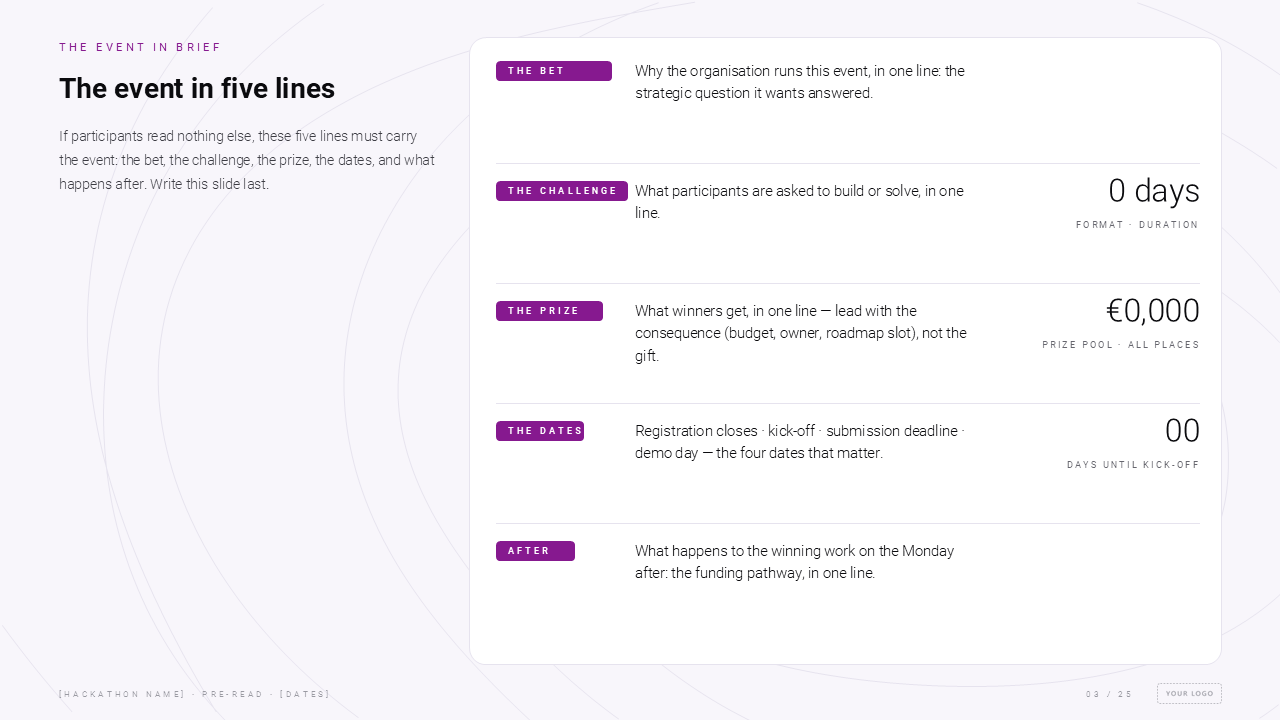
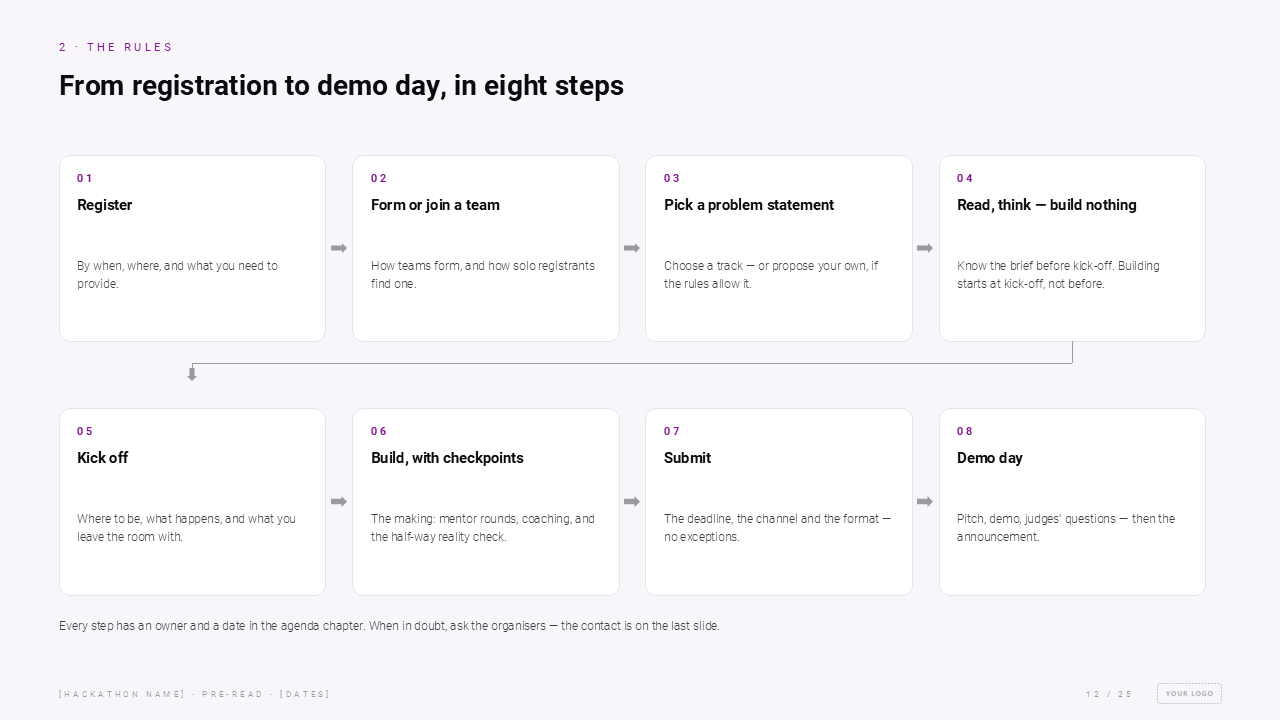
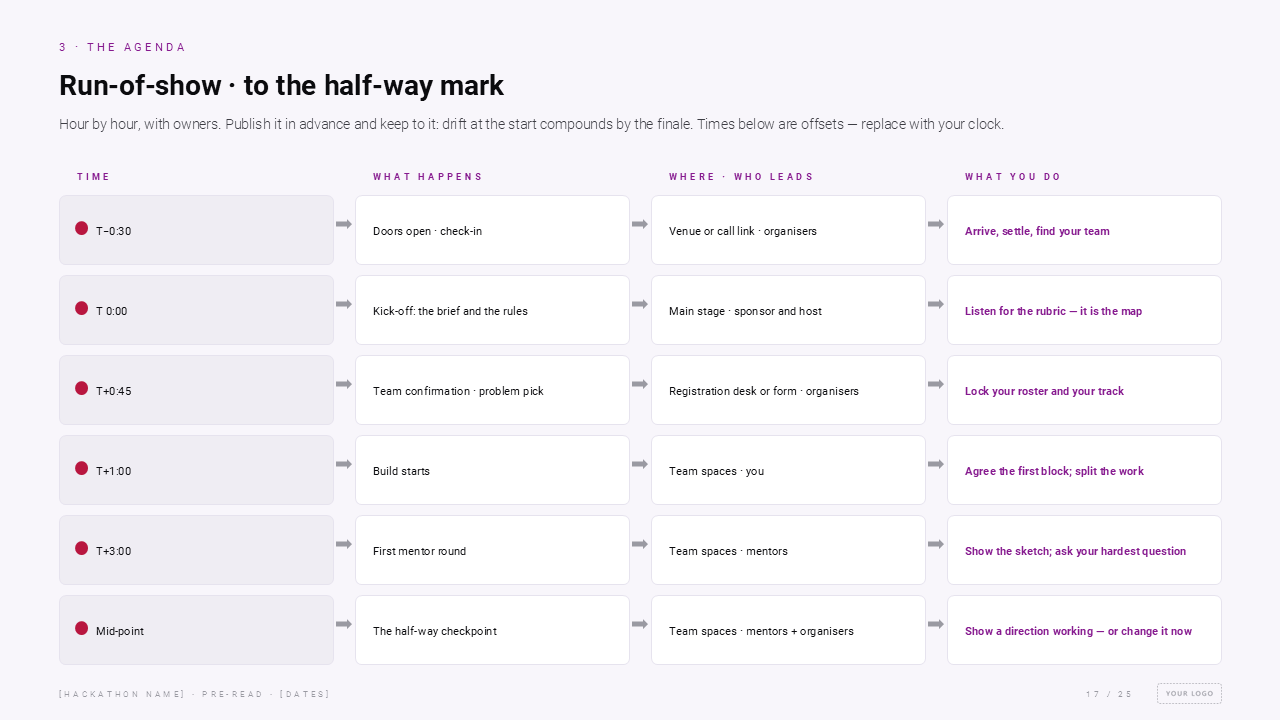
- The pre-read deck: what participants read before they sign up, from the theme and rules to the agenda and judging criteriaPPTX
- The pitch deck: the template every team presents with, built around how it will be judgedPPTX
- The scoring workbook: weighted criteria, conflict handling and a ranking you can defendXLSX
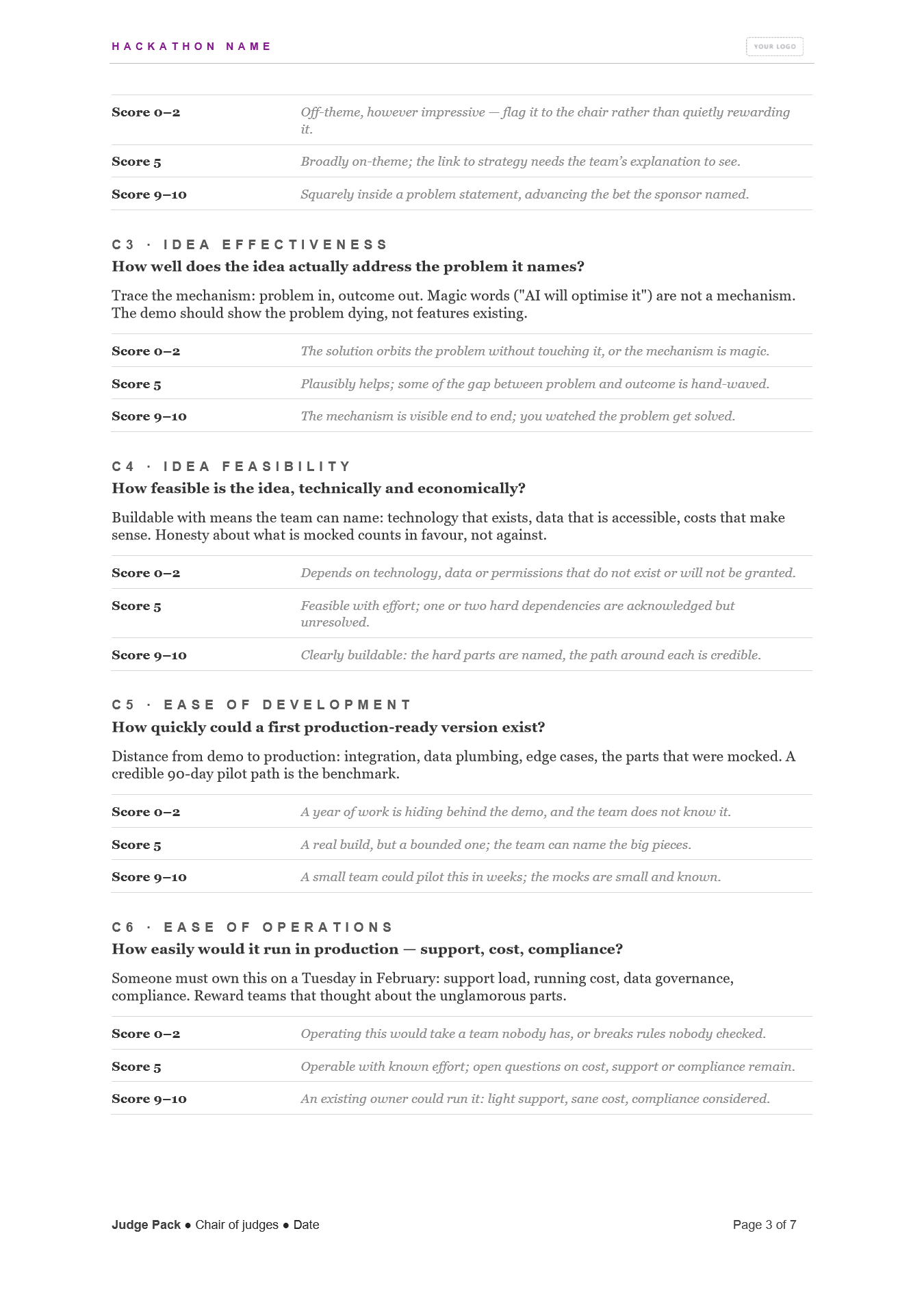
- The judge pack: scoring guidance, the conflict-of-interest protocol and the chair's scriptDOCX
- The communications library: every message, from the first announcement to the 30-day resultsDOCX
The worked example
A complete hackathon, described from end to end, with the reasoning behind every decision.
The package includes a realistic worked example: one corporate hackathon, from the first brief to the final results, written out in the same templates and annotated with why each choice was made. You see what good looks like, and why, before you write your own.
 Pre-read
 Pre-read
 Brief
 Pre-read
 Judge pack
 Pre-read
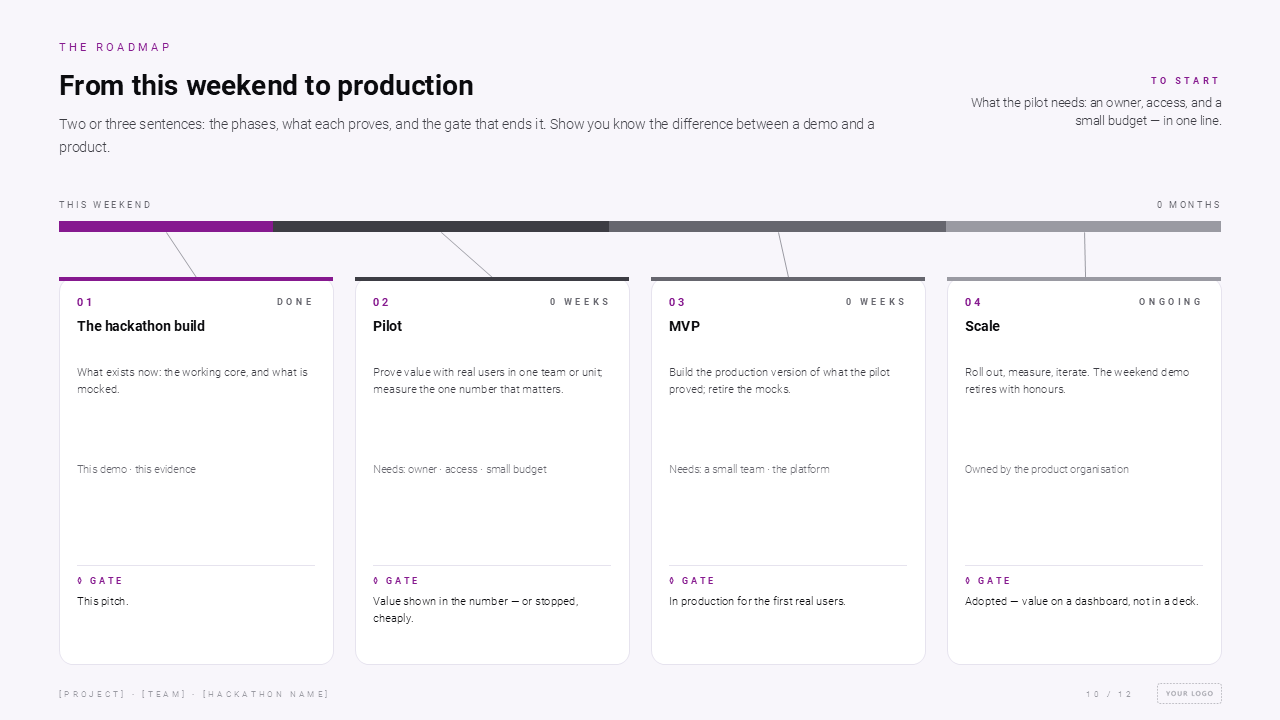 Pitch deck
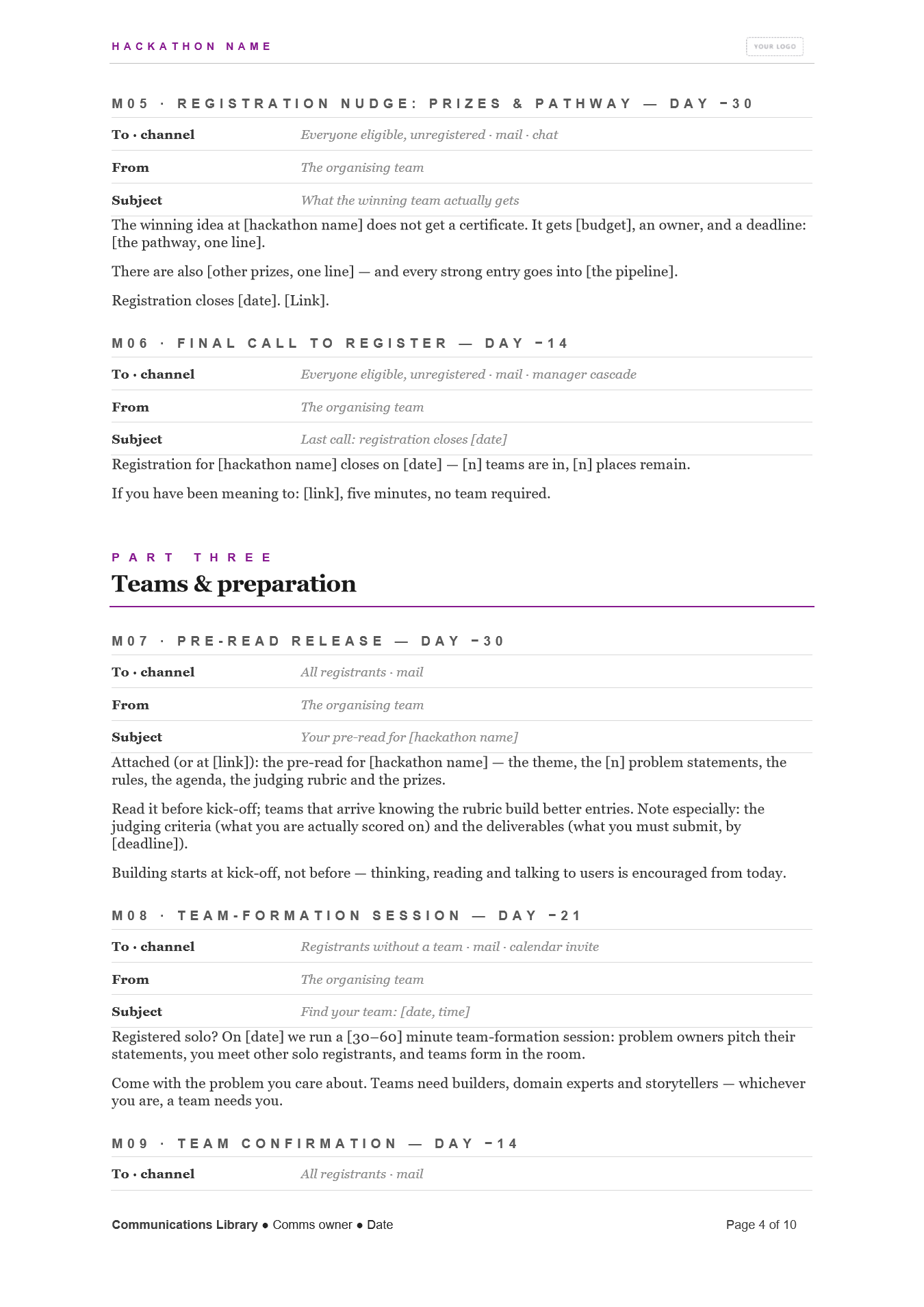 Communications
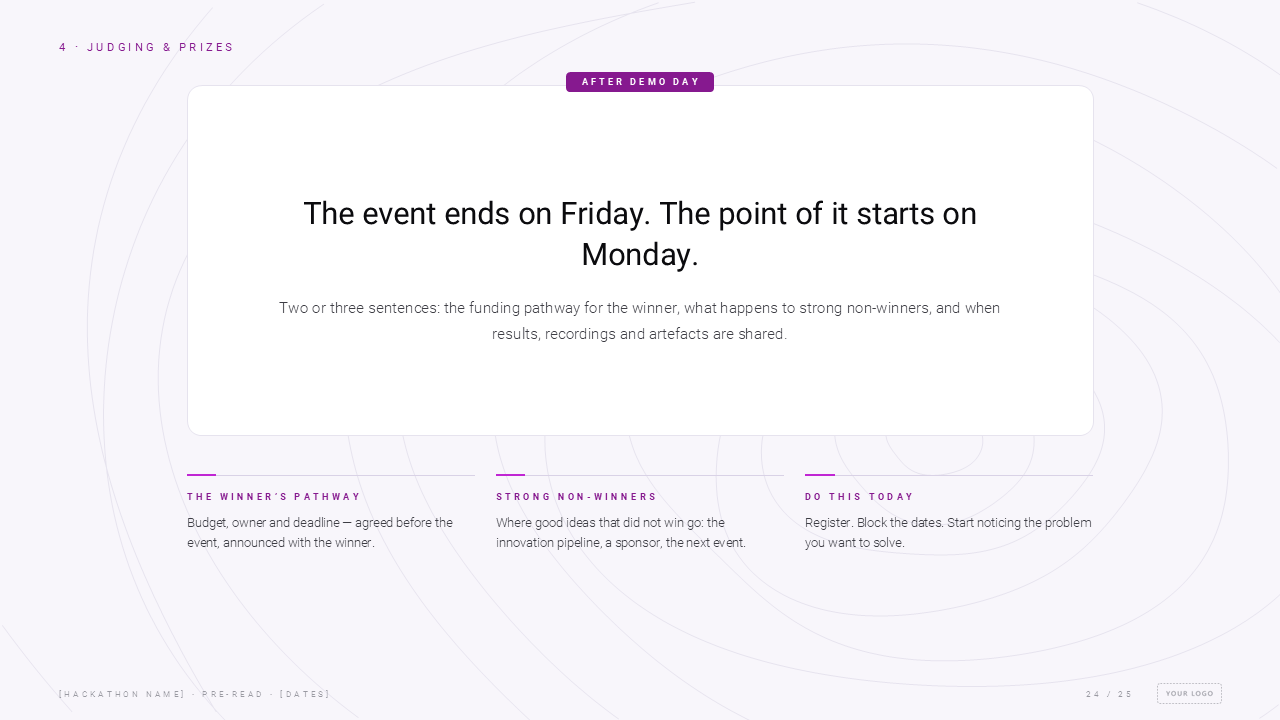 Pre-read
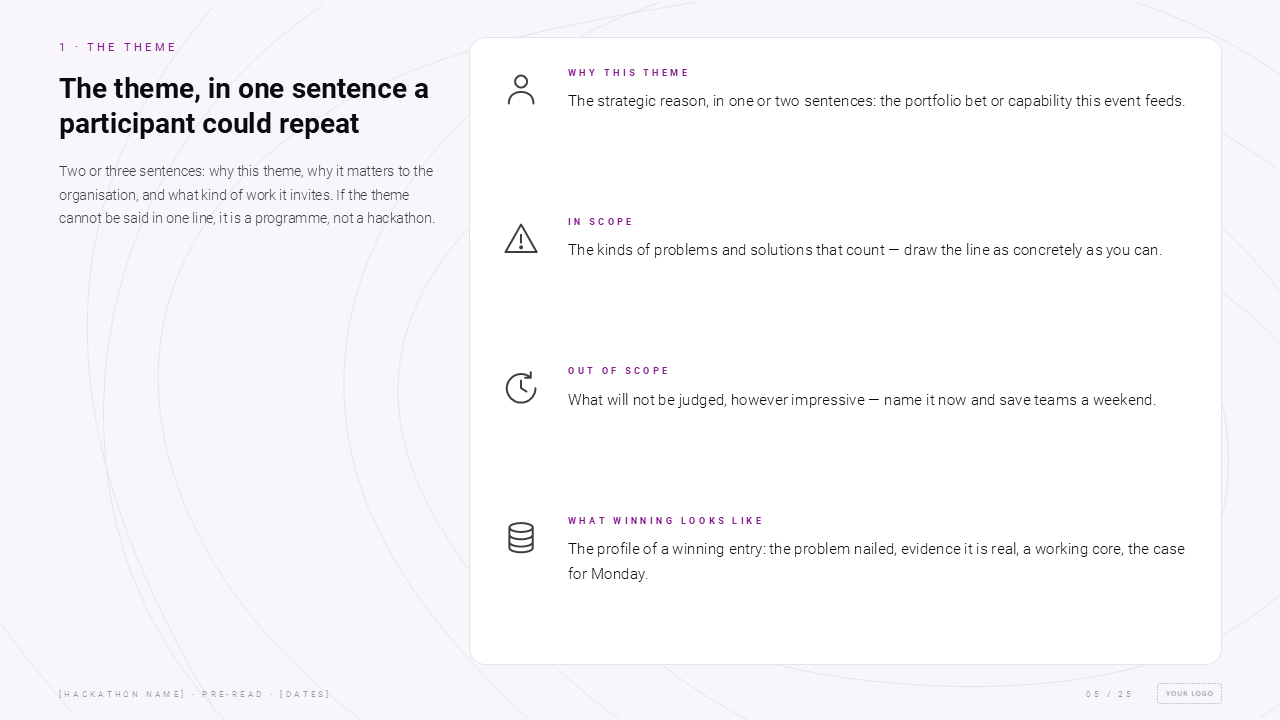 Pre-read
The method behind it
Grounded in a published method.
Not just templates. Unique insights from innovation practitioners.
The masterclass is built on the hackathon method in George Krasadakis's book Innovation Mode, the same framework behind the free guides on this site. The book sets out the method; the masterclass walks you through each decision; the templates put it to work.
Start with the free guides
While the masterclass is in production:
Built for
For leaders who drive true innovation.
Innovation leads
Put winners on the roadmap
Walk into the next steering committee with a defensible scoring model, an audit trail behind every decision, and a funding pathway already drawn for the winner.
- Tie every theme to a portfolio bet
- Back every scoring decision with a clear record
- Hand the winner a budget, an owner and a deadline
Programme managers
Plan in days, not weeks
Start from finished documents instead of a blank page: the brief, the pre-read and the communications calendar, adapted to your event.
- A run-of-show with owners on every row
- 26 pre-written messages, announcement to recap
- One format, standardised across every event
R&D & engineering directors
Surface real ideas, not just energy
Use a hackathon to find what is worth building. The rubric and the funding pathway turn weekend ideas into roadmap items, and the checkpoints kill the ones that aren't.
- Theme design tied to your roadmap
- Mentor checkpoints that stop weak ideas early
- A pathway from winner to funded pilot
Product & CX leaders
Win on the problem, not the prototype
Your hackathon doesn't have to be an engineering contest. The rubric weights problem clarity, evidence and the business case above demo polish.
- Submission rules that accept business cases
- Eligibility rules that invite domain experts
- Templates designed for cross-functional teams
The offer
Run it in-house, or design it with us.
Give your team the method and the templates to run the hackathon in-house, or have us design it with you. For organisations that run hackathons at scale, we build the programme.
01 · The Hackathon Masterclass
The method and the templates, for your team to run.
- The 90-minute video masterclass: how to design and run a hackathon that delivers, in eight modules
- The presentation deck: the full masterclass in slides, yours to present inside your organisation
- Every template to run the hackathon: brief, pre-read and pitch decks, scoring workbook, judge pack and communications library, fully editable
- A complete worked example: one realistic hackathon, written out in the same templates, with the reasoning behind every decision
- Unlimited internal use: every hackathon you run, no per-seat fees, no expiry
- First to know
- First access
- A launch discount for subscribers
One or two emails about this launch and nothing else. No newsletter, no list sharing, unsubscribe anytime.
02 · Advisor-led Available now
The Masterclass, Live
Your hackathon, designed with us from end to end, on the same method.
- Discovery: a 30-minute call, then a structured questionnaire on strategy, audience, format, judging, prizes and IP.
- Design: a plan for your hackathon, delivered as a working document and refined with you.
- Calibration: a 60–90 minute session with your judging panel before the event.
- Debrief: a review after the event covering outcomes, how to track them, and what to change next time.
Optional: an independent chair of judges. We run the calibration, uphold the protocol and chair the deliberation. Your leaders decide; we guarantee the process.
Also included: the full Masterclass at launch, and three months of Ainna.ai Pro for theme generation, idea screening and submission scoring.
Discuss your hackathon →For comparison, a bespoke hackathon plan from an innovation consultancy typically costs €20,000 or more.
03 · Custom Available now
Programmes at scale
For organisations that run hackathons as a capability, not a one-off event:
- Multi-event programmes and recurring challenges
- Multi-region rollouts across divisions
- Train-the-trainer for internal programme managers
- Custom rubric and theme design
- Judging and chairing at your events
- A permanent operating model for your innovation function
Engagements typically start at €25,000.
Questions
Questions, answered.
What exactly will I receive?
A 90-minute video masterclass with its presentation deck, and every template you need to run the hackathon: the brief, the pre-read and pitch decks, the scoring workbook, the judge pack and the communications library, plus a complete worked example written out in the same templates and annotated with the reasoning behind each decision. All in standard, editable formats; no subscription, no DRM.
Where can I watch the masterclass video?
It comes with your purchase, to watch as often as you need, on any device. The presentation deck that accompanies it is yours to present inside your organisation.
When does it launch, and what will it cost?
The templates are finished; the masterclass is in production. Prices are announced at launch. Subscribers hear first and receive the launch discount.
Who is it for?
The people who organise hackathons: innovation leads, programme managers, R&D and engineering directors, product leaders. It is not aimed at participants, although it includes the pitch deck template and guidance your teams will use. Participants can start with our free survival guide for hackathon teams.
Does it cover both internal hackathons and open innovation challenges?
Yes. The two differ in a handful of decisions (audience, eligibility, intellectual property, format and duration), and the masterclass treats them as exactly that. The templates work for either, from a 24-hour sprint to a challenge that runs for several weeks.
Does it work for in-person, hybrid and virtual hackathons?
Yes. The method holds for all three, and the masterclass covers where they differ: schedules, time zones, mentor checkpoints and live judging. The templates adapt to each format, from a single room to teams spread across countries.
What software do I need?
Microsoft Word, PowerPoint and Excel (Microsoft 365, or Office 2016 and later). The files also open in Google Workspace and Keynote, where some layout details may shift. The video plays on any device.
Can I use it for client work?
Use is unlimited inside your own organisation: every event, every team, every copy. Consultancies and agencies that run hackathons for clients need a separate agreement, so please get in touch.
Is there an academic licence?
Yes. Universities, business schools, innovation centres and accelerator programmes can use the masterclass and the templates for teaching, research and student-run hackathons. Tell us about your institution and how you plan to use it.
Can you run the hackathon with us, or judge it?
Yes. Masterclass, Live takes one hackathon from discovery to debrief, with an independent chair of judges as an option: your leaders decide, and we guarantee the process. Custom covers programmes at scale, including judging and chairing at your events. For wider transformation work, see Innovation Advisory.
Couldn't I just ask an AI assistant to plan it?
An AI assistant will draft an agenda in seconds. What it cannot supply is judgement: which prizes distort behaviour, why demo polish should not be scored, when to stop a weak idea, and how to make the winning decision stand up to scrutiny. That judgement is what the masterclass brings.
Go deeper
Read the framework while you wait.
Corporate Hackathon Guide
The strategic framework behind the masterclass: lifecycle, design parameters, evaluation models and reward structures.
Read the guide Measure what mattersMeasuring Hackathon Success
The measurement framework for hackathon outcomes, from participation quality to post-event pipeline conversion.
Read the framework Start planningHow to Plan and Run a Hackathon
The free step-by-step guide: a first pass at the decisions the masterclass covers in depth.
Start planning Choose your themeCorporate Hackathon Ideas
Themes framed around real business problems: AI, sustainability, customer experience, operations and more.
Browse themesMore on hackathons: all hackathon articles · how to plan and run a corporate hackathon · Design Sprint Guide
Other toolkits: Innovation Toolkit · Product Definition Toolkit · For wider transformation work: Innovation Advisory · AI Strategy Advisory
Make your next hackathon one that delivers.
Most hackathons fall short long before demo day, undone by a vague brief, unclear rules and judging nobody trusts. The masterclass shows you how to get each of them right. It is in production now: join the list to hear first, get first access and receive the subscriber discount.
One or two emails about this launch and nothing else. Unsubscribe anytime.
Part of the Innovation Mode toolkit series · By George Krasadakis · theinnovationmode.com
Educators and universities: ask about academic licensing.