
Most startup post-mortems tell the same story. The team ran out of money. The market shifted. The timing was wrong. But when you read carefully, the root cause is almost always the same: they built something nobody wanted.
Not because the founders were naive. Not because the idea was bad on paper. But because they skipped - or shortcut - the one process that could have told them, cheaply and early, whether the idea was worth building: systematic validation.
After more than 25 years of building products at multinationals and five ventures of my own, I've seen this pattern destroy more promising ventures than any competitor, recession, or technical failure. And most of it is preventable.
TL;DR
Building before validating is the most expensive mistake in startup building. This article introduces the three types of unknowns every startup idea carries (risks, uncertainties, and silent assumptions), explains why most validation methods fail (they test the wrong thing in the wrong order), and describes the Innovation Mode approach to idea validation - from the Problem Framing Template through the Nine-Dimension Idea Assessment Model to the Business Experiment Framing Template.
The Real Cost of Skipping Validation
The cost of skipping validation is not the money you spend building. It's the time you lose.
Money can be raised again. Teams can be rebuilt. But the 12-18 months a founder spends building an unvalidated product - iterating on features nobody asked for, optimizing onboarding for users who won't retain, polishing a pitch deck for a market that doesn't exist - that time is gone. And in startup building, time is the one resource that doesn't compound. It just depletes.
The Startup Genome Report found that 70% of startups scale prematurely - committing resources to growth before establishing product-market fit. But premature scaling is a symptom, not the disease. The disease is premature building: writing code before validating that the problem is real, the solution resonates, and the demand exists.
I treat idea validation as two interconnected capabilities that must operate before any building begins: Opportunity Discovery (identifying and assessing high-potential concepts) and Opportunity Validation (testing the riskiest assumptions with real-world evidence). These aren't optional steps in a process. They're organizational capabilities - and as I argued in the book launch essay, in an era where AI can generate ideas in seconds, the scarce capabilities are no longer ideation but opportunity discovery, rapid validation, and execution speed. Companies that build these capabilities systematically innovate faster, fail cheaper, and succeed more often.
The Three Unknowns That Kill Startups
Most startup advice treats all unknowns the same. "Identify your risks," the textbooks say. "Test your assumptions." But this flattening of very different types of unknowns into a single category leads teams to apply the wrong response - and end up with a false sense of security.
I distinguish between three different types of unknowns, each requiring a different response:
Risks
Risks are known challenges with estimable probability and impact. You know what could go wrong - competitive response, technical reliability, regulatory compliance, scalability - and you can plan for it. The response is mitigation: reduce the probability, limit the impact, prepare contingencies.
Most founders handle risks reasonably well because they're visible and familiar. The startup ecosystem has abundant frameworks for risk management.
Uncertainties
Uncertainties are different. These are situations where you don't know what will happen and can't assign meaningful probabilities. How will users actually behave with your novel product? How will emerging technologies reshape your market next year? What societal shifts will change what people consider desirable?
You can't plan for uncertainties. You can only experiment. Design a test, expose it to real conditions, observe what happens, and adapt. This is the domain of business experimentation - and it's where the Business Experiment Framing Template becomes essential.
Silent Assumptions
And then there are silent assumptions - the most dangerous of the three. These are beliefs embedded in your thinking that you haven't even identified as assumptions. "Our users have reliable internet access." "People will switch from their current tool." "The data we need is available and clean." "Enterprise buyers can approve purchases under $50K without a procurement process."
As I put it in the book: "When beliefs about customer behavior, market dynamics, or technological capabilities remain unchallenged or even unnoticed, entire business plans and important decisions may rely on an unstable basis. Unlike identified risks or uncertainties, which are documented and considered, these silent assumptions are blind spots."
Silent assumptions are why startups fail despite doing everything "right." The team identified their risks, ran their experiments, talked to users - but never questioned the foundational beliefs that their entire concept rested on. When one of those beliefs turned out to be wrong, the whole structure collapsed.
The Opportunity Validation team is built to tell these three apart. Unlike traditional risk management that applies standard frameworks uniformly, this team distinguishes between quantifiable risks, explorable uncertainties, and hidden assumptions - applying probabilistic assessment, experimentation, or discovery techniques as appropriate. Their expertise lies in recognizing which type of unknown they're facing and selecting the right approach for each case.
Why Most Validation Fails: Testing the Wrong Thing
Even founders who do validate often validate the wrong thing - or validate in the wrong order.
The most common pattern I see: a founder has an idea for a product. They build a landing page, drive traffic with ads, and count signups. "200 people signed up! Validated!" No. You validated that 200 people would click a button on a page with compelling copy. You haven't validated that a real problem exists, that your solution is the right one, or that those 200 people would actually use (let alone pay for) the product.
In the Innovation Mode methodology, validation proceeds through layers - what I call the Three-Layer PMF Journey:
Layer 1: Problem-Market Fit. Does a real, painful problem exist for a large enough audience? Use The Problem Framing Template to articulate who is affected, what the current state is, and what the ideal state looks like. Validate through conversations, not surveys. Talk to 10-15 people who match your target persona. Ask about their problems, their workarounds, their frustrations. Do not mention your solution.
Layer 2: Solution-Market Fit. Does your proposed approach resonate with the people who have the problem? Frame your concept using The Universal Idea Model: "An [object] for [users] that [does X] in order to [achieve Y]." Test it through design sprints, rapid prototyping, or concept testing sessions. Measure resonance, not politeness.
Layer 3: Product-Market Fit. Does your built product deliver the solution in a way users adopt, retain, and value? This is where you build the MVP and begin the experiment-build-measure cycles that drive toward fit. But you shouldn't reach this layer until Layers 1 and 2 are confirmed.
Most failed startups jump directly to Layer 3. They have an idea, they build a product, they launch, and then they discover - with a shipped product and depleted resources - that the problem wasn't significant enough, the solution didn't resonate, or the market was too small. Each layer is cheaper and faster to validate than the next. A week spent on Layer 1 can save months of misguided building at Layer 3.
The Nine-Dimension Idea Assessment Model
Once you've framed your problem and your solution concept, how do you assess whether the idea is worth pursuing? Gut feeling? Team consensus? Investor enthusiasm?
All of these are unreliable. Gut feeling is biased toward what excites you, not what the market needs. Team consensus optimizes for agreement, not accuracy. Investor enthusiasm reflects what's fundable, not what's viable.
The Nine-Dimension Idea Assessment Model is a structured framework that evaluates multiple qualities of both the idea and the business problem to produce a single Opportunity Score. The nine dimensions span problem quality, solution quality, execution complexity, and business potential. Each is scored 0-10 by evaluators with domain expertise, and a weighted aggregation produces the overall score.
But the real value of the model isn't the score. It's the conversations it forces and the blind spots it reveals. Three dimensions in particular catch founders off guard:
Strategic alignment is the one most founders skip entirely. They assess whether the problem is important - but they don't assess whether it's important to them, in their market, with their capabilities. The model separates these: Dimension 1 captures universal importance ("Is this a significant problem in general?"), while Dimension 2 captures strategic fit ("Is this the right problem for us to solve?"). The interesting insights emerge when these two diverge. A problem that scores 9 on universal importance but 3 on strategic alignment might signal a pivot opportunity - a massive market your company hasn't considered. A problem that scores 3 on importance but 9 on alignment might indicate an internal bias toward familiar territory that limits your ambition.
Certainty of demand is the one founders most often inflate. "Of course there's demand - everyone has this problem!" But having a problem and being willing to adopt a new solution for it are very different things. People tolerate enormous pain when switching costs are high, when the problem is intermittent, or when "good enough" workarounds exist. This dimension forces the honest question: not "Does the problem exist?" but "Will enough people actually change their behavior to adopt our solution?"
Feasibility is the one founders most often overweight - and I deliberately push back on this: "Overemphasizing the feasibility of an idea, especially at an early stage, may introduce constraints and limit its potential." Feasibility should be assessed, but it shouldn't kill ideas prematurely. The pace of technological change means that what's infeasible today may be trivial in 18 months. The model includes feasibility as one of nine dimensions, not the gatekeeper.
The remaining six dimensions - effectiveness, ease of implementation, ease of operation, business impact, novelty, and importance of the problem - complete the picture. Together, the nine dimensions transform idea assessment from an opinion-driven debate into a structured, repeatable process where disagreements become visible and assumptions become explicit.
The model also supports different "lenses" - a product team might weight feasibility and ease of implementation heavily, while an IP strategy team might weight novelty above everything else. Same scores, different interpretation, depending on the strategic context.
Validation Is Not the Opposite of Building
There's a trap that catches even disciplined founders: validation becomes so comfortable that it replaces the thing it's supposed to enable.
It's easy to see how it happens. Every conversation reveals a new nuance. Every experiment raises a follow-up question. The methodology works so well at reducing uncertainty that you keep wanting one more round - one more interview, one more prototype iteration, one more data point. The validation process is genuinely productive, the learning is real, and at no point does it feel like you're stalling. But months pass, and the product still doesn't exist.
This is validation theater - or, what I call, the validation trap - and it's just as destructive as skipping validation entirely. The difference is that it feels productive. You're talking to users! You're running experiments! You're being disciplined! But if your tenth interview confirms what your third interview told you, you're not validating anymore - you're procrastinating with a methodology excuse.
Validation is not a substitute for building. It's a prerequisite.
Here's how to know you're done: when the remaining unknowns can only be resolved by putting a real product in front of real users. When your last five conversations reveal nothing new. When the questions on your list all start with "How will users behave when..." rather than "Does anyone have this problem?" Those behavioral questions require a live product - no amount of pre-build testing will answer them.
As I put it in the book:
"The real risk is releasing a non-viable first instance too late."
Notice the emphasis: too late. Not "too early." Not "before it's perfect." Too late. Every week you spend over-validating is a week a competitor might spend learning from real users.
The Innovation Mode approach addresses this through a structured, decisive handoff. When the Opportunity Validation team confirms that the concept is worth pursuing, the opportunity package - validated problem statement, product concept, risk and uncertainty analysis, experiment results - is handed to the Opportunity Realization team (the Venture Studio), who applies the Seven-Step MVP Definition Process and builds. The handoff is decisive, not gradual. The validation team says "go," and the build begins.
This structural separation matters because it creates accountability in both directions. The validation team can't hand off a half-validated concept - they're accountable for the quality of their recommendation. And the build team can't keep requesting "one more experiment" - the decision has been made.
A practical heuristic: if you've completed problem validation (conversations, desk research) and concept testing (design sprint, prototype feedback) and signals are consistently positive, you likely have enough. The remaining layers of validation - pricing experiments, extended user testing, functional prototyping - are for ideas with specific high-risk uncertainties that justify the additional investment, not for every idea that passed the first two checks.
The AI Validation Challenge
For founders building AI-powered products - and in 2026, that's most of you - validation carries an additional layer of complexity that the traditional startup playbook doesn't address.
Traditional startups validate one hypothesis: will users want this product? AI startups must validate two simultaneously: will users want this product? and can the AI actually deliver it at sufficient quality? These are independent questions, and confusing them is a common and expensive mistake. Strong demand for a capability doesn't mean current AI can deliver it reliably. And a technically impressive AI demo doesn't mean users will adopt it for real work.
I've experienced this tension firsthand. Back in 2012 I was working on a very ambitious social commerce concept - which became a patent application in 2016 - autonomous AI agents that negotiate purchases on behalf of humans. The architecture was sound, the market demand was obvious, but the enabling technology - language models capable of nuanced multi-turn negotiation - didn't exist yet. The idea was validated on the demand side but would not pass the technology validation test - it was simply far ahead of its time. Distinguishing between these two types of validation would have saved a lot of energy spent on solutions that the state of the art couldn't yet support. Today, with models from OpenAI, Anthropic, and Google reaching the required capability, that same concept is suddenly viable - and every major tech company is racing to build it.
The good news is that AI prototyping has never been cheaper or faster. For LLM-powered products, you can often validate the core AI capability with a well-designed prompt chain before writing a single line of product code. Build a prompt-based prototype, test it with five target users, and measure whether the output quality crosses the threshold of usefulness. This is what we do with Ainna - the entire product was initially validated as a prompt-based prototype before any platform code was written.
But there's a deeper question that most AI founders avoid: what do you own? Your product's core intelligence is almost certainly rented through third-party APIs. If removing the model API would leave you with nothing defensible - no proprietary data, no domain expertise, no workflow integration, no accumulated user insights - your idea has a fragility problem that validation should surface early. I explore this model dependency risk in depth in the AI PRD article, but the key question for validation is straightforward: would your product survive a competitor using the exact same API?
There's also the expectation gap. Users in 2026 compare every AI product to ChatGPT and Claude - regardless of whether the comparison is fair. Your specialized AI tool for legal contract review will be judged against the general-purpose conversational experience those models provide. Validate user expectations specifically, not just whether your AI works. It might work perfectly and still disappoint users whose reference point is a frontier foundation model.
What Good Validation Looks Like in Practice
Let me walk through what this actually looks like - not as a methodology diagram, but as a calendar.
In the first week, you're doing nothing but understanding the problem. Use The Problem Framing Template to articulate who's affected and how. Have 10-15 conversations with people who match your target persona. Don't pitch - listen. In parallel, run desk research: competitive analysis, market sizing, trend analysis. By Friday, you should have a validated problem statement and a clear view of who else is trying to solve this. If you don't - if the conversations reveal indifference rather than pain - you've just saved yourself months. Stop here, redirect, and be grateful for the cheap answer.
In the second week, you frame the solution. Articulate your concept using The Universal Idea Model and expand it with The Product Concept Template. Then do something most founders skip: score it honestly against the Nine-Dimension Idea Assessment Model. Where are the gaps? What assumptions are you making? Which unknowns are risks (plannable), which are uncertainties (testable), and which are silent assumptions (invisible until they break you)? By the end of week two, you have a framed concept and a map of exactly what needs testing next.
Weeks three and four are for experiments. Use the Business Experiment Framing Template to design each test with a hypothesis, success criterion, and pre-committed interpretation before you run it. The specific experiment depends on what you're testing: a design sprint for UX-heavy concepts, a landing page for demand validation, a concierge MVP for service-based ideas, a prompt-level prototype for AI products. What matters isn't the format - it's the discipline of defining what you'll learn and what you'll do with the answer.
Some ideas need a fifth and sixth week - functional prototyping, extended user testing, pricing experiments. But most digital product ideas can be validated or invalidated in four weeks. Two to six weeks total, compared to six to twelve months of building the wrong thing. The math is not subtle.
Reading the Signals the Market Already Produces
Some of the strongest validation evidence is already out there. You don't always need to run your own experiments.
Read every 1-star and 3-star review of competing products. The 1-star reviews tell you what's broken. The 3-star reviews - the "it's good but..." reviews - tell you what's almost good enough. That gap is your opportunity.
Search community forums - Reddit threads, Hacker News discussions, Quora questions, industry Slack groups. When someone posts "Is there a tool that does X?" or "I've been doing Y manually for years and I can't believe there isn't a better way" - that's unprompted, unbiased demand validation. It's also your future marketing copy.
Look at job postings. If companies are hiring people to solve the problem you're automating, there's validated demand. The market is paying real salaries to address this pain manually. Your product is the automation of that role.
These signals don't replace structured validation - but they accelerate it. By the time you start your own experiments, you should already have a strong hypothesis built from the signals the market is producing on its own.
The Frameworks That Make This Systematic
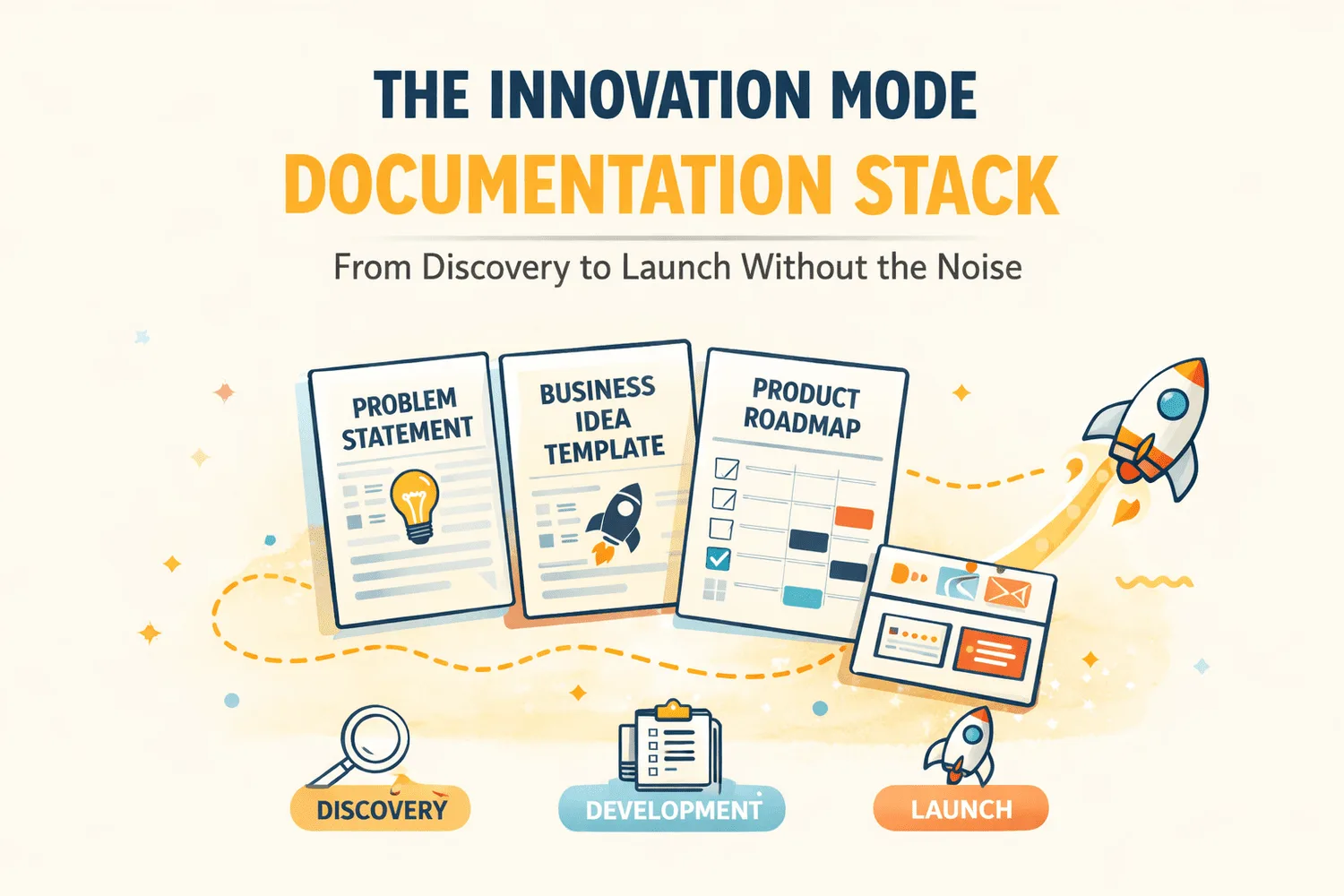
Everything I've described above is codified in the Innovation Toolkit as a set of templates and frameworks that any founder or product team can apply:
- The Problem Framing Template - for articulating the problem clearly before jumping to solutions
- The Universal Idea Model - for framing your concept as a single, testable statement
- The Product Concept Template - for expanding the concept into a structured description
- The Business Experiment Framing Template - for designing experiments that produce decisions, not just data
- The Nine-Dimension Idea Assessment Model - for evaluating opportunity potential systematically
In short
The most expensive startup mistake isn't running out of money. It's spending months building a product based on assumptions you never tested, for a problem you never validated, in a market you never sized.
The founders who beat the odds don't have better ideas. They have better validation discipline. They distinguish between risks they can plan for, uncertainties they must experiment on, and silent assumptions they need to surface. They validate the problem before the solution and the solution before the product. And when the evidence says build, they build decisively.
The complete framework - including the Nine-Dimension Idea Assessment Model, the Three-Layer PMF Journey, and the risks-uncertainties-assumptions framework - is detailed in Innovation Mode 2.0 (Springer, 2026).
References
Krasadakis, G. (2026). Innovation Mode 2.0: Designing Innovative Companies in the Era of Artificial Intelligence. Springer, Cham. https://doi.org/10.1007/978-3-032-00835-0
Krasadakis, G. "MVPs and Startups: FAQs." The Innovation Mode Blog.
Krasadakis, G. "Product Discovery Documentation: The Chief Innovation Officer's Guide to Turning Ideas into Products." The Innovation Mode Blog.
Krasadakis, G. Google Scholar Profile.