Product Discovery Documentation: The Chief Innovation Officer's Guide to Turning Ideas into Products
Why lean, just-enough documentation separates product innovation leaders from innovation theater—and how Chief Innovation Officers can build clarity without bureaucracy.
Every innovation team has experienced it: a brilliant idea emerges from a brainstorming session, everyone gets excited, and then... nothing happens. The idea gets lost in email threads, misremembered in follow-up meetings, or quietly abandoned because nobody could quite articulate what it actually was.
This isn't a creativity problem. It's a clarity problem—and it's one of the most common challenges Chief Innovation Officers face when scaling product innovation across their organizations.
The solution isn't more process, longer documents, or bureaucratic checkpoints. It's lean, focused documentation—just enough to capture what matters, align stakeholders, and enable action. One page per problem. One page per idea. Clarity on paper, not paperwork for paperwork's sake.
The AI Paradox: More Content, Less Clarity
We're living in an era where anyone can generate anything in seconds. AI tools produce endless documents, summaries, analyses, and plans. Content has never been cheaper to create.
And yet—or perhaps because of this—clarity has never been more valuable.
When everyone can generate 50 pages of plausible-sounding strategy, the signal gets lost in the noise. When AI can produce comprehensive documentation on demand, the ability to distill what actually matters becomes the differentiator.
The irony of the AI content explosion is that it makes essential, authentic, laser-focused documentation more important than ever. Not more documentation. Better documentation. Documentation that reflects genuine thinking, real decisions, and actual clarity—not just words that fill pages.
For Chief Innovation Officers leading product innovation initiatives, this shift is critical. Your innovation team's ability to cut through the noise with precise, purposeful communication is now a competitive advantage. The organizations that win are those with disciplined documentation practices that capture substance, not just volume.
Documentation Has a Bad Reputation (And Sometimes Deserves It)
Let's be honest: when most people hear "documentation," they think of corporate bureaucracy—endless templates, review committees, documents nobody reads, and process that exists to justify itself.
That's not what effective product innovation requires.
Bad documentation is:
Long — 50-page requirements documents that nobody finishes
Vague — Covers everything in generalities, commits to nothing specific
Backward-looking — Exists to prove work was done, not to enable future work
Ceremonial — Required by process, ignored in practice
Good documentation is the opposite. It's lean—one page that forces clarity. It's specific—captures decisions, not options. It's forward-looking—exists to enable action. And it's living—used daily, not filed and forgotten.
The goal isn't to document for documentation's sake. The goal is clarity. Clarity about what problem you're solving. Clarity about what your idea actually is. Clarity about how you'll know if it works.
When documentation creates clarity, it accelerates product innovation. When it creates bureaucracy, it kills it.
The Hidden Cost of No Documentation
The opposite extreme is equally dangerous. Many innovation teams, reacting against bureaucracy, swing to "move fast and break things"—verbal agreements, whiteboard sketches, tribal knowledge.
This approach has hidden costs that every Chief Innovation Officer should recognize:
Good ideas get lost. Without even minimal documentation, promising concepts disappear into the void of half-remembered conversations.
Teams misalign. What sounds like agreement in a meeting becomes disagreement during development when people realize they understood the idea differently.
Evaluation becomes political. Without objective criteria, idea selection devolves into who argues most persuasively.
Learning doesn't compound. Each product innovation initiative starts from scratch because there's no institutional memory.
The answer isn't zero documentation or maximum documentation. It's just-enough documentation—the minimum viable clarity that enables aligned action across your innovation team.
Building Your Innovation Language
An innovation language is a standardized, lightweight way of describing problems, ideas, and concepts. Think of it as a shared vocabulary for your innovation team—when everyone uses the same simple templates, communication accelerates:
Ideas become discoverable—you can search and compare systematically
Collaboration accelerates—less time explaining, more time developing
Evaluation becomes objective—consistent criteria applied consistently
Knowledge compounds—learnings persist beyond individual projects
For Chief Innovation Officers managing multiple product innovation streams, this shared language is essential. It enables portfolio-level visibility and decision-making that would be impossible with inconsistent, ad-hoc documentation.
The key word is simple. Each template should fit on one page. If it doesn't fit on one page, you're not being clear enough—you're being comprehensive, which is the enemy of clarity.
Let me walk you through the essential documents every innovation team needs.
Document #1: The Problem Statement (One Page)
The most common product innovation mistake is rushing to solutions without understanding the problem.
Innovation teams jump to "we need an app" before anyone can articulate what problem they're solving. This leads to elegant solutions for problems nobody has.
A one-page problem statement forces clarity across four dimensions:
The Environment: Who's affected? What's the ecosystem? Who has a stake in solving this?
The Dynamics: When did this emerge? How is it evolving? What's been tried before?
The Current State: What are the symptoms? What are the root causes? How do people experience this problem today?
The Ideal State: What does success look like? How would stakeholders benefit if this disappeared?
One page. Four sections. That's it.
The constraint is the point. If your innovation team can't articulate a problem concisely, they don't understand it well enough to solve it. The one-page limit forces prioritization—what actually matters?
Pro tip: Share your problem statement with brainstorming participants before the session. Ten minutes of reading beats an hour of confused ideation.
Document #2: The Business Idea Template (One Page)
Once you understand the problem, you need a consistent way to capture solutions. Not a 20-page business case. A one-page snapshot.
Four sections:
The Problem Being Solved: What situation does this address? Why does it matter? (Yes, repeat it—ideas without clear problem links are solutions looking for problems.)
Users, Value, and Form: Who benefits? What value do they get? What form might this take—app, service, platform?
The Logic: How does it actually work? What's the mechanism?
The Big Unknowns: What must be true for this to work? What are you assuming? What could kill this?
That last section is crucial and often skipped. Every product innovation idea carries assumptions. Making them explicit creates a validation roadmap and prevents expensive late-stage surprises.
One page forces you to know what your idea actually is. If you need five pages to explain it, you don't have one idea—you have five.
The Universal Idea Model: One Sentence
Sometimes one page is too much. You need to communicate an idea in a single sentence—for executives, for quick alignment, for elevator pitches.
The Universal Idea Model:
An [object] for [users] that [does something] in order to [achieve goal]. Users benefit by [getting value] when [in a specific situation].
Examples:
Meeting Optimizer: "An intelligent component for business users that recommends meeting participants in order to ensure the right people are in the room. Users benefit by instantly finding relevant experts when setting up meetings."
Smart Do Not Disturb: "A software component for smartphones that detects noise-sensitive situations in order to minimize notification disturbance. Users benefit from socially appropriate phone behavior when in places requiring quiet."
One sentence. Complete clarity about what, who, how, why, and when.
If your innovation team can't complete this sentence, they don't have an idea yet—they have a vague notion. The structure reveals gaps in thinking.
Document #3: Idea Assessment (One Spreadsheet)
Say you have 50 ideas from a hackathon. How do you decide which three to pursue?
Without structure, selection becomes political. With too much structure, it becomes bureaucratic theater.
The lean approach: a simple spreadsheet with weighted criteria.
Score each idea 1-10 on:
Problem Importance
Strategic Fit
Solution Effectiveness
Feasibility
Potential Impact
Market Demand Certainty
Weight the criteria based on what matters to your organization. Multiply, sum, rank.
This isn't about achieving perfect objectivity—that's impossible. It's about forcing explicit conversations about priorities and applying them consistently. For Chief Innovation Officers managing product innovation portfolios, this systematic approach enables defensible resource allocation decisions. A 30-minute scoring session beats a 3-hour debate.
Document #4: The Product Concept (A Few Pages)
For ideas that survive assessment, expand into a product concept. This is the most detailed discovery document—but "detailed" means 5-10 pages, not 50.
Cover:
Market context and competition
Target users and personas
Key user stories (not hundreds—the essential ones)
Product vision and core features
Technology approach
Go-to-market strategy
Monetization model
The product concept is your alignment artifact. When stakeholders disagree, return to it. When scope creeps, ask "is this in our concept?" When new innovation team members join, it's their onboarding document.
But keep it lean. A product concept that takes two weeks to write is too heavy. If your concept runs to 40 pages, it's time to make harder choices about what's essential. Brevity forces clarity.
Document #5: The Business Experiment (One Page)
Before scaling, validate your riskiest assumptions. A one-page experiment template:
Hypothesis: What specific prediction are you testing?
Method: How will you test it?
Metrics: What will you measure?
Success Criteria: What results mean "proceed" vs. "pivot" vs. "kill"?
Timeline: When will you have results?
Define decision rules before running the experiment. "If we see X, we'll do Y." Without predetermined rules, you'll rationalize whatever results you get.
One page. Clear hypothesis. Clear success criteria. That's a real experiment, not innovation theater.
From Discovery to Development: PRDs and Pitch Decks
The documents above cover the discovery phase—understanding problems, generating ideas, evaluating opportunities, and validating assumptions. But as ideas mature into products, your innovation team needs more comprehensive documentation.
The Product Requirements Document (PRD) becomes essential when you're ready to build. While discovery documents capture the "what and why," the PRD details the "how exactly"—specific user stories with acceptance criteria, technical specifications, edge cases, and implementation requirements. A solid PRD might run 20-40 pages, but it's built on the foundation of your lean discovery documents. Without that foundation, PRDs become wish lists disconnected from validated user needs.
The Pitch Deck serves a different purpose: communicating your product innovation opportunity to stakeholders who need to make investment decisions—whether that's leadership allocating resources, investors providing funding, or partners considering collaboration. A compelling pitch deck distills your problem statement, solution, market opportunity, competitive advantage, business model, and team into a visual narrative. Typically 15-25 slides, it should tell a story that makes the opportunity impossible to ignore.
Executive One-Pagers bridge the gap—when you need more than an idea template but less than a full pitch deck. These single-page summaries of the problem, solution, and opportunity are perfect for initial stakeholder alignment, portfolio reviews, and quick decision-making. Chief Innovation Officers often use these to communicate across their product innovation portfolio to executive leadership.
The key insight: these development-phase documents are only as good as your discovery-phase clarity. A pitch deck built on a vague problem statement will be vague. A PRD built on an unvalidated idea will specify the wrong things. The lean discovery documents aren't just a phase you pass through—they're the foundation everything else builds upon.
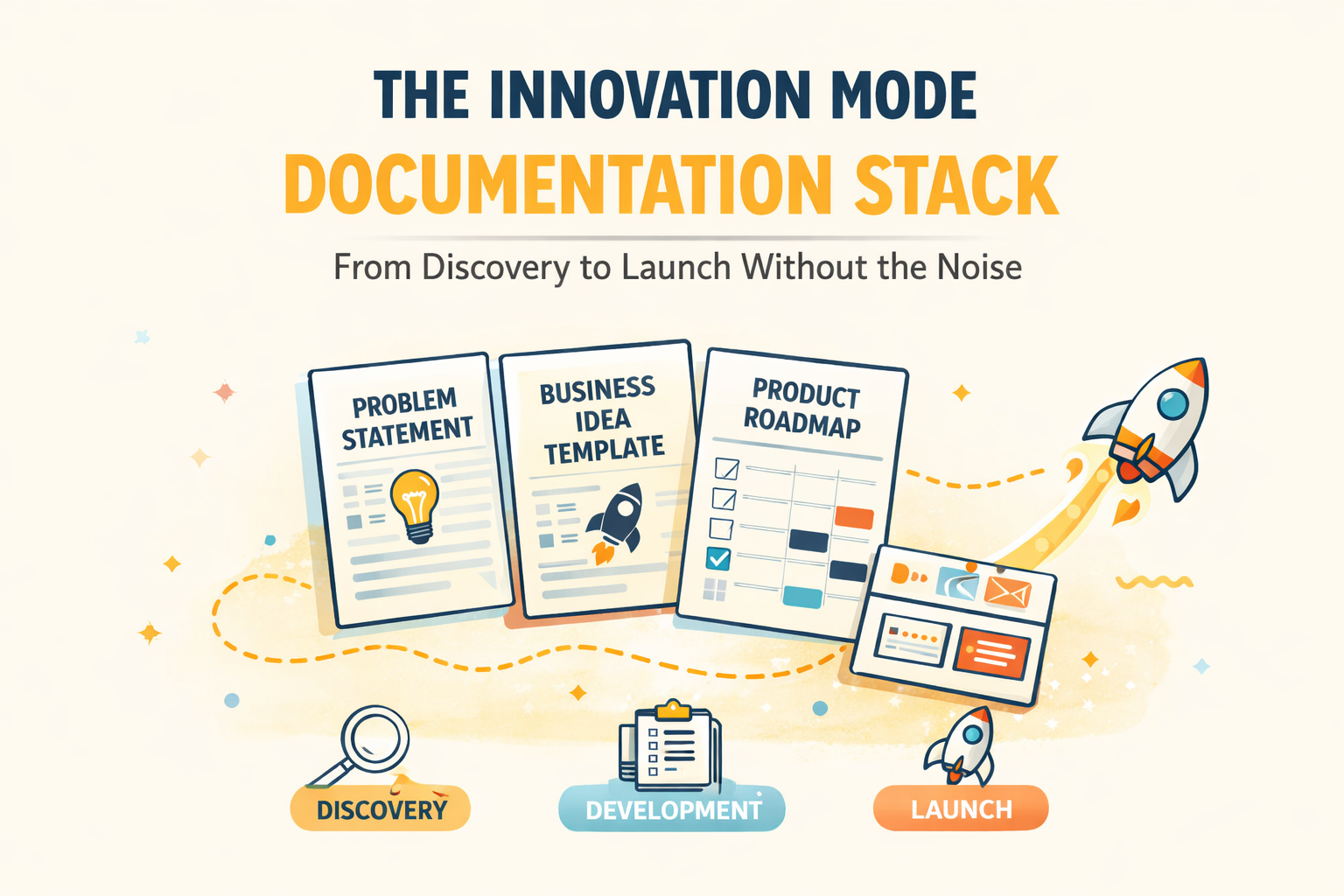
The Innovation Mode Documentation Stack
Here's the complete progression from rough idea to board-ready documentation that every Chief Innovation Officer should implement:
Discovery Phase (Problem to Validated Opportunity)
Document Length Purpose Problem Statement 1 page Understand what's worth solving Business Idea 1 page Capture solution concepts Idea Assessment 1 spreadsheet Evaluate and prioritize Product Concept 5-10 pages Detail the chosen solution Business Experiment 1 page Validate critical assumptions
Development Phase (Validated Opportunity to Product)
Document Length Purpose Executive One-Pager 1 page Stakeholder alignment and quick decisions Pitch Deck 15-25 slides Investment and resource decisions Product Requirements (PRD) 20-40 pages Engineering specification and implementation
The discovery phase is deliberately lean—mostly one-pagers that force clarity and enable rapid iteration. The development phase scales up appropriately, but only for opportunities that have survived validation. This prevents the all-too-common mistake of writing comprehensive PRDs for ideas that haven't been tested.
For Chief Innovation Officers, this staged approach provides governance without bureaucracy. You can track product innovation initiatives across their lifecycle while ensuring resources flow to validated opportunities.
The Discipline of Brevity
Here's the counterintuitive truth: writing short is harder than writing long.
Anyone can produce a 50-page document that covers everything. It takes discipline to distill it to one page. That discipline is exactly what creates clarity.
One-page constraints force decisions:
What's the actual problem? (Not five related problems)
What's the core idea? (Not every feature you might build)
What's the real risk? (Not a list of everything that could go wrong)
In the age of AI-generated content, this discipline matters more than ever. When producing words is effortless, the value shifts to producing meaning. When anyone can generate comprehensive documentation, the competitive advantage goes to innovation teams who can identify what's essential and communicate it with precision.
This is lean documentation. Not less thinking—more thinking, compressed into less paper.
From Manual to Automated
Even lean documentation takes time. Traditionally, creating comprehensive product innovation documentation required weeks of consultant engagement or PM bandwidth.
This is why we built Ainna. Ainna applies The Innovation Mode methodology to generate complete documentation packages—pitch decks, PRDs, executive summaries—in 60 seconds. Same lean, structured approach. Radically faster execution.
The difference from generic AI content generation? Ainna isn't just producing words—it's applying a proven methodology to create documentation with genuine strategic substance. The output reflects The Innovation Mode framework, not just plausible-sounding filler. For Chief Innovation Officers looking to scale product innovation documentation across their teams, it's a force multiplier.
But whether you use templates, consultants, or AI, the principle remains: lean documentation is the foundation of systematic product innovation. Not bureaucracy. Not process theater. Just enough clarity on paper to turn ideas into products.
Start Today
You don't need to implement everything at once. Start with one constraint: require a one-page problem statement before any brainstorming session.
That single discipline will transform your innovation team's ideation quality. Then add one-page idea templates. Then lightweight assessment criteria. Build your innovation language incrementally.
The goal is never documentation for its own sake. The goal is clarity—the kind of clarity that lets good ideas survive and thrive instead of dying in the gap between conversation and action.
In a world flooded with generated content, your best product innovation ideas deserve better than noise. Give them focused documentation that captures what matters, and watch what happens.
Ready to accelerate your product innovation documentation?
Download the Innovation Toolkit — 8 lean templates for problem framing, ideation, assessment, and more
Try Ainna — Generate complete product documentation in 60 seconds
Explore the Problem Template — Start with structured problem framing
See Business Idea Examples — Real examples using The Innovation Mode templates