I have spent 25 years building products, filing 20+ patents in AI and data-driven systems, working with product teams at Microsoft, Accenture, and advising four startups. I have written hundreds of Product Requirements Documents. And I can tell you with certainty: the traditional PRD is dangerously inadequate for AI products.
Not because PRDs are obsolete - they're more important than ever. But because AI products break every assumption that traditional product specifications are built on. If you're writing PRDs for AI products the same way you write them for traditional software, you're setting your team up for failure.
Here's why, and what to do about it.
The Fundamental Mismatch
A traditional PRD works beautifully for deterministic systems. You specify an input, define the expected output, verify the result. Input A always produces Output B. The acceptance criteria are binary: it works or it doesn't.
AI products shatter this model. They are fundamentally probabilistic - the same input can produce different outputs every time. And "correct" is no longer binary; it exists on a spectrum. A chatbot's response might be accurate, mostly accurate, misleading, or completely hallucinated. A recommendation engine might surface the perfect product, a reasonable alternative, or something bafflingly irrelevant. The system doesn't crash or throw an error in any of these cases. It just... varies.
This means that a specification saying "the AI should be helpful and accurate" is too vague to be actionable, too ambiguous to verify, and too static to keep up with a system that changes behavior every time the underlying model is updated.
As I write in Innovation Mode 2.0: innovation needs novelty, and novelty brings unknowns. But with AI products, the unknowns aren't just about market fit or user behavior - they're embedded in the product's core functionality. The system itself is uncertain.
What Is an AI Product, Really?
Before we fix the PRD, we need to define what we're specifying. And this is where most teams go wrong from the very first line of their document.
An AI product is not simply a product that "uses AI somewhere."
It's a product where a learned, probabilistic system - rather than hand-coded logic - is responsible for generating, predicting, classifying, or deciding something that directly shapes the user experience.
The defining characteristic is that the product's core value depends on a model making judgments that cannot be fully specified in advance.
Here's a quick test I use with product teams: if you replaced the AI component with a hand-coded rules engine, would the product still deliver its core value? If yes, it's a product using AI. If no, it's an AI product. And it needs a fundamentally different kind of specification.
This distinction matters because AI products introduce failure modes that don't exist in traditional software. Hallucinations, bias amplification, adversarial vulnerabilities, model drift. And perhaps most dangerously: traditional software breaks visibly - with error messages and crashes. AI products can fail silently, producing confident-sounding but wrong outputs that users trust.
The AI Product Spectrum
Not all AI products are equal in complexity. I find it useful to think about them on a four-level spectrum, because where your product sits directly determines how much PRD surgery you need:
Level 1 - AI-Enhanced Features. Traditional product with AI sprinkled in. Autocomplete, spell-check, image auto-tagging. The product works without AI; AI improves it. A standard PRD with an AI implementation appendix usually suffices.
Level 2 - AI-Assisted Products. AI handles a significant workflow, but humans review and approve. AI-drafted emails, code suggestions, document summarization. You need eval frameworks for output quality, guardrails for safety, and clear UX for human review.
Level 3 - AI-Native Products. AI is the product experience. Conversational chatbots, generative design tools, AI tutors. These need the full treatment: comprehensive evals, guardrails, model strategy, monitoring, responsible AI considerations.
Level 4 - Autonomous AI Agents. AI makes decisions and executes actions with minimal human oversight. This is the territory I explored in my Artificial Intelligence Negotiation Agent patent (US20170287038A1), filed in 2016 at Microsoft - a framework where autonomous buyer and seller AI agents discover each other, negotiate within "elasticity thresholds," and converge on optimal terms. What was theoretical nine years ago is now becoming operational reality. These systems need everything from Level 3 plus action boundary specifications, human override mechanisms, audit trails, and regulatory compliance.
Most products today are Level 2 or 3. The mistake teams make is treating a Level 3 product as Level 1 - writing a standard PRD with a paragraph about "the AI part."
The Dependency Trap: Your Core Intelligence Is Rented
Here is something that traditional product management has no precedent for: in most AI products, the core intelligence that delivers your value proposition is not your code. It's someone else's model, accessed through an API, governed by their terms, updated on their schedule.
Think about what this means. In traditional software, if your product stops working, your engineering team can debug it, fix it, and deploy a patch. You own the logic. With an AI product, if your model provider pushes an update that changes response quality, adjusts pricing, deprecates a capability, or simply experiences an outage - your product is broken and you cannot fix the root cause. You can only react.
This is not a theoretical risk. Model providers update their systems regularly - sometimes with advance notice, sometimes without. A "minor model improvement" at the API level can silently change your product's behavior across thousands of edge cases. Outputs that were accurate yesterday become unreliable today. Response formats shift. Latency characteristics change. Your carefully tuned prompts stop working as intended. And your users don't know or care that the problem originated at your provider - they blame your product.
Even if you host models internally, you're not immune. The pace of AI advancement means that today's state-of-the-art model is tomorrow's baseline. Open-source models that powered your product six months ago may be outperformed by a freely available alternative, creating competitive pressure to migrate. And every migration means re-evaluating quality, re-running evals, and potentially rearchitecting your prompt chains and retrieval pipelines.
This dependency creates risks at multiple levels that your PRD must explicitly address:
Quality risk.
Your provider upgrades the model. Your eval scores drop by 5%. Your users notice before your monitoring does. The PRD should specify: what is the eval cadence for detecting provider-side changes? What quality degradation threshold triggers an alert versus an automatic rollback to a cached or alternative model?
Availability risk.
The API goes down. Your product goes from intelligent to inert. The PRD should specify: what is the fallback behavior? Does the product gracefully degrade to a simpler model, cached responses, or a "service temporarily limited" experience? Or does it simply crash?
Economic risk.
Your provider changes pricing. Your cost per query doubles. At scale, this can make your business model unsustainable overnight. The PRD should specify: what is the maximum acceptable cost per interaction, and what triggers a migration evaluation?
Strategic risk.
Your provider launches a competing product that uses the same model you're paying for - but with zero API costs. The PRD should specify: what is your defensible differentiation beyond the model itself? Proprietary data, domain expertise, workflow integration, user network effects? If your only advantage is "we use a good model," any competitor with API access can match you.
This is why model strategy is not an engineering implementation detail - it's a product strategy decision that belongs in the PRD. Your specification should document the multi-model architecture (primary, fallback, cost-optimized), the provider diversification strategy, and the evaluation protocol for model migrations. It should also specify your data moat: how does user interaction data improve your product in ways that survive a model switch?
In my experience building Ainna, this dependency management is one of the most demanding aspects of AI product development. The models get better constantly - which is wonderful - but each improvement creates a decision point: adopt, evaluate, wait, or hedge. Your PRD needs to anticipate this cadence of change rather than pretend stability.
Evals Are the New Acceptance Criteria
In traditional software, you write test cases. Input A, expected output B, pass or fail. For AI products, this approach is meaningless because the outputs vary.
The replacement is evaluations - structured, repeatable tests that measure how well your AI performs across defined quality dimensions. Instead of "the chatbot answers correctly," you specify: "the chatbot achieves 93% accuracy on our 200-question golden test set, measured by AI-as-judge, with a safety compliance rate of 99.5% on adversarial inputs."
This is not just a technical detail - it's a fundamental shift in how product managers define "done." The eval framework becomes your acceptance criteria, your quality contract, and your regression test suite all at once. It defines the target, measures pass or fail, tracks improvement over time, and prevents regression when the underlying model changes.
Your PRD should specify which quality dimensions need evals (accuracy, relevance, tone, safety, completeness, format compliance), what measurement method each uses (algorithmic checks, AI-as-judge, human review), and what the pass thresholds are.
Start with three to five measurable signals per feature - you can expand as you learn what actually matters to users.
For a deeper dive into designing eval frameworks and every other section of an AI-specific PRD, see our complete AI PRD guide.
The AI Sandbox: Constraining What AI Must Not Do
In traditional products, you specify what the system does. In AI products, specifying what the system must never do is equally important - and often harder.
This is the guardrails layer, and it belongs in your PRD from day one - not as a post-launch safety patch. Your PRD should specify guardrails across four layers: input filtering (what prompts to reject), output validation (what responses to block), action boundaries (what the AI can and cannot execute), and escalation triggers (when to hand off to a human).
In Innovation Mode 2.0, I describe this as operating an AI Innovation Sandbox - creating isolated computing environments with carefully controlled data feeds, strict access control via well-defined Model Context Protocol (MCP) servers, and intelligent monitoring systems. The principle applies beyond innovation: any AI product needs a sandbox that defines its operational boundaries.
To secure smart AI agents, extra measures are needed beyond typical security strategies. Given that AI agents are able to perform operations, there should be strict controls about what they can do and how they are allowed to communicate with other systems. Imagine a hacked AI agent that silently performs additional operations beyond the ones it was initially configured for. This is not hypothetical - it's an active threat vector.
Your PRD should include kill switches for immediate termination of AI threads if anomalies or unexpected behaviors are detected. It should specify that critical decisions always involve human oversight - what I call a solid Human-in-the-Loop implementation, where the system maintains "ongoing monitoring and feedback from humans, along with a statistical comparison of the effectiveness of agent versus human-made decisions."
Why AI Products Need a Different Risk Framework
Traditional product risk is about things going wrong. AI product risk is about things going wrong in ways you didn't anticipate, silently, and at scale.
In Innovation Mode 2.0, I draw a sharp distinction between risks and uncertainties that applies directly to AI product specification. Risks are possibilities with known negative outcomes that can be estimated with some confidence. Uncertainties are situations with limited information where not all possible outcomes can be explored. Both require fundamentally different responses: mitigation for risks, experimentation for uncertainties, and pivot paths for when assumptions fail.
For AI products, this distinction is critical. Some AI behaviors are risks - you know the model might hallucinate, and you can measure the rate and implement guardrails. Others are genuine uncertainties - you don't know how users will react to probabilistic outputs, or how a model upgrade will change behavior across edge cases. Your PRD should distinguish between these explicitly.
The EU AI Act adds a regulatory dimension. Products are classified into four risk tiers:
- Unacceptable (banned)
- High (strict requirements for medical devices, credit scoring, recruitment)
- Limited (transparency obligations - chatbots must disclose they are AI)
- Minimal (no specific requirements)
Your PRD must specify which tier applies and what obligations follow. For high-risk AI systems, you may need conformity assessments, technical documentation, and registration in the EU database.
The MVP Question: Start Narrow, Validate Fast
The MVP concept is even more critical for AI products than for traditional ones - but the definition of "viable" changes.
As I write in Innovation Mode 2.0: "When building a new product, the real risk is releasing a non-viable first instance too late." For AI products, this risk is amplified because you're facing uncertainty not just about market fit but about whether the AI itself can deliver sufficient quality. A traditional MVP validates demand. An AI MVP also validates whether the technology meets the quality bar your users require.
This means your AI MVP PRD should focus on one primary use case with a narrow eval scope. Prove the AI adds value before broadening. Accept higher error rates than the full product, but maintain baseline safety requirements. And critically, specify what you're trying to learn, not just what you're trying to build - the key assumptions about AI quality that need real-world validation.
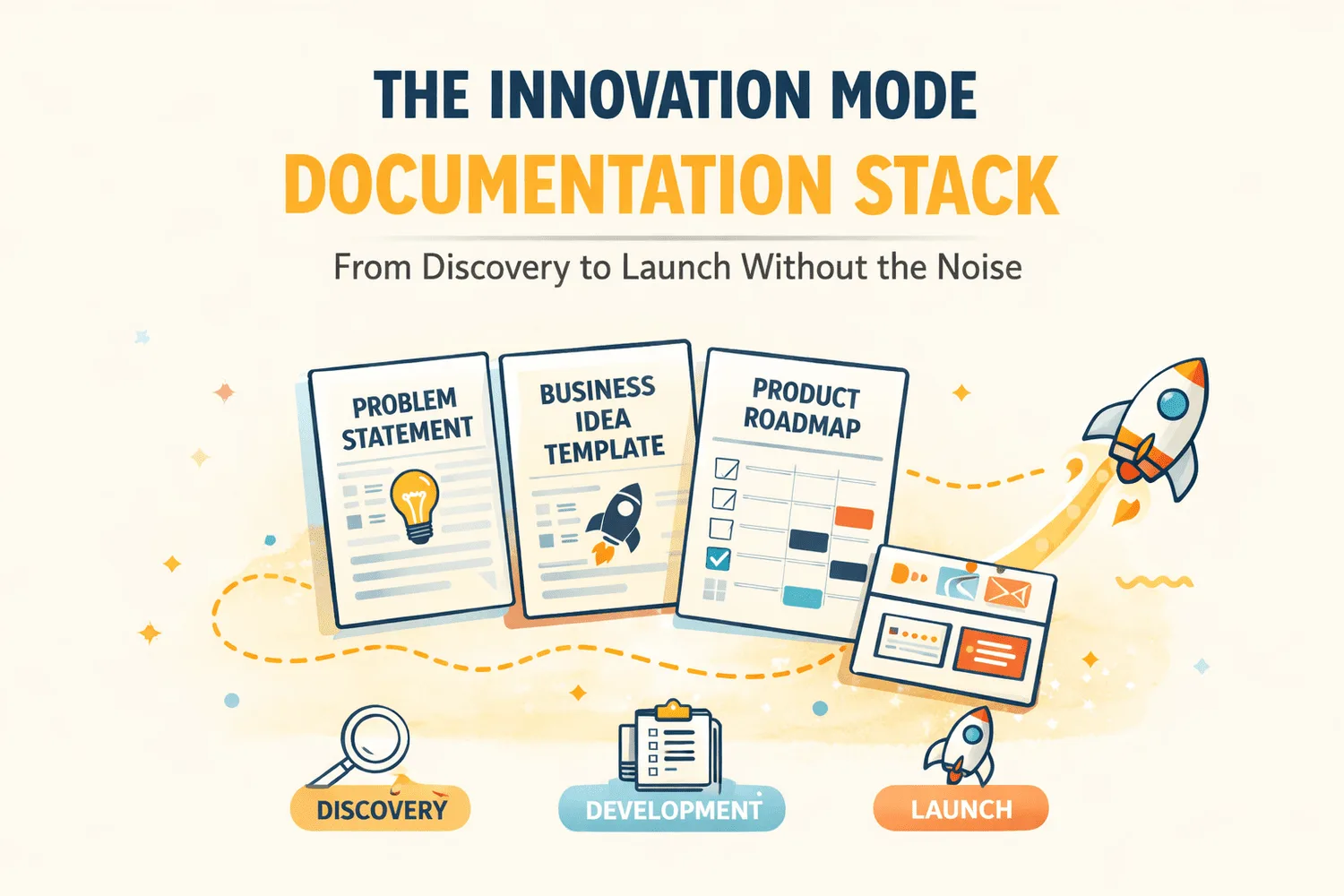
Use the Business Experiment Template to structure your AI hypothesis validation before committing to a full PRD. The cost of validating an AI hypothesis with prompt experiments and user testing is a fraction of the cost of building a full product that doesn't meet quality expectations.
The PRD vs. the Agent Spec: A Growing Confusion
With the rise of AGENTS.md, system prompts, and AI coding agent specifications, I'm seeing a growing confusion between product requirements and agent configuration. These are fundamentally different documents.
The AI PRD is a strategic alignment artifact for humans. It tells your team, leadership, and stakeholders what you're building, why, and how you'll measure success. The agent specification is a technical instruction set for AI systems - it tells the model how to behave, what tools to use, and what boundaries to respect.
One aligns people; the other constrains machines. You need both, and neither replaces the other.
Think of it as the same relationship as a traditional PRD and the codebase: the PRD specifies what the product should do, and the code implements it. With AI products, the PRD specifies the requirements, and the agent specification - plus prompts, evals, and guardrails - implements them. Writing a detailed AGENTS.md without a PRD is like coding without requirements: you might build something impressive, but you can't verify it's the right thing.
A Personal Perspective: From Patents to Products
I've been thinking about autonomous AI systems since long before the current LLM era. My AI Negotiation Agent patent described a framework where buyer and seller AI agents operate autonomously - discovering each other, negotiating within defined parameters, and converging on deals. The enabling technologies (LLMs, function calling, RAG) didn't exist in 2016. The vision preceded the infrastructure by nearly a decade.
Similarly, my work on natural language query systems, voice-driven ideation managers, and adaptive content translators - all filed as patents at Microsoft and other organizations - dealt with the same fundamental challenge that AI product managers face today: how do you specify the behavior of a system that understands and generates natural language? How do you define "correct" when the system's value comes from its ability to be flexible, contextual, and creative?
The answer I've arrived at, after two decades: you don't define correct. You define acceptable, you measure quality on a spectrum, and you build the feedback loops that let the product improve continuously. That's what an AI PRD should capture.
The Living Document
Perhaps the biggest shift from traditional PRDs: an AI PRD must be designed as a living document from the start. The underlying models evolve. New capabilities emerge. Competitors ship features that reshape expectations. A PRD written for GPT-4-class models in January may be obsolete by March.
The solution is to structure your PRD in layers. The strategic layer (problem, users, value proposition, business metrics) changes rarely - review it quarterly. The tactical layer (feature priorities, quality thresholds, guardrail rules, UX patterns) evolves as you learn from users - review monthly. The technical layer (model selection, prompt engineering, eval datasets, infrastructure) may change with every major model release.
Version your PRD and track what changed and why. This creates an audit trail and helps the team understand the rationale for shifts. The traditional PRD was a photograph of requirements at a point in time. An AI PRD is a video - it captures the requirements and how they're expected to evolve.
Getting Started
If you're a product manager working on an AI product and your PRD looks like a traditional specification, here's where to start:
- First, classify your product on the four-level spectrum. This tells you how much of the AI PRD framework you actually need.
- Second, define three measurable quality signals for your most important AI feature. Build your first eval around those signals. This single step transforms vague quality aspirations into actionable engineering targets.
- Third, specify your guardrails. What must the AI never do? Write these as hard constraints in the PRD, with test scenarios for each.
- Fourth, use The Problem Framing Template and The Universal Idea Model to ground your AI product concept before diving into technical specifications. The quality of your AI PRD depends on the quality of your problem understanding.
For the complete framework with all sections, examples, and detailed guidance, see our comprehensive AI PRD FAQ guide on Ainna, or start from the deck and document templates and the annotated worked example in the Product Toolkit.
George Krasadakis is the founder of The Innovation Mode methodology and Ainna, the AI-powered product strategist for innovators. He holds 20+ patents in AI and data-driven systems, has led product innovation at Microsoft and Accenture, and is the author of Innovation Mode 2.0: Designing Innovative Companies in the Era of Artificial Intelligence (Springer, 2026).