For credit-bearing courses in entrepreneurship, innovation and competitive strategy: the book and the Innovation Toolkit for the whole cohort, a desk copy and teaching materials for faculty, and Ainna for course workshops.
The whole cohorteBook and Toolkit through a course-specific code
FacultyA desk copy, in print or eBook
Course workshopsAinna for one or two weeks, by arrangement
No set-upNothing is required from the department
What is included
One programme, three ways to use it.
Free for the cohort
For students
The Author’s Edition eBook and the Innovation Toolkit, for the whole cohort, through a course-specific download code. Individual students can also request access directly. Nothing is required from the department to set this up.
Where a course includes a product or innovation workshop, Ainna can be made available to the cohort on terms set for the classroom, sized to the class and timeboxed to a one or two week window.
AI that makes people think harder, rather than AI that thinks for them.
As AI absorbs execution, entrepreneurship becomes one of the defining skillsets of the AI era. Deciding what to build is the judgement that must not be delegated to a machine, and a university is where this can be practised.
With Ainna, innovators work with AI agents to frame the problem, generate and challenge product and venture concepts, score them and bring in domain experts to assess them, then enrich the venture concept through market sizing, competitive landscape, persona analysis and go-to-market. Concepts are held to an evidence standard rather than simply agreed with, and the verdict stays with the human team.
In a classroom the effect is pedagogical: each cycle trains sharper framing, surfaces hidden assumptions and rewards evidence over conviction.
Two formats, following the hackathon model in Chapter 5
A virtual company
Students take innovator and domain-expert roles, and pitch to a panel.
A mini-hackathon
Teams work on a shared brief, run on the hackathon lifecycle the book sets out.
How a workshop runs
A live demo for the instructor and their team.
Format and logistics, agreed together and sized to the class.
Access codes and one introductory session for the students.
Platform support for the duration, a one or two week window.
Course design, facilitation and grading remain with the instructor.
The book in your course
Chapters that stand alone, mapped to your module.
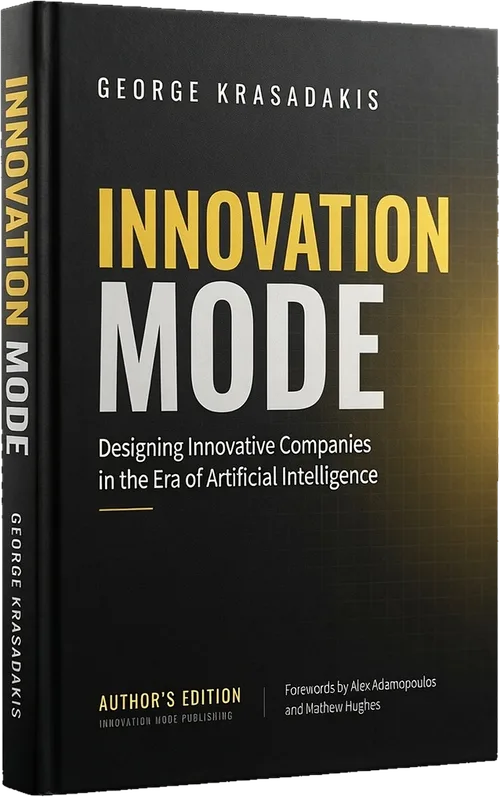
First published by Springer in 2020 and revised throughout for the Author’s Edition (2026), Innovation Mode is a 434-page practitioner manual, in 11 chapters, on designing and running innovative companies in the AI era. It starts from diagnosis, why innovation programmes fail, and builds the innovation function from there, closing with a model for autonomous, AI-driven opportunity discovery.
Chapters 5 to 8
Entrepreneurship and new-venture teaching
Innovation workshops and the impact of AI; then discovery, validation and realisation: framing problems and ideas, scoring, experimentation, prototypes and MVP definition.
Chapters 2, 9 and 10
Innovation management and strategy
The innovative organisation and why corporate innovation fails; innovation performance measurement; and the Innovation Masterplan.
The eleven chapters
Chapters
Theme
In brief
1–2
Innovation redefined; the innovative organisation
The vocabulary and the diagnosis: why corporate innovation fails across six named deficits, and the Innovation Maturity Index.
3–4
People, culture and AI-powered capabilities
The human system, then the capability system: who leads innovation, the blockers of innovation culture, and the capability layer.
5
Innovation workshops and the impact of AI
The operational playbook for brainstorming, design sprints and the full hackathon lifecycle, and what AI does to the people in the room.
6–8
Discovery, validation, realisation
Framing problems and ideas, the Idea Assessment Model, autonomous discovery, business experimentation, prototypes and MVP definition.
9
Innovation performance measurement
Measuring innovation as a performance function rather than an activity log.
10–11
The Innovation Masterplan
The theory made actionable: programme setup, which capabilities to build first, and six sequenced phases.
The book is written for real innovation environments, and several of its core frameworks now run in production: the discovery and validation pipeline and the opportunity scoring behind it are implemented inside Ainna. The Innovation Maturity Index scores an organisation, the Idea Assessment Model scores an idea, the Masterplan sequences the work.
“An excellent overview and reference point about people, culture, and capabilities as the key pillars of innovation and practical ways to discover, validate, and realize opportunities on the road to innovation.”
Dr Mathew Hughes, Professor of Innovation and Entrepreneurship, University of Leicester, from the Foreword
In use
Adopted for teaching, used on real products.
Universities are adopting the book for graduate and undergraduate courses in entrepreneurship, innovation and competitive strategy. The Toolkit has been in use by innovation teams worldwide since 2021, and Ainna is used by product managers and innovators working on real products.
The conditions
Credit-bearing teaching. The programme applies to credit-bearing courses. Anything outside that, such as accelerators, venture competitions or executive education, is arranged separately.
Teaching and research. Coursework, teaching and non-commercial research, with attribution.
Inside the course. Materials are shared with enrolled students through a course platform that is not publicly accessible.
From a university address. Requests come from a university email address.
The full licence is in the terms of use, under Academic use.
Why we do this
Our vision
Our vision is bigger than software for companies: a world where anyone, from a global enterprise to a single person with one idea, can turn the right ideas into real opportunities. Teaching the method is part of it. Read the full vision.
If the programme works for your course, three things help us, and none is required:
Cite the book in your reading list.
Tell us at the end of term what worked and what did not.
Let us name your course among those that teach with Innovation Mode.
Questions
Questions from faculty and students
Is the Innovation Mode eBook free for students?
Yes, on a credit-bearing course. The instructor requests a course pack, and the whole cohort receives the Author’s Edition eBook and the Innovation Toolkit through a course-specific download code. Individual students can also request access directly.
How do I get a desk copy of Innovation Mode?
Faculty teaching a relevant course can request a desk copy, in print or eBook, with the form on this page. It comes with slide-ready diagrams of the core frameworks, and a chapter-to-module map can be developed with you for the course.
Which courses is the book suited to?
Graduate and undergraduate courses in entrepreneurship, innovation and competitive strategy. The chapters stand alone: 5 to 8 sit closest to entrepreneurship and new-venture teaching; 2, 9 and 10 to innovation management and strategy.
Can my students use Ainna?
Where a course includes a product or innovation workshop, Ainna can be made available to the cohort on terms set for the classroom, sized to the class and timeboxed to a one or two week window. It starts with a live demo for the instructor, and course design, facilitation and grading remain with the instructor.
What does the department need to do?
Nothing. The instructor makes the request, and the codes, materials and, for a workshop, the introductory session and platform support are provided.
Does the programme cover executive education or accelerators?
No. The programme applies to credit-bearing teaching. Accelerators, venture competitions and executive education are arranged separately; use the form to tell us what you have in mind.
Request
Tell us about your course.
You’ll hear back within 5 working days, from George.
Course pack: your institution, the course and its level, the expected number of students, and the academic term.
Ainna workshop: the dates, the class size, and the format you have in mind. We start with a live demo.
Guest lecture: format (in person or online), audience size, topic area, and dates you’re considering.
Student project or thesis: your supervisor’s name, the topic, and the kind of guidance you’re hoping for.