Skip to content
Corporate Innovation Advisory

Architect the innovation function the AI era demands.

Work directly with the author of Innovation Mode to design an AI-powered innovation function for your company: diagnosed from your context, shaped with your leadership team and sequenced into a 24-month masterplan, with support for delivery if you want it.

George Krasadakis

George Krasadakis

Author of Innovation Mode. Four innovation centres designed or optimised; five technology ventures founded. Senior roles at Microsoft, Accenture, GSK and ResMed.

8weeks
From the readiness assessment to the leadership readout
6modules
Each shaped with your leadership team and closed with a defined output
4deliverables
Board-ready: assessment, performance framework, playbook and masterplan
1masterplan
Your Innovation Masterplan: the next 24 months, sequenced and ready for the board
For
CxOs and innovation leaders with programmes, labs and hackathons under way, but a thin pipeline and little real-world evidence.
Objective
An innovation function that turns activity into validated opportunities, with the sequence to build it and the measures the board will fund.
Structure
Working sessions with your core team every week, remote or hybrid, with the opening and closing workshops on site if you prefer.
What makes it different

The need to innovate is real. So is the innovation theatre.

Innovation features in every leadership communication, and programmes are funded, governed and reported on. Three quarters later, the pipeline is thin, pilots stall before market and real-world evidence is scarce: the condition Innovation Mode names innovation-busy. The deficit isn’t creative. It’s architectural.

Instead ofThis programme delivers
A 200-slide strategy deck from a consultancyA branded playbook your teams can actually execute
Innovation treated as a hiring problem rather than a structural oneA diagnostic that identifies your specific structural deficits
“Ideas submitted” tracked as a success metricA measurement framework with KPIs that track real capability
Hackathons that produce demos, and labs that become corporate showroomsA sequenced masterplan with prioritised interventions for your context
True innovation goes beyond isolated programmes, technology labs, hackathons, fancy collaboration spaces, and bold innovation titles.Innovation Mode
The programme path

From first call to masterplan

Four stages, each with its own outcome. Start with the call or the diagnostic; the diagnostic fee counts in full towards the programme.

  1. 30 minutes

    Strategy call

    Free

    Talk through your innovation function and which first step fits, with George directly. No preparation needed.

    Arrange a call →
  2. Recommended first step
    Three weeks

    Innovation Maturity Diagnostic

    €12,000, fixed

    An anonymous assessment across a cross-section of your organisation, scored on the 7-level Innovation Maturity Index. You get your real maturity level, where leadership’s view differs, and what to fix first, in a leadership briefing and a written report.

    Request the diagnostic →
  3. Eight weeks

    Corporate Innovation Programme

    Priced on proposal

    The full plan: a readiness assessment, an innovation performance framework, a branded innovation playbook and a 24-month Innovation Masterplan.

    Request a proposal →
  4. Monthly or quarterly

    Ongoing advisory

    Priced on proposal

    A senior adviser beside your innovation lead while the masterplan runs: quarterly reviews, portfolio decisions and board preparation, or a fractional Chief Innovation Officer role.

    Ask about ongoing advisory →
The programme

What the eight weeks deliver

  1. Innovation Readiness AssessmentYour level on the 7-level Innovation Maturity Index, and a diagnosis across the six innovation deficits: leadership, organisational design, capabilities, real-world connection, talent and culture, and venture building.
  2. Innovation Performance FrameworkKPIs and a dashboard design that measure capability, not activity: validation velocity, concept-to-MVP cycle time, portfolio health and innovation ROI, reported to the board and to the teams.
  3. Innovation PlaybookA branded operating manual of methods, templates, decision frameworks, AI tools and roles that answers “how do we innovate here?” in one language across every business unit.
  4. Innovation MasterplanA 24-month roadmap across the Six Phases of Innovation Transformation, sequencing the interventions for your context, each with its why, its how and its order. Your board-ready innovation strategy.
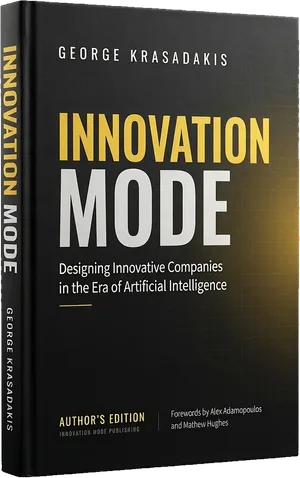
Innovation Mode by George Krasadakis, Author's Edition

Built on the book. Every deliverable uses the frameworks in Innovation Mode: the Innovation Maturity Index, the six innovation deficits and the 70+ documented interventions, so your teams can keep using the method after the programme. Ten copies are included for your leadership team.

The AI advantage

Built on the first published architecture for agentic corporate innovation

The programme applies the method published in Innovation Mode to both the cultural foundations of corporate innovation and the AI architecture that scales it.

  1. Autonomous opportunity discovery

    Architecture for AI agents that scan markets, patents, research and competitive signals, and surface ranked opportunities. We design the system; your technology function builds it.

  2. AI-powered concept validation

    Simulated panels of AI personas that stress-test concepts for feasibility, market fit and risk, compressing weeks of research into hours. We design the framework; you operate it.

  3. Accelerated realisation

    Templates and prompt libraries for AI-assisted product framing: user stories, technical stack, go-to-market hypotheses and experiment designs.

  4. Portfolio intelligence

    Specifications for dashboards that track the portfolio across all initiatives: pipeline strength, validation progress and portfolio balance.

Not theoretical. The same architecture is running in production at Ainna.ai, the agentic innovation platform built by the same author.

How it runs

The programme, module by module

Weekly working sessions with your core team, each with a defined objective and output. Remote or hybrid, with the first or final week on site if you prefer.

  1. Week 1Readiness: stakeholder interviews, a survey across your teams and a review of current programmes on the Innovation Maturity IndexOutputInnovation Readiness Assessment with gap analysis
  2. Week 2Opportunity discovery: your ideation funnel, and where AI adds value in market scanning, signal detection and concept generationOutputDiscovery recommendations with AI integration points
  3. Week 3Performance: what innovation success means in your context, and how to measure capability rather than activityOutputKPI framework and dashboard architecture
  4. Week 4Culture: risk tolerance, collaboration, recognition, psychological safety and openness to AIOutputCulture assessment and interventions
  5. Week 5Playbook: definitions, methods, tools, templates and decision processes, in one shared languageOutputDraft Innovation Playbook
  6. Weeks 6–8Synthesis, presented to your leadership teamOutputMasterplan, final playbook and recommendations

The masterplan sequences the interventions across the Six Phases of Innovation Transformation, starting where your organisation is today.

  1. Power-UpFoundations
  2. SparkMomentum
  3. ConnectOne system
  4. EmpowerPeople
  5. Scale-UpEnterprise pace
  6. EmbedAutonomy
Who you work with

Designed and led by George Krasadakis

George built this programme on the method he published in Innovation Mode, and he leads every module himself, from the first workshop to the leadership readout. Your leadership team works with him directly throughout.

  1. CorporateSenior roles at Microsoft, Accenture, GSK and ResMed; four innovation centres designed or optimised
  2. FounderFive technology ventures founded and 80+ data-driven technology projects shipped
  3. Inventor18 patent families (24+ filings) covering AI-powered ideation, voice-driven brainstorming agents and intelligent negotiation systems
  4. TodayArchitect of Ainna Enterprise, the agentic innovation platform for organisations

More about George

On the book behind the method
“Not just a book but a blueprint for what it really takes to build innovative companies in today’s world: companies that don’t just talk about innovation but live it in their culture, in their systems, and in their everyday decisions.”Alex Adamopoulos, CEO, Emergn
“An excellent overview and reference point about people, culture, and capabilities as the key pillars of innovation and practical ways to discover, validate, and realize opportunities on the road to innovation.”Dr Mathew Hughes, Professor of Innovation and Entrepreneurship, University of Leicester
Questions

Questions about the programme

How much does it cost?

The strategy call is free. The Innovation Maturity Diagnostic is a fixed €12,000, excluding VAT, for three weeks, and its fee counts in full towards the programme if you continue. The eight-week Corporate Innovation Programme and ongoing advisory are priced on proposal, according to the scale of your organisation and the depth of the diagnostic and masterplan; the programme includes ten copies of Innovation Mode for your leadership team. You get a written proposal within two working days of your request.

What’s the time commitment for our team?

Expect 4 to 6 hours a week from a core team of 3 to 5 people with sight of both strategy and operations, across interviews, workshops and reviews. The diagnostic asks far less: a short anonymous survey for a cross-section of your people and a briefing for your leadership team. Sessions run remotely or hybrid, with the opening and closing workshops on site if you prefer.

We already have an innovation team, or a Chief Innovation Officer. Do we still need this?

Usually yes, and often more than an organisation starting from scratch. The diagnostic shows where your team’s effort is absorbed by structural friction: unclear mandates, weak measurement, broken handoffs to product. A new or sitting Chief Innovation Officer gets the diagnostic, playbook and masterplan in eight weeks instead of building them over the first year, so year one goes on outcomes. The programme strengthens your function; it does not replace it.

Is this suitable for our company size?

It suits organisations from about 50 employees to large enterprises. Below that, there is usually too little structure to sequence. The method is the same at every size; what changes is the scale of implementation.

How is this different from engaging a strategy firm?

Strategy firms bring brand, scale and large teams, which suit open-ended transformations with large budgets. This is narrower: a fixed scope with named deliverables, led personally by the author of the method, who has built innovation functions inside large companies. The method is published in Innovation Mode, so your team can keep using it after the engagement.

What return should we expect?

Innovation returns build over years, so an eight-week programme will not deliver measurable revenue on its own. It delivers what makes the return possible: shorter validation cycles, less budget spent on unvalidated ideas, and a measurement framework that lets the board fund what works rather than what is loudest. Specific revenue figures are not promised, because they depend on factors outside the programme.

What happens after the eight weeks?

You own every deliverable and can implement it yourselves with the masterplan, the playbook and the book. If you want support while the masterplan runs, ongoing advisory provides quarterly reviews, portfolio decisions and board preparation, with no lock-in.
Get started

Build your innovation engine

Choose a starting point and tell us about your context. It takes about two minutes.

What would you like to start with?
About you
Your context
Organisation size
Where is your innovation function today?
When would you like to start?

How we handle your data

Also available: AI Strategy Advisory, a board-ready AI strategy in eight weeks. Not ready for advisory? The free membership brings the monthly Innovation Mode Briefing and early access to new releases.

Free downloads

Free to download and share.

From the blog

Latest insights on corporate innovation

Who Should Lead Corporate Innovation? Five Models and Their Hidden Risks
The Chief Innovation Officer

Who Should Lead Corporate Innovation? Five Models and Their Hidden Risks

Most companies get innovation leadership wrong - not from lack of commitment, but from misunderstanding the trade-offs. Five models dominate: embedded CxO roles, VPs below the C-suite, the CINO, innovation councils, and embedded teams. Each carries hidden risks.
· 9 min read
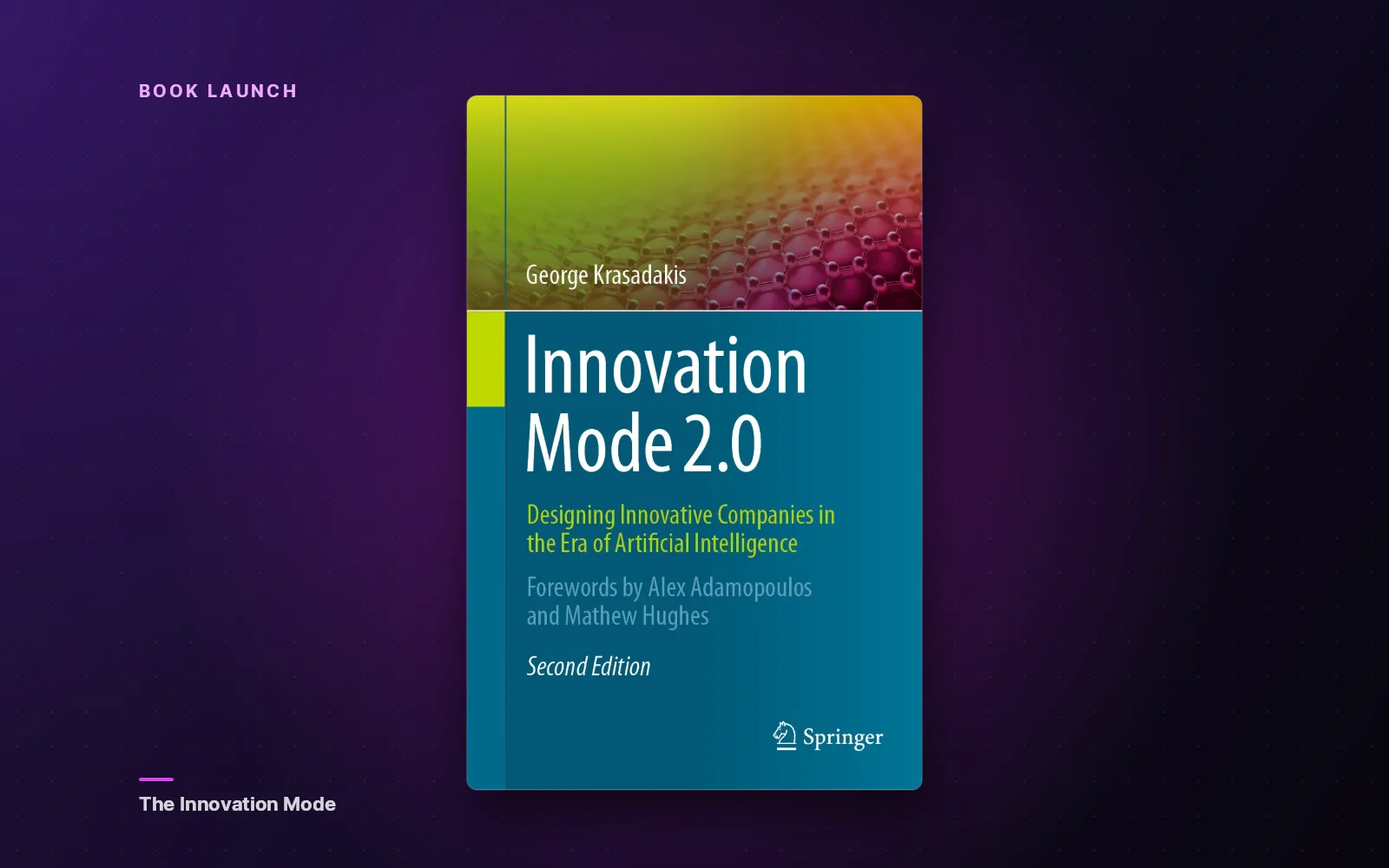
Cover of Innovation Mode 2.0 by George Krasadakis, second edition, published by Springer
Corporate innovation

Innovation Mode 2.0: The Chief Innovation Officer's Blueprint for the Agentic AI Era

Book launch announcement: Innovation Mode 2.0 by George Krasadakis (Springer, January 2026) delivers the first comprehensive architecture for corporate innovation in the agentic AI era, where AI can generate ideas, build prototypes, and shape strategies in minutes. The book introduces a diagnostic framework of six innovation deficits, a seven-level Innovation Maturity Index, and 70+ interventions for building AI-powered innovation engines. Backed by 25 years at Microsoft, Accenture, and GSK, 20+ AI patents, and a working autonomous innovation agent (Ainna.ai), this is implementation, not theory.

· 6 min read
2026 Technology Innovation: Trends, Opportunities, Risks.
Corporate innovation

2026 Technology Innovation: Trends, Opportunities, Risks.

The technologies shaping 2026 (agentic AI, humanoid robots, quantum computing, brain-computer interfaces, AI for science, and climate tech) are no longer emerging; they're converging. For innovation leaders, this demands a fundamental shift: when AI commoditizes ideation, the scarce capabilities become opportunity discovery, rapid validation, and execution speed. Innovation is no longer a competitive advantage; it's a survival trait.
· 16 min read